
A 1962 ranch in Garner has roughly a one-in-three chance of hiding something in the attic, under the kitchen floor, or wrapped around the ductwork. Asbestos is the culprit, and it has sunk more sales in this state than termites ever did. Still, a sunk sale and an unsellable house aren’t the same thing. If you own an older place here and you’re wondering whether asbestos ends your sale before it starts, the short answer is no.
Is Asbestos Dangerous, and How Do You Know If It’s in Your Home?
For years I treated every test result like an emergency, and I was wrong about that. Danger really just depends on whether the fibres can get loose. Intact asbestos sitting undisturbed behind a wall poses a very different risk than the same material shredded by a sledgehammer.
The health hazard shows up when microscopic fibres go airborne and get inhaled. Lung scarring, mesothelioma, and other serious illness have all been tied to long-term exposure, so federal rules tightened on asbestos decades ago. Your eyes won’t help you spot asbestos. Asbestos looks like ordinary insulation, ordinary tile, ordinary joint compound.
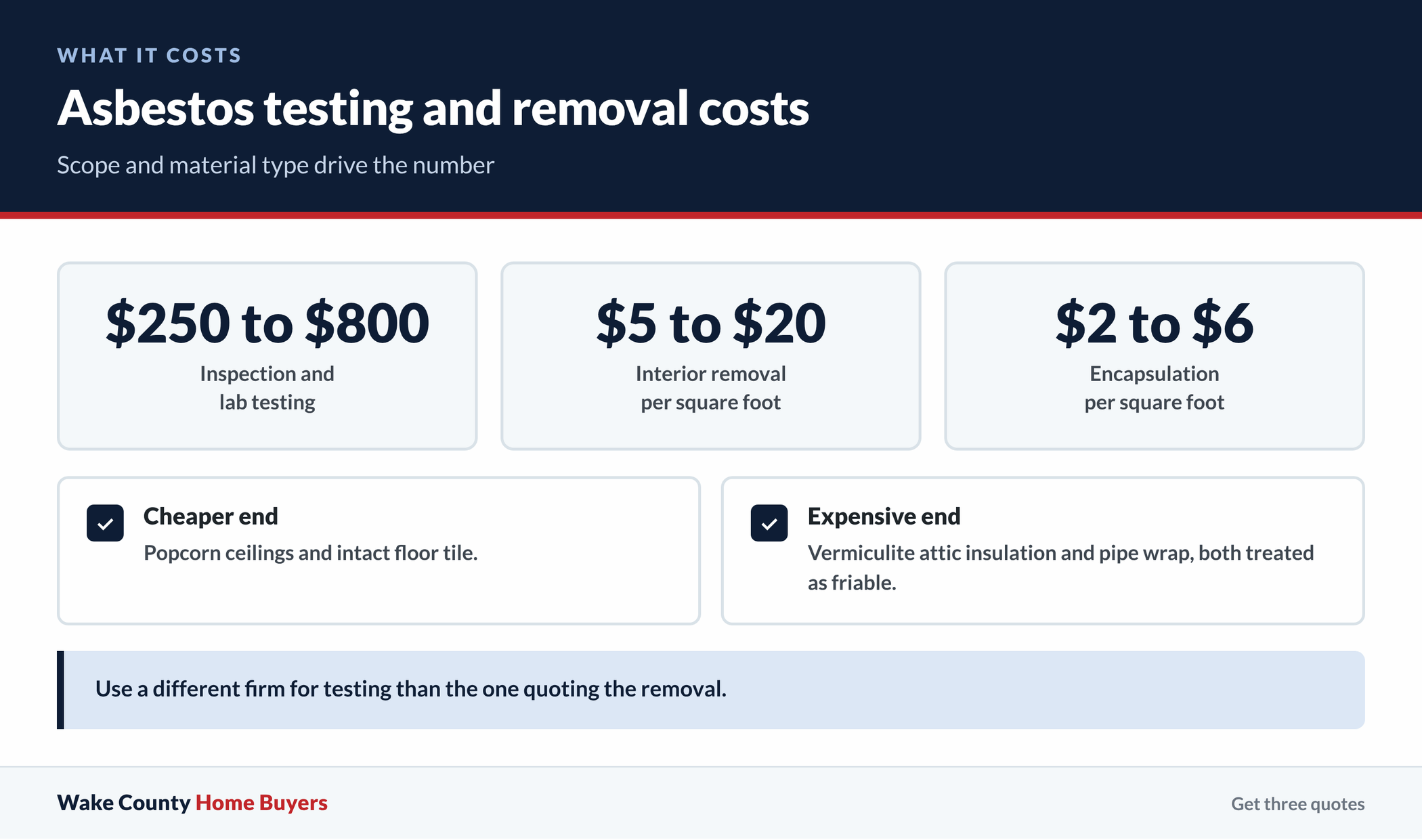
Only a lab can confirm it. A certified inspector takes samples and sends them off, since professional inspection and lab testing generally runs $250 to $800 before any abatement work starts. For a house built before the mid-1980s, that’s cheap insurance.
When your home went up matters a lot here. If your home went up in the 1950s, 60s, or 70s anywhere in North Carolina, odds are decent that something in it contains asbestos. Chrysotile, also called white asbestos or serpentine asbestos, was the most common type used in American residential construction.
A couple of years ago an out-of-state heir called me about her late father’s brick ranch in Kernersville. Her employer moved her division and she had five weeks to be out of the house. The garage was full of his woodworking tools, and the basement was wrapped in old pipe insulation she was afraid to touch. We closed before her move date, so she never had to open a single sample bag.
Where Does Asbestos Hide in Older North Carolina Homes?
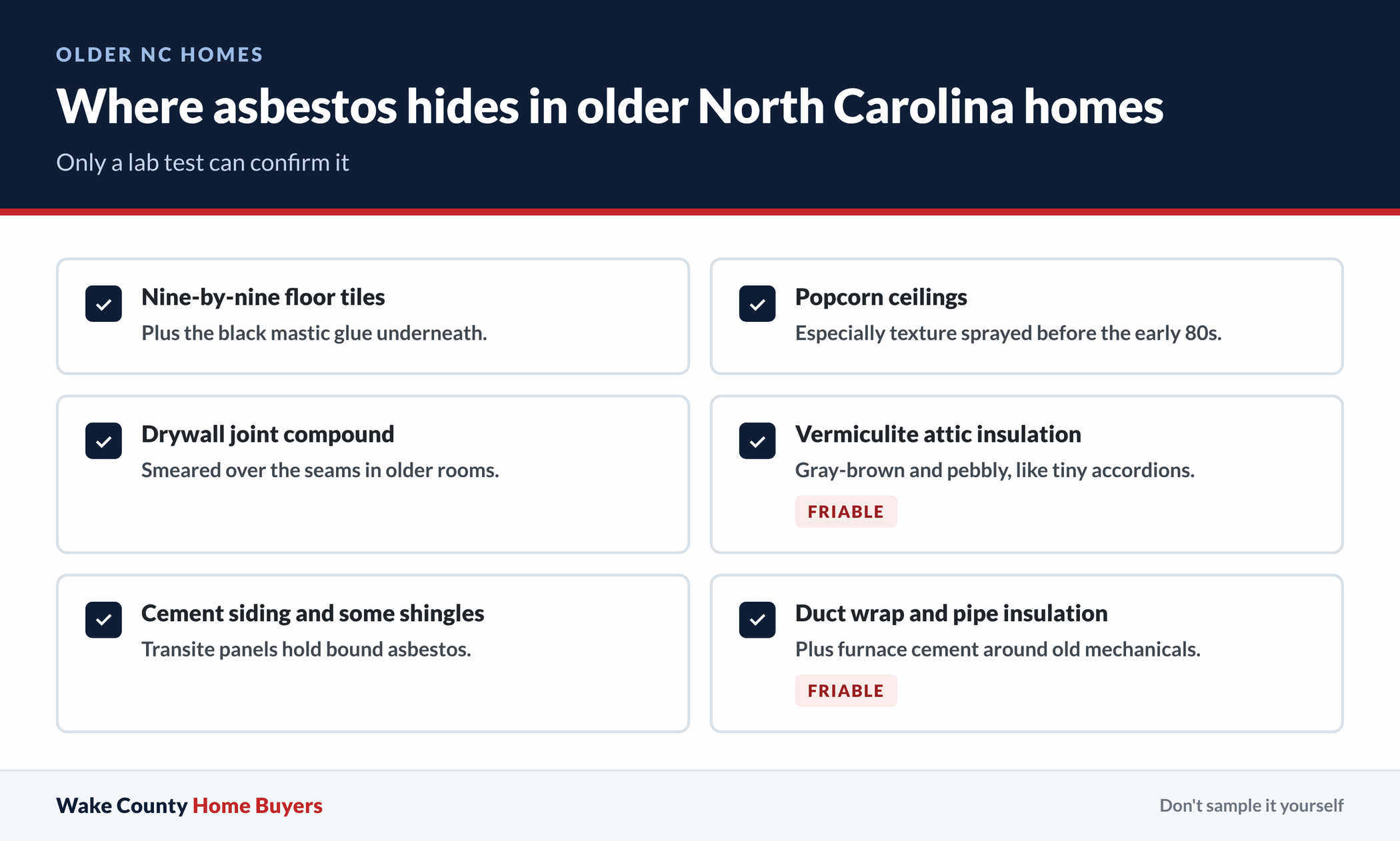
A seller in Winston-Salem pulled up her kitchen linoleum one Saturday to surprise her husband. Underneath sat nine-inch vinyl floor tiles, a size that practically shouts mid-century, and she spent the next two weeks panicking instead of packing.
Nine-by-nine tiles are the classic tell. So is the black mastic glue beneath them. Popcorn ceilings sprayed before the early 80s frequently contain asbestos, and the same goes for the joint compound smeared over drywall seams.
Attic insulation deserves its own mention. Vermiculite, that gray-brown pebbly material that looks like tiny accordions, often carries asbestos from the mine that supplied most of the U.S. market. Plenty of attics across the Piedmont still hold it.
Outside, cement siding panels (Transite) and some roofing shingles contain bound asbestos. Around the mechanicals you’ll find it in duct wrap, furnace cement, and the corrugated paper insulation on old boiler pipes. Basements in the older parts of Asheville and Hendersonville are full of this material.
People credit humidity less than it matters here. North Carolina summers push moisture into crawl spaces, so over decades that moisture degrades old pipe wrap until it crumbles at a touch. A crawl space inspection in July tells you more than one in February.
Ever wonder why your home inspector didn’t flag any of this? General inspectors aren’t licensed to sample asbestos, and most won’t even guess, so finding it takes a separate accredited survey, and that survey is the only document a serious buyer will trust.
Friable Vs. Non-friable Asbestos: Why the Difference Matters
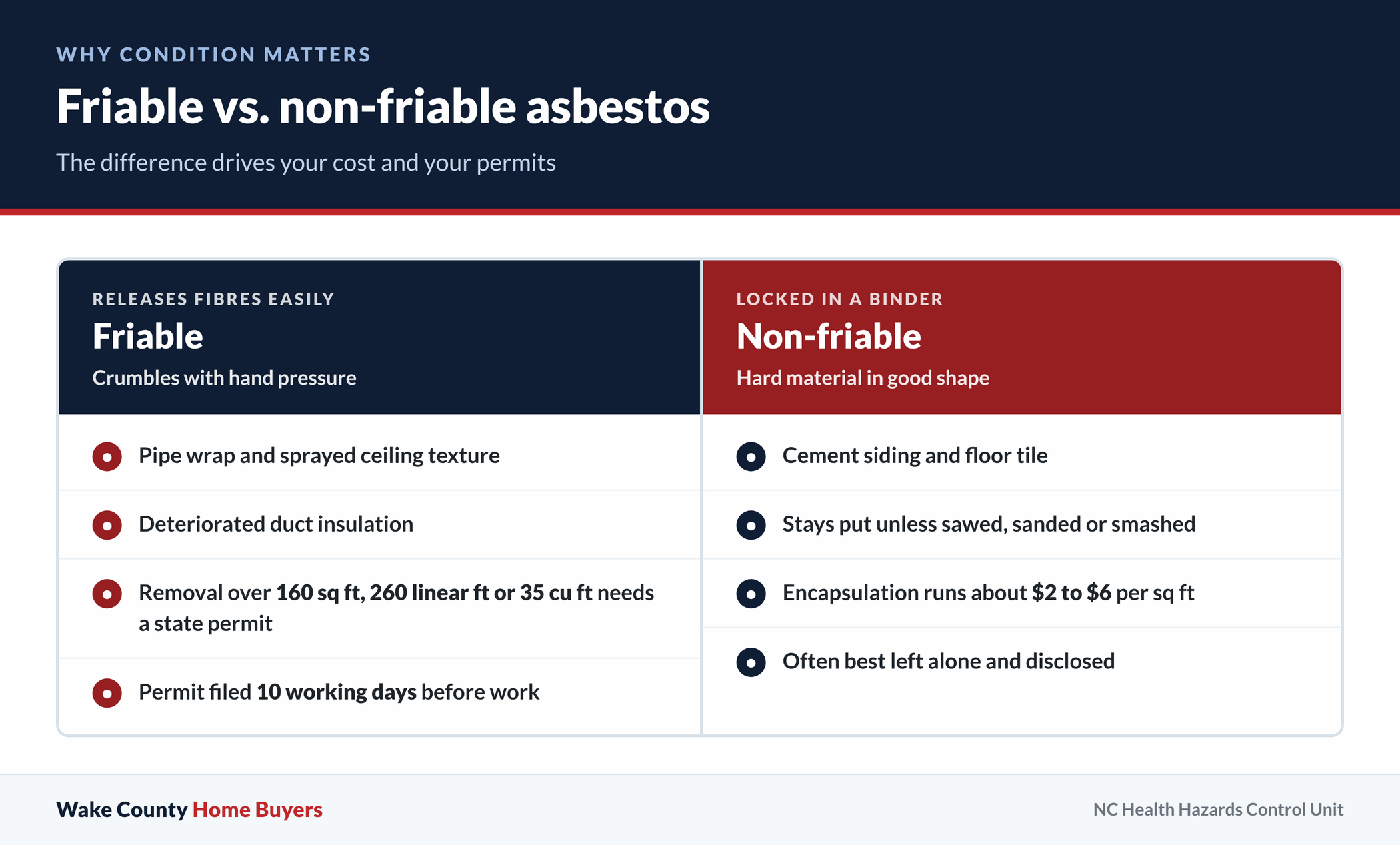
Two hundred square feet of intact vinyl tile might cost you a few thousand dollars to handle. Crumbling vermiculite across the same square footage in the attic can cost several times that. The word that separates them is friable.
Friable means you can crumble it with hand pressure. Pipe wrap, sprayed ceiling texture, deteriorated duct insulation: these release fibres easily, so regulators treat them accordingly. Non-friable asbestos stays locked inside a hard binder, like cement siding or floor tile, and stays put unless somebody saws, sands, or smashes it.
Why should you care about a vocabulary lesson? Because the distinction drives your cost, your permit obligations, and what a lender says about your house.
North Carolina rules follow the federal thresholds. According to the state’s Health Hazards Control Unit, removal of friable or regulated asbestos above 35 cubic feet, 160 square feet, or 260 linear feet triggers the full permit application and notification requirement. Below those amounts a smaller project may be handled differently. The unit itself can tell you which bucket your job falls into.
Nobody brings up encapsulation often enough, and it deserves more attention. Sealing intact material in place runs about $2 to $6 per square foot, and for non-friable asbestos in good shape, I’d argue it beats ripping everything out. Disturbing solid material to “be safe” sometimes creates the exact hazard you were trying to avoid.
Condition decides the path. Good condition plus non-friable usually means leave the asbestos alone and disclose it honestly to your buyer.
What Does North Carolina Law Say About Asbestos Disclosure?
Hiding a known problem to protect your price is the single worst financial decision you can make as a seller in North Carolina. Our state runs on a disclosure form, not a warranty. Under the Residential Property Disclosure Act, sellers of most existing homes must deliver the Residential Property and Owners’ Association Disclosure Statement to a buyer no later than the time the buyer makes an offer.
Three answers exist for each question: yes, no, and no representation. Because of the no representation option, the form technically mandates no disclosure at all. That surprises most sellers.
The escape hatch has a floor, though. A seller who answers “No” when the honest answer is “Yes” can face civil liability for misrepresentation, since the North Carolina Real Estate Commission has explained as much. Marking no representation to bury something you know about is the move that gets people sued.
Your agent can’t hide behind your form either. A listing agent who learns of a material fact must disclose it even when the seller doesn’t, according to NC REALTORS guidance.
My take, after a lot of closings: tell the buyer about the asbestos. Volunteer the lab report if you have one. Sellers who disclose early almost never face legal action later. The ones who stay quiet carry that worry for years. A clean conscience also tends to produce a cleaner contract.
Can You Sell a House with Asbestos in North Carolina?
Get this wrong and you can lose a buyer at day 40 of a 60-day contract, then relist with a stale listing and a price cut. Handle it right and asbestos is a line item, not a sale killer.
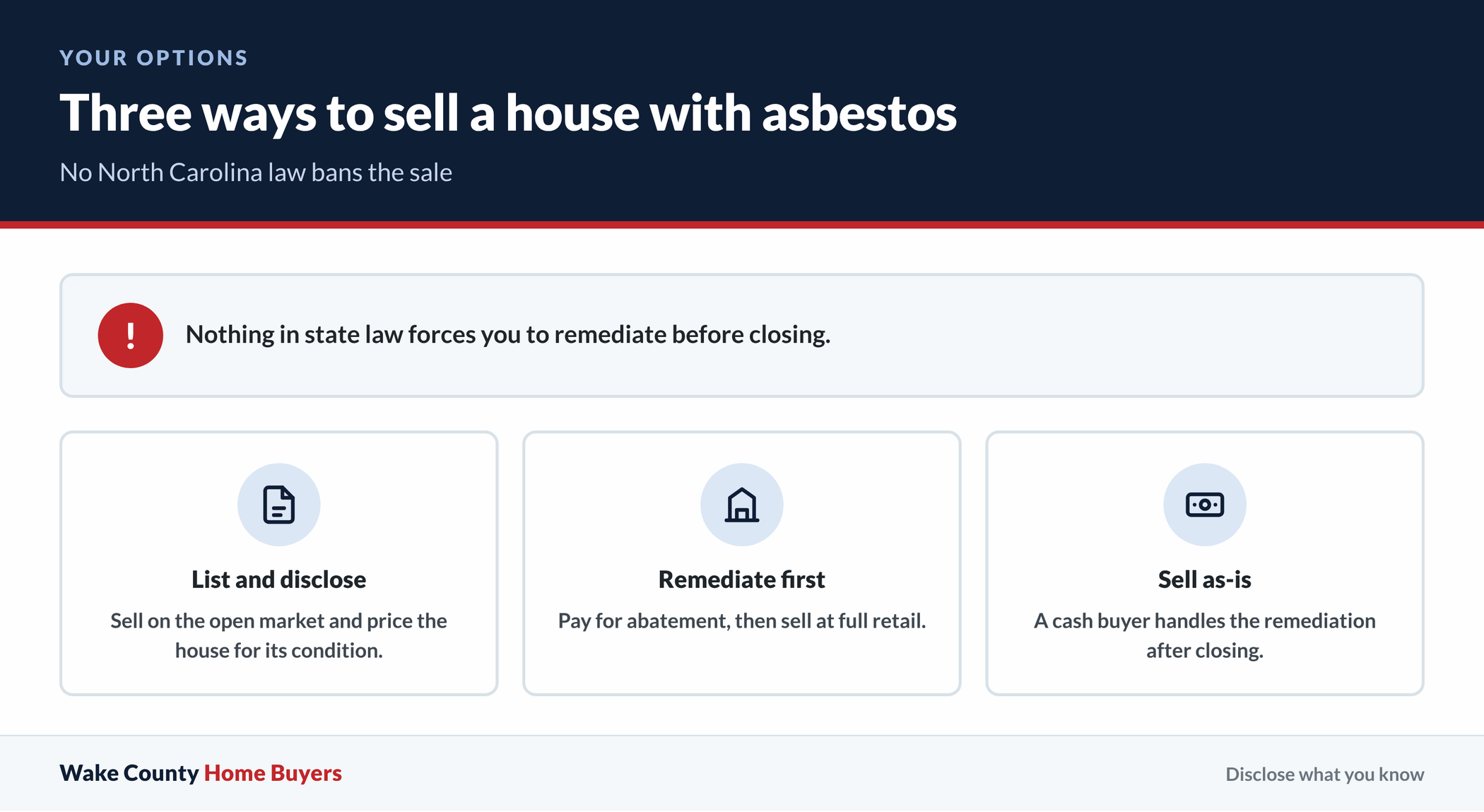
Yes, you can sell a house with asbestos in North Carolina. No state law bans the sale. Nothing forces you to remediate before closing. Thousands of homes with asbestos change hands here every year, including in Raleigh neighborhoods like Five Points and Mordecai where the housing stock predates the material’s decline.
Your realistic paths come down to three. List on the open market with full transparency and price the property to reflect the condition. Remediate first, then sell at full retail. Or sell as-is to investors and cash home buyers who handle remediation themselves.
Timing favors the honest approach right now. Median days on market across North Carolina hit 71 in October 2026, up from 63 in July, according to Realtor.com data tracked by FRED. Slower markets punish surprises. A buyer who discovers asbestos during due diligence in a soft market walks, because there are other houses.
Which path fits you depends on your timeline and your cash position, and those two things rarely line up neatly. Wake County Home Buyers buys properties with asbestos across the Triangle without asking sellers to fund abatement first. That solves the cash problem for people who don’t have ten thousand dollars sitting around.
How Does Asbestos Affect Your Home Sale in North Carolina?
“My house is fine, so why would a buyer care about something sealed inside a floor?” Fair question, and the answer has less to do with health than with money and financing.
Mortgage lenders get nervous. Conventional loans usually close without issue when the asbestos is non-friable and intact. FHA and VA appraisers, though, flag deteriorated material as a health hazard, and the repair gets required before funding. That single appraisal note can cost you a month.
Price takes a hit too, though not the catastrophic one sellers imagine. Buyers typically deduct remediation costs plus a worry premium. On a typical Triangle house, a five-thousand-dollar abatement often turns into an eight-thousand-dollar concession request.
Buyer pool narrows as well. First-time homebuyers using low-down-payment programs often back out. Renovators and investors step in, and they’re not scared of asbestos because they’ve priced it a hundred times.
One pattern I keep seeing: sellers who get a survey done before listing negotiate better than sellers who wait. When the lab report is already in hand, you control the conversation instead of reacting to a buyer’s worst-case estimate. The information itself becomes leverage.
Disclosure also protects your sale from falling apart twice. Sales that die in due diligence in North Carolina leave a public days-on-market trail that every later buyer sees.
Should You Remove Asbestos Yourself or Hire a Professional?
Please don’t go up in that attic with a shop vac and a dust mask. I’ve watched a seller turn a contained problem into a whole-house contamination in an afternoon, and the cleanup cost more than the original abatement quote.
North Carolina regulates this work seriously. The Health Hazards Control Unit issues permits for asbestos removal projects and accredits the people who perform asbestos management activities in the state. Accredited contractors know the containment rules, the wetting methods, and the approved disposal sites.
Permitted projects run on a clock. The state’s form instructions say to submit it with an original signature at least 10 working days before work begins, which you can confirm on the DHHS Form 3768 page. Factor that lead time into any closing date you agree to.
Homeowners doing small-scale work on their own residence sit in a different regulatory spot than contractors. Before you touch anything, call the Health Hazards Control Unit and ask about your specific project; they’ll tell you plainly what applies.
Even where DIY is technically allowed, the economics rarely work. Asbestos disposal has to go to an approved landfill. Protective gear, negative-air equipment, and clearance testing add up fast, and a botched job can poison a sale.
Would you rather save two thousand dollars or keep your buyer? That’s the real trade.
What Does Asbestos Removal Cost North Carolina Homeowners?
A seller in Greensboro got a $14,000 whole-house quote and nearly listed at a fire-sale price. Then a second opinion scoped only the furnace room, and the number dropped under four figures per room.
Scope drives everything. Interior work commonly runs $5 to $20 per square foot. Exterior siding and roofing jobs run $50 to $150, which explains why Transite siding quotes shock people.
Material type shifts the math again. Popcorn ceilings land at the cheaper end; vermiculite attic insulation and pipe wrap sit at the expensive end because both are treated as friable.
Get three quotes. I’d also follow the EPA’s suggestion to use a different firm for testing than the one doing removal, since the company that finds asbestos shouldn’t be the company that prices its removal.
Does the money come back at resale? Partially. Remediation protects your buyer pool more than it raises your price. In a market like Wake County, where the median sale price was $459,000 over the three months ending October 2026 with homes averaging 50 days on market, a clean file matters.
A landlord in Concord reached out after he’d quietly carried two mortgages for almost a year. His tenant moved out, the floor tile testing came back positive, and he’d been covering the payment out of pocket as the house sat empty, a broken dryer still in the laundry room. He didn’t need top dollar. What he needed was for the bleeding to stop, and selling the property as-is did that in under three weeks.
Frequently Asked Questions About Selling a House with Asbestos in North Carolina
Do Asbestos Shingles Have to Come Off Before You Sell?
Asbestos shingles are usually non-friable and bound in cement, so an intact roof or siding wall isn’t releasing fibres into your living room. Selling with the shingles in place is common, as long as the material is left alone or properly encapsulated. What you shouldn’t do is power-wash it, drill into it, or let a general contractor tear it off without accreditation. Expect buyers to price the eventual exterior work into their offers, because that category is the most expensive one to abate.
Can You Get Rid of Asbestos for Free?
Not usually, though it’s worth asking around before you assume. North Carolina has run reimbursement programs connected to federal funding in past years, and the Health Hazards Control Unit can tell you whether anything is currently open and whether you’d qualify. Some county solid waste departments also accept small quantities of properly bagged material at reduced disposal rates. The other route to zero out-of-pocket cost is selling the property as-is and letting the buyer handle abatement after closing.
Is Asbestos Testing Required in North Carolina?
No law forces a homeowner to test before selling a house in North Carolina. Testing becomes mandatory in practice when you’re demolishing or renovating, because the state wants notification and the permit process depends on knowing what’s there. Many sellers still test voluntarily, and I think that’s smart. Knowing exactly what you have beats letting a nervous buyer imagine something worse than the truth.
Does Asbestos Have to Be Removed Before Closing?
Not as a matter of North Carolina law. Removal gets required when a lender’s appraiser calls the material a health hazard, or when your contract says so after negotiation. Plenty of closings happen with asbestos still in the floor tile and a signed disclosure in the file. Your buyer’s financing type tends to decide this more than anything else.
Will Asbestos Show Up on a Standard Home Inspection?
A general inspector may note suspect materials and recommend further evaluation, but they can’t confirm asbestos without lab analysis. That’s why a dedicated survey by an accredited inspector exists as a separate service. If your inspection report mentions possible asbestos-containing material, treat it as a prompt to test rather than a finding. The lab result is what buyers, lenders, and attorneys actually rely on.
Can I Sell a House with Asbestos to a Cash Buyer in North Carolina?
Yes, and that’s the most common exit for properties where the abatement cost exceeds what the seller can front. Investors and local home buyers underwrite the remediation into their offer, so you skip the permit timeline and the contractor scheduling entirely. You’ll typically net less than a fully remediated retail sale, but you also avoid carrying costs while the work gets done. Compare a real cash offer against your retail number minus abatement, commissions, and a few more months of payments before deciding.
If you’re sitting on an older house with asbestos and you’re not sure whether to test it, fix it, or just be done with it, I’m happy to talk it through. We buy houses across Wake County and the surrounding areas in whatever condition they’re in, and sometimes the right answer is listing with an agent instead. Either way, you’ll leave the conversation knowing your options. No pressure, no obligation, and no cost to find out where you stand.
Older Homes With Asbestos in Raleigh
Homes here don’t move as fast as they did a few years ago. Listings across the Raleigh metro took a median of 64 days to sell in October 2026, according to Realtor.com figures published by FRED. An older house with an asbestos question can sit longer than that, so it pays to know your options before the listing clock starts.
Talk Through Your North Carolina Asbestos Sale
If a test result or an inspector’s note has you worried, reach out to Wake County Home Buyers and tell us what you’re working with. You can also fill out the form below for a clear answer on your options.