A crawl space in Greensboro taught me more about selling houses than any closing table ever did. Nobody noticed the slow supply-line drip under the master bath for maybe three years, and by the time anyone looked, the joists were fuzzy and gray. She thought her sale was finished, but it wasn’t. Mold in North Carolina stops a lot of transactions, but almost never because of the mold itself. It stops them because of how the seller handles it.
What Is Mold and Why Does It Matter When Selling?
Water causes this problem, not dirt, and sellers who treat a moldy wall as a cleaning job lose money every single time.
Spores drift through every house in North Carolina right now, yours included. The EPA points out that molds exist naturally everywhere, indoors and out. They only turn into a real issue once they start growing inside. Controlling moisture is the way to control that growth.
The state’s climate does sellers no favors. Humid summers from Wilmington up through the Piedmont, sealed crawl spaces, undersized HVAC systems that cool the air without pulling water out of it: all of that feeds mold growth. I see more of it in homes built between 1960 and 1995 than in anything newer.
Why does a buyer care so much? Because mold is a symptom. A buyer standing in your laundry room isn’t worried about the stain on the drywall; they’re wondering what caused it and whether the fix is a $400 dehumidifier or a new roof deck.
Two adult children called me a couple of years ago about their mother’s ranch house in Kannapolis. A contractor had quoted them a full kitchen gut after finding it behind the sink cabinets. That number came back higher than that kitchen would ever add to the sale price. This told me right away they’d never recoup it. We bought it with the mold in place, they skipped the renovation altogether, and their mom closed on her new place without touching her savings.
That arithmetic repeats constantly across the state. Sometimes the repair is worth it. Other times it’s just a very expensive way to reach the same sale price.
What Are the Health Risks of Mold in Your Home?
“Is this stuff going to make my grandkids sick?”
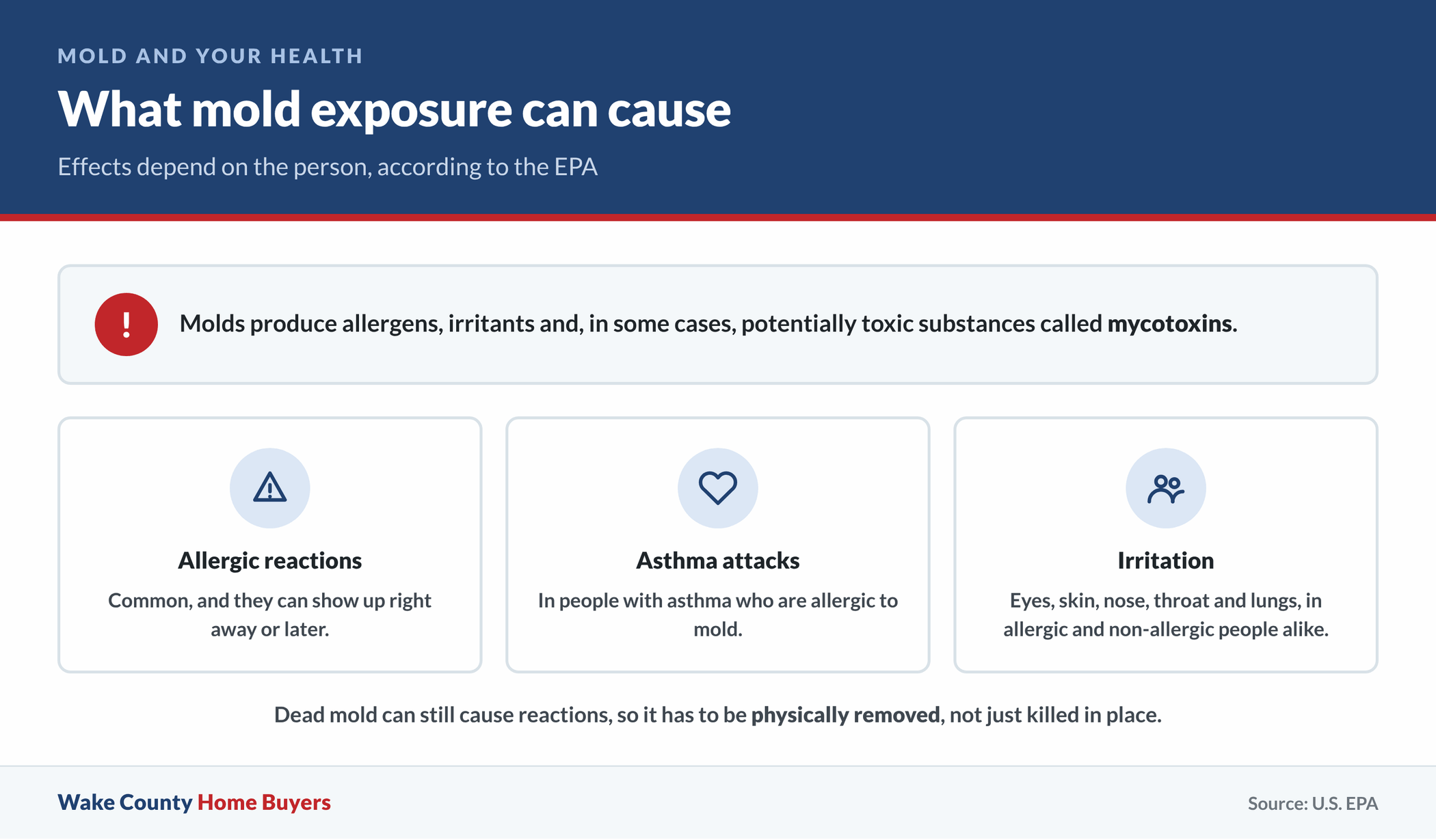
I get asked that at kitchen tables more than any other question, so the honest answer is that it depends on the person. Allergic reactions to mold are common, the EPA notes, and can show up right away or later. Mold can trigger asthma attacks in people with asthma who are allergic to it. Exposure can irritate eyes, skin, nose, throat, and lungs in allergic and non-allergic people alike.
Respiratory problems top the list of complaints. Headaches, runny noses, itchy eyes, a cough that only shows up at home: those patterns send a lot of local homeowners looking for the source. Molds produce allergens, irritants, and in some cases possibly toxic substances known as mycotoxins.
Symptoms beyond the allergic and irritant categories aren’t commonly reported from inhaling mold, and research on mold and health effects continues. Remediation companies that promise you a diagnosis are selling past what the science supports.
Here’s where it bites sellers specifically. A buyer with an asthmatic kid will walk from your house over a single moldy closet, no matter how reasonable your price. You can’t argue them out of it, and you shouldn’t try.
One more thing worth knowing: killing mold isn’t enough. Dead mold can still cause allergic reactions, so it has to be physically removed rather than simply killed in place. Bleach-and-paint jobs fail inspections constantly for exactly this reason.
Can You Legally Sell a House with Mold in North Carolina?
Plenty of sellers believe a positive test freezes a sale until a licensed remediator signs off. The law says something different. Disclosure and repair are two separate obligations, and you can disclose mold and still sell the home in the condition it’s in.
Nobody in North Carolina state government is going to stop your closing because of it. The state doesn’t license or register remediators or assessors of it, and there’s no state certification a contractor must carry to advertise remediation work.
Lenders and their appraisers are the real gatekeepers. An appraiser who notes visible mold growth in the report can trigger a repair condition before the loan funds, and that stalls conventional and government-backed loans alike. Cash buyers don’t face that hurdle, and I’ve seen that gap alone push mold-affected properties in North Carolina toward investors more often than not.
Insurance adds another wrinkle. Many homeowners policies exclude mold damage that stems from long-term seepage or neglected maintenance, covering it only when it follows a sudden covered event like a burst pipe.
Sellers can legally sell as-is, often the smartest financial move. What you can’t do is hide it. Painting over visible mold to conceal it exposes you to a fraud claim down the road. I’ve turned down houses where a seller clearly tried that, not out of principle alone, but because concealment means I have no idea what else is back there.
What Does North Carolina Law Say About Mold Disclosure?
“Nothing in state law mentions this stuff, so why would I volunteer anything?”
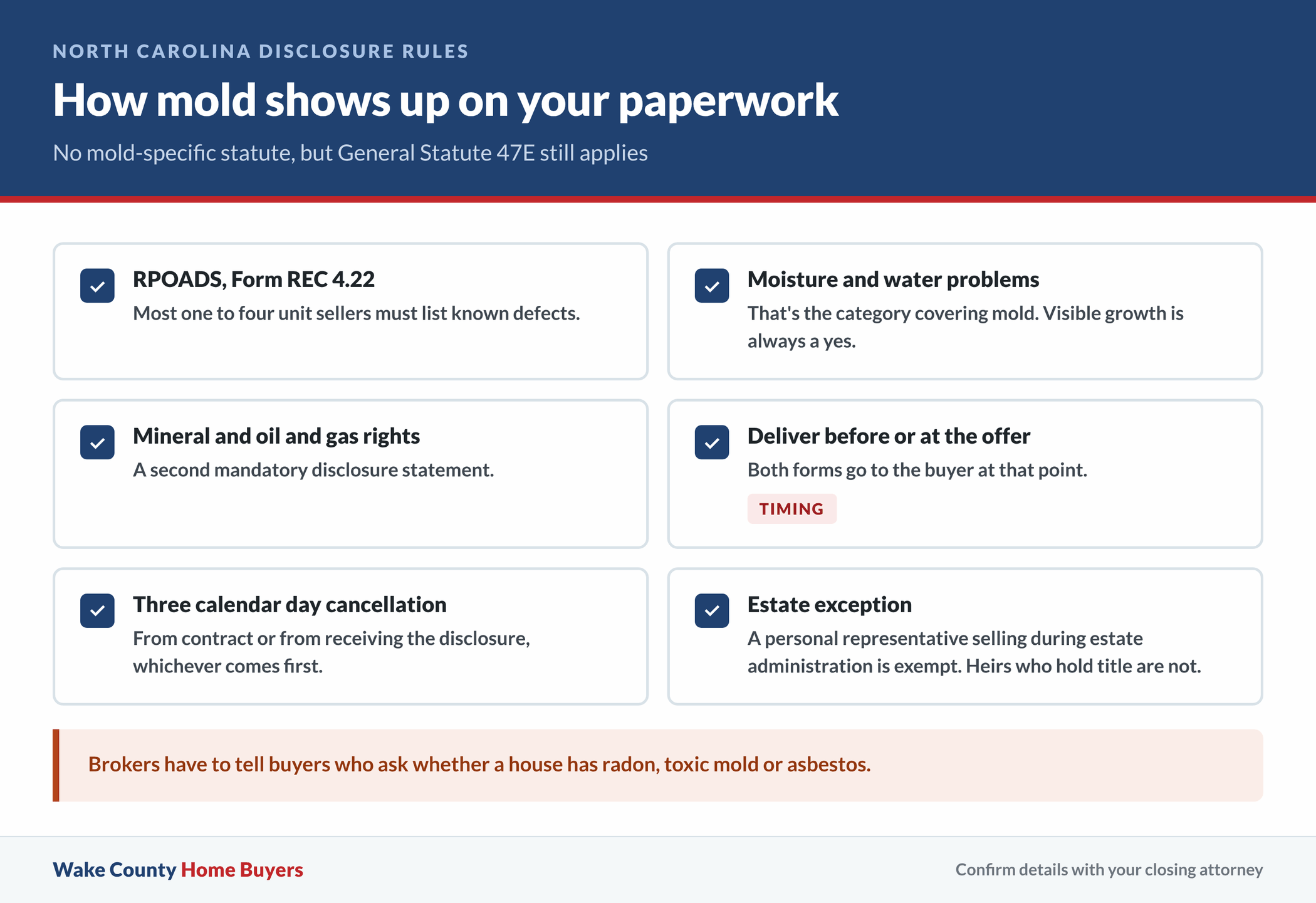
The state has no mold-specific disclosure statute, so the obligation arrives through a broader route. Under North Carolina General Statute 47E, most sellers of residential real estate with one to four units must complete a Residential Property and Owners Association Disclosure Statement listing known defects.
That form, known as RPOADS, is Form REC 4.22. Sellers must also provide the Mineral and Oil and Gas Rights Mandatory Disclosure Statement before the buyer makes an offer. Both must be delivered before or at the time of the offer. Buyers get a cancellation right of three calendar days from contract or three calendar days from receiving the disclosure, whichever comes first. The North Carolina Real Estate Commission publishes the current forms, and your closing attorney can confirm which version applies to your transaction.
Where does it fit on the form? The disclosure asks about moisture and water problems, and that’s the category covering it. Active growth visible at listing is always a yes.
Not every seller has to fill it out. A personal representative who sells the house while administering an estate is exempt under North Carolina law. If you inherited the property and the deed is already in your name, that exemption doesn’t cover you. Confirm your situation with an attorney before relying on either rule.
Agents carry their own duty. Brokers have to tell buyers who ask whether a house has radon, toxic mold, or asbestos.
Transparency kills fewer sales than suspicion does.
Is Black Mold a Dealbreaker for Buyers in North Carolina?
A seller in Fayetteville called me on a Tuesday after her buyer’s home inspector wrote “suspected Stachybotrys” in a report about her garage wall. The buyer terminated by Friday, and she was convinced her house was now unsellable.
Black mold has a reputation that outruns the evidence. The term usually points to Stachybotrys chartarum, but color alone identifies nothing, so plenty of harmless species look dark on drywall. Lab testing tells you the species. A visual inspection tells you where water is getting in, which honestly matters more.
Retail buyers in Raleigh, Charlotte, and Asheville have read the same alarming articles everyone else has, and many will not write an offer regardless of what your report says.
That narrows your buyer pool rather than eliminating it. Investors, contractors, and experienced landlords across North Carolina look at black mold as a line item. They price the remediation, subtract it, and move forward.
You’re fighting the clock in a slower market. Median days on market statewide hit 71 in October 2026, up from 69 in September and 66 in August. So a listing that sits while buyers trade mold reports can easily stretch past four months.
Price honestly from day one. Buyers forgive mold; they don’t forgive discovering it in week six after they’ve paid for an inspection.
How Much Does Mold Remediation Cost Before Selling in North Carolina?
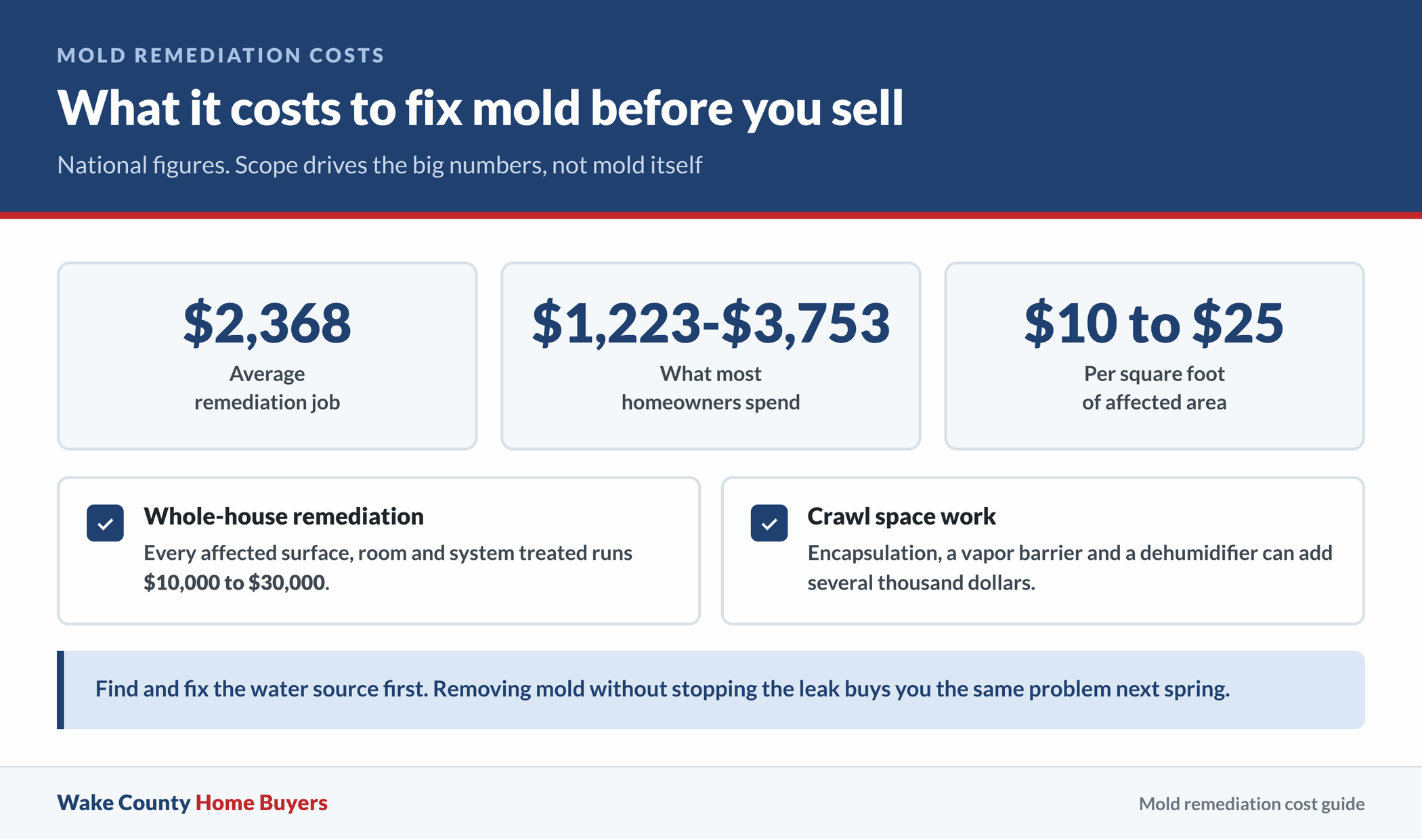
What’s going to make this worth the money? Before you write a check to a remediation company, find out what caused the water, because fixing mold without fixing the leak just buys you the same problem next spring.
Typical jobs aren’t catastrophic. National data puts the average mold remediation cost at $2,368, with most homeowners spending between $1,223 and $3,753. Contractors generally price the work at $10 to $25 per square foot of affected area.
The scary numbers come from scope, not from mold being expensive per se. Whole-house remediation, where every affected surface, room, and system gets treated, runs $10,000 to $30,000.
North Carolina crawl spaces deserve their own warning. Encapsulation, a new vapor barrier, and a dehumidifier can run several thousand dollars on top of the remediation itself, and that’s before any rotted framing gets sistered.
Who should spend the money? Sellers with cosmetic bathroom mold and a strong house underneath, mostly. Spend $1,500, remove the objection, list normally.
Sellers facing structural damage should think harder. Remediation rarely returns dollar for dollar at the appraisal, and you’re fronting cash on a house you’re leaving. Many homeowners in that position talk to Wake County Home Buyers precisely because they’d rather sell at a mold-adjusted price than finance someone else’s renovation.
Get three written scopes before you commit. Since North Carolina doesn’t vet mold contractors, lean on voluntary certifications like the IICRC, proof of liability and workers’ compensation coverage, local references, and a detailed written scope of work.
What Are Your Options for a Mold-affected House in North Carolina?
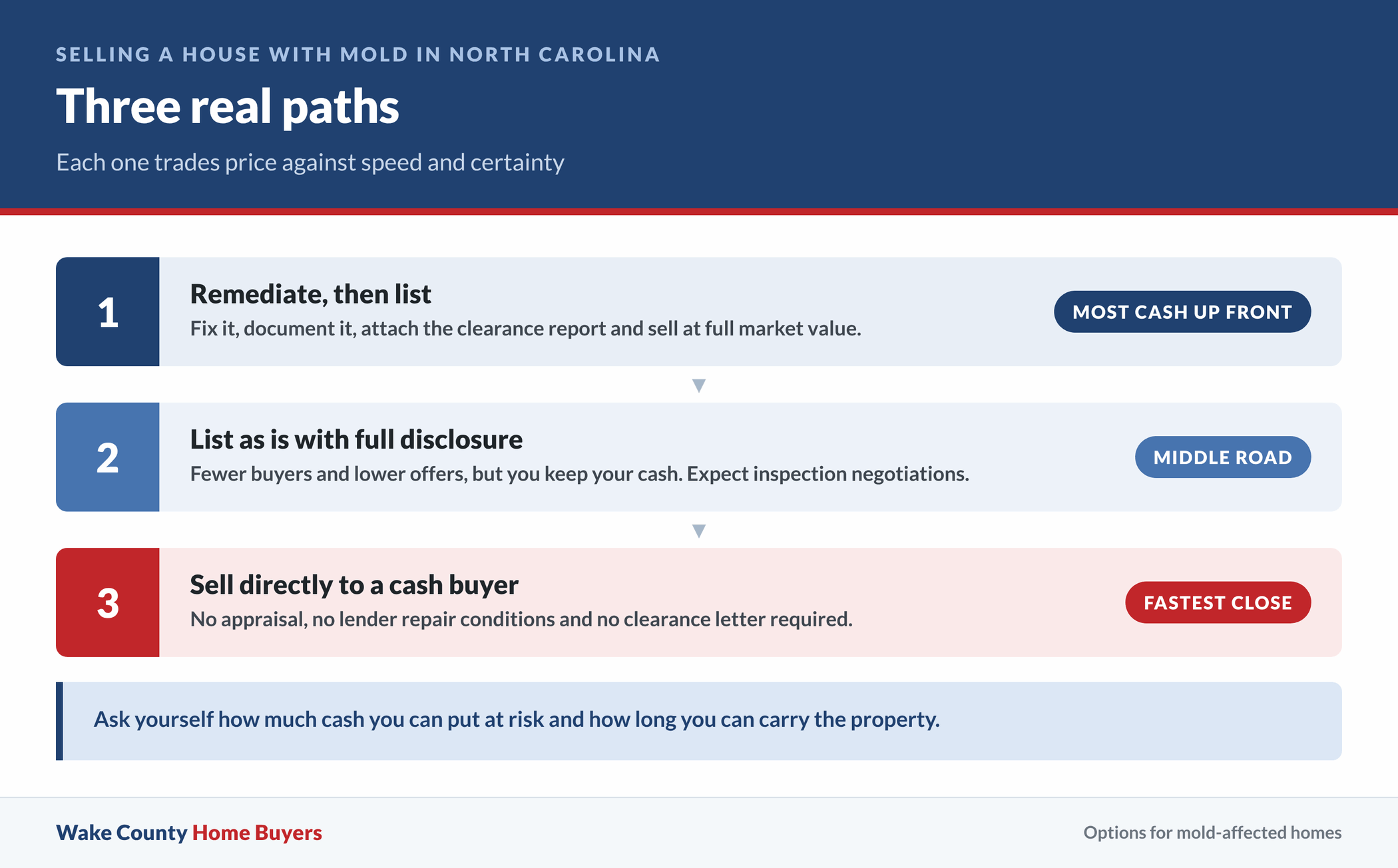
Three real paths exist, and the right one depends on your cash position and your timeline.
Full remediation plus a traditional listing works beautifully when the mold is contained and your house is otherwise strong. You fix it, document it, attach the clearance report to the disclosure, and sell at full market value, so the whole process stays clean and verifiable. A comparative market analysis from a local agent will tell you whether the repair math works in your specific neighborhood.
Listing as-is with full disclosure is the middle road. You’ll attract fewer buyers and field lower offers, though you keep your cash. Price it below the mold-free comps and expect inspection negotiations anyway.
Selling directly to a cash buyer closes fastest, since there’s no appraisal, no lender repair conditions, no mold clearance letter required. You trade some price for certainty, and for a lot of people that trade makes sense.
Which one fits your situation? Ask yourself how much cash you can put at risk and how long you can carry the property. Wake County home prices were down 4.1% year over year over the three months ending October 2026, with a median of $459K. Homes averaged 50 days on the market compared to 46 a year earlier.
One pattern I keep seeing: sellers remediate, then discover the buyer still wants a credit because the stain remains visible. The EPA acknowledges that mold can leave staining and cosmetic damage even after proper removal. Budget for paint and new trim, not just the remediation.
What Are the Key Takeaways for Selling a House with Mold?
Which brings everything back to the single decision that matters: do you spend the money, or do you price it in?
Disclose what you know. Fix the water source if you can afford it. Price the mold honestly rather than hoping nobody notices during due diligence.
Your market context matters too. Durham’s median sale price sat at $425K over the three months ending October 2026, down 1.2% year over year, with homes averaging 49 days on the market versus 40 the year before. Buyers in North Carolina have more choices than they did two years ago, and choice makes them picky about mold.
Don’t let a remediation quote decide your future by default. Get the quote, then compare it against a cash offer and against your own patience.
A woman in Hickory called me last spring after moving her father into assisted living. His split-level had a finished basement nobody had entered in two winters. The mold along the back wall had crept up behind the paneling, right past the shelves of fishing tackle he’d stacked there since the eighties. She didn’t have the time, the money, or the emotional bandwidth to manage contractors from two hours away. We bought it as it stood, she kept the tackle boxes, and the sale funded a year of his care.
Situations like hers are why I push back when people describe mold as a disaster. It’s a condition with a price tag, and conditions get sold every day across North Carolina.
Frequently Asked Questions About Selling a House with Mold in North Carolina
How Do I Sell a House That Has Mold in It?
Start by writing down everything you know about the mold and where the water came from, then put it on your disclosure form before the buyer makes an offer. From there you either remediate and list at full market value, list as-is at a discounted price, or sell directly to a cash buyer who doesn’t need lender approval. Each path works; they just trade price against speed and certainty in different proportions.
Will Mold Lower My Home’s Appraisal in North Carolina?
It can. An appraiser who sees active mold growth may flag it in the report, and the lender can then require repairs before the loan funds. Even after removal, leftover staining can pull offers down. Keeping your remediation paperwork and clearance report gives everyone something solid to work from.
Will a Home Inspection Always Find Mold in a North Carolina House?
Not always. Home inspectors in North Carolina look for visible mold and moisture indicators, but they don’t open walls or sample air as part of a standard inspection. Hidden mold behind cabinets, inside HVAC ductwork, or under subflooring often shows up only when someone orders a separate assessment or starts demolition.
Does Homeowners Insurance Pay for Mold Remediation in North Carolina?
It depends entirely on how the water got there. Policies commonly cover mold that follows a sudden, covered event like a pipe bursting, and commonly exclude mold that grew from a slow leak or deferred maintenance. Read your policy’s exclusions section and call your carrier before you assume either way.
Should I Test for Mold Before Listing My North Carolina Home?
Testing helps when you need to define the scope for a contractor or prove to a nervous buyer that remediation worked. It hurts when you order a test, get a scary-sounding species name, and now have to disclose a document you didn’t need. If you can already see the mold and know the source, spend your money on the repair instead of the lab report.
Can a Buyer Sue Me Later Over Mold I Didn’t Mention?
Concealing a known defect is where sellers in North Carolina get into real trouble, and a fraud or misrepresentation claim can surface after closing. Answering the disclosure form truthfully, including noting what you genuinely don’t know, is your protection. Keep copies of the signed form, your photos, and any contractor paperwork for your records.
We Buy Houses With Mold in Raleigh and Wake County
Our team works out of the Triangle and buys homes with moisture problems in every town around it. Raleigh’s typical home value was $428,671 at the end of August 2026, down 1.7% over the past year, according to Zillow. When values slip, a buyer who finds mold has room to push hard on price. Selling as is lets you skip that fight and the remediation bill.
If you’re sitting on a house with mold in North Carolina and you’re not sure whether to fix it or sell it, I’m happy to walk through the numbers with you. We’ve bought plenty of houses in your exact situation, and sometimes the right answer is to list it with an agent instead of selling to us. Either way, you can reach out to Wake County Home Buyers and get a straight conversation about what your options are worth. No pressure, no obligation, and no one will call you twice.
Get a Cash Offer for Your House With Mold
Send us the address and a short note about where the mold is and what caused it. You can reach out to our team through the site, or fill out the form below. We’ll look at the house and tell you plainly what we can offer, with no pressure either way.