Twenty thousand dollars. Roughly that much walks out the door on a median-priced sale in this state before you’ve paid off a dime of your mortgage. What realtors charge to sell a house in North Carolina sits at the top of the seller’s cost list, ahead of repairs, ahead of taxes, ahead of everything. I’ve been buying houses around the Triangle for years, and the commission talk is still the one sellers understand least when they sit down at my kitchen table.
What Do Realtors Charge to Sell a House in North Carolina?
A seller in Garner listed her house and signed a 6% agreement without reading past the first page. She figured one page was close enough to the whole thing. Four months later she closed and handed nearly six cents of every sale dollar to the agents, more than she’d budgeted for her entire move.
The gap between the signature and the settlement statement is where most of the pain lives. Realtors charge a percentage, and percentages feel small until a closing attorney turns them into a wire transfer.
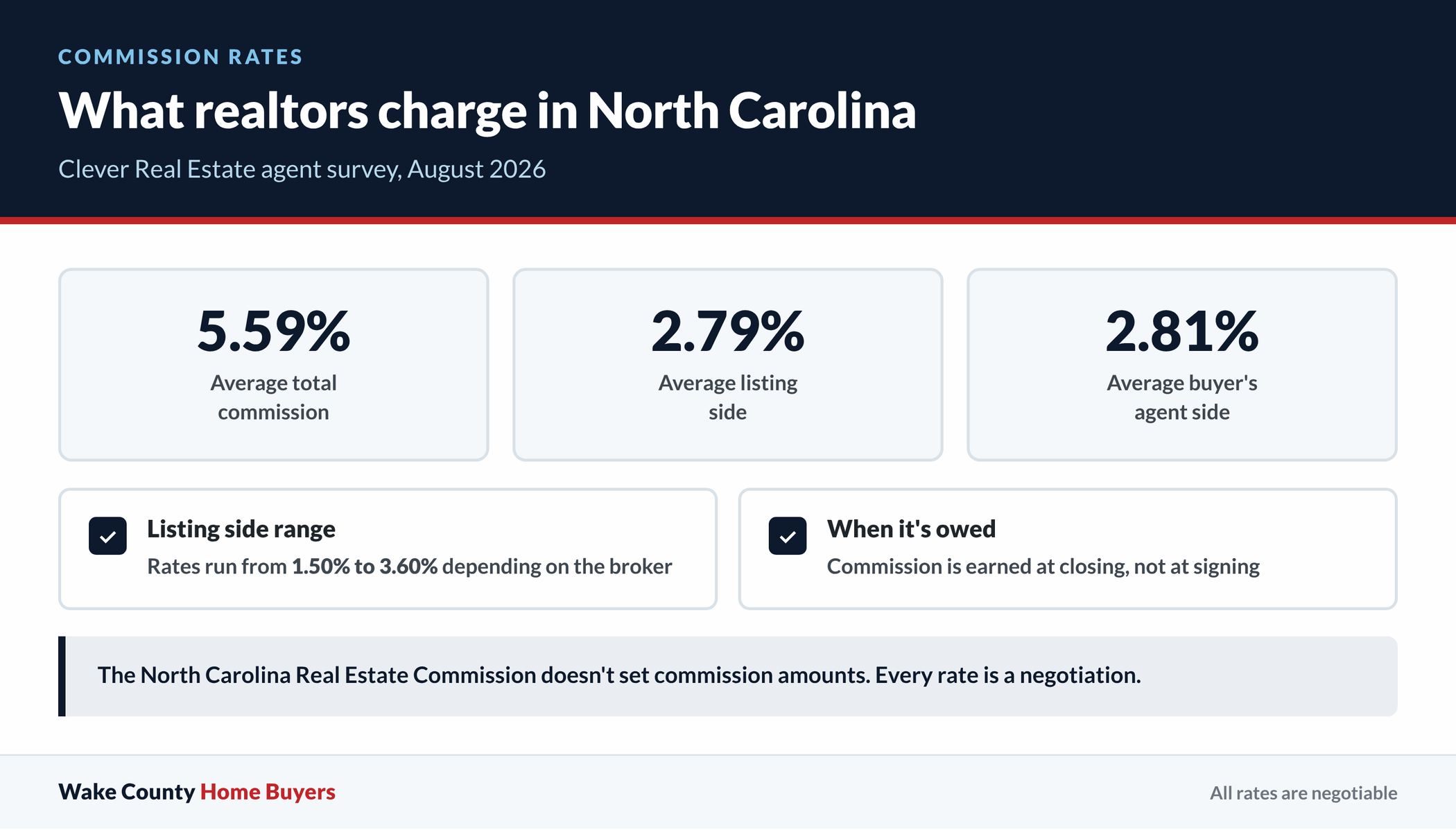
Statewide, total commission landed at 5.59% in an August 2026 survey of North Carolina agents. That splits into about 2.79% on the listing side and 2.81% on the buyer’s side.
The Wake County Register of Deeds put the county’s median sale at $440,000 in August 2026. Apply that rate and you’re looking at close to $24,600 in agent fees alone.
Last fall I bought a house in Knightdale from two brothers whose listing had sat for five months. Their dad’s workshop still had his table saw bolted to the floor, and they’d stopped answering showing requests. We closed in nineteen days, and they split the proceeds before Thanksgiving.
Commission is the headline cost, but it isn’t the whole bill. You’ll also pay the excise tax, the payoff of any liens, your share of the attorney’s closing work, and any concessions the buyer squeezes out during due diligence.
Any good listing agent earns the fee on a house that needs marketing, staging and a bidding war. Things change with a rough property, a tired roof and a motivated seller. Plenty of homeowners end up paying what realtors charge for full service they never use.
How Much Is Realtor Commission in North Carolina, Exactly?
Three percent per side was the old rule of thumb for what realtors charge, and the real market slipped below it some time ago. The typical per-side figure now sits a little under that mark.
Real numbers make the math specific. On a $400,000 sale, the statewide average rate comes to about $22,360 in commission. Shave half a point off the listing side and you keep $2,000.
Most realtors charge nothing until closing, because commission is earned then, not at signing.
If your house never sells, a standard listing agreement usually means you owe nothing in commission. Most agreements work on a no-sale, no-fee basis. Two clauses still deserve a careful read, though. One is an early cancellation fee. The other is a protection period that can still bind you if you sell to someone the agent brought through.
Flat-fee and discount brokers operate in Charlotte, Raleigh, Greensboro and Asheville now, and some charge a fixed dollar amount no matter the sale price. Listing-side rates run anywhere from 1.50% up to 3.60%, so what realtors charge really depends on who you call first. My opinion: sellers with a clean, updated home in a hot ZIP code are the ones most likely to overpay. Their house would’ve sold with a yard sign and a weekend.
What Factors Affect How Much Realtors Charge in North Carolina?
A $900,000 lakefront place on Lake Norman and a $185,000 brick ranch in Rocky Mount just don’t command the same rate. No honest agent pretends otherwise. The dollar yield on the high-end listing is huge even at two percent, so that seller has leverage the Rocky Mount seller doesn’t.
Your house’s condition matters a lot too. An agent pricing in six months of showings on a dated property will protect their margin, and realtors charge more when they expect to work harder for it.
Speed of sale factors in as well. Median days on market across the state hit 71 in October 2026, up from 66 in August, according to Realtor.com data on the St. Louis Fed’s FRED site.
Where you’re selling shapes it too. Coastal markets around Wilmington and the Outer Banks run on other seasons than inland Piedmont towns. Someone working Dare County in February has a much slower year than a broker in Cary.
What about dual agency? When the same firm represents both sides, some brokers discount the total rate because there’s no second office to pay.
One pattern I keep seeing: sellers push hard on the listing rate, then quietly agree to cover the buyer’s agent at full freight during offer review. The savings vanish in a single paragraph of the sales contract. What realtors charge sellers is really two separate talks, and the second one happens when you’re tired and attached to a buyer.
Who Pays the Realtor Fees When You Sell in North Carolina?
A seller in Cary assumed her buyer would cover his own agent. Her settlement statement showed both commissions coming straight out of her proceeds.
For decades the fees realtors charge came out of one seller check covering both sides, and the listing broker shared a portion with whoever brought the buyer. That setup shifted in August 2024. Under the current rules, the seller pays the listing agent and the buyer covers their own agent’s fee, unless the two sides agree to something different.
In practice, plenty of sellers here still chip in toward the buyer’s agent as a concession, because buyers here are short on cash. No law makes a seller pay a buyer’s agent. It’s a contract term settled in the listing agreement and, when needed, in the sales contract.
Buyers now sign written agreements before touring, so their agent’s fee gets settled up front instead of assumed. Commission Rule 58A .0112 bars a buyer’s agent from making the offer depend on an agreement to pay them, as a North Carolina Real Estate Commission bulletin explains.
Sellers working with Wake County Home Buyers skip this split, since a direct sale has no listing side and no buyer’s side to fund. It’s the right answer for sellers who’ve already run the commission math and found it doesn’t leave enough to move.
Whatever realtors charge, the bill lands on the person holding the deed. Know that before you sign anything.
Can You Negotiate What Realtors Charge in North Carolina?
Yes, and nearly every seller forgets to ask. The North Carolina Real Estate Commission doesn’t set commission amounts at all, and most seller guides bury that fact. Agents who coordinated rates with competitors would be price-fixing.
So yes, you can negotiate the rate, and you should. Sellers who negotiate lose nothing by asking. MLS members have to tell buyers plainly that broker commissions are not set by law and are fully negotiable. The same truth applies on the listing side.
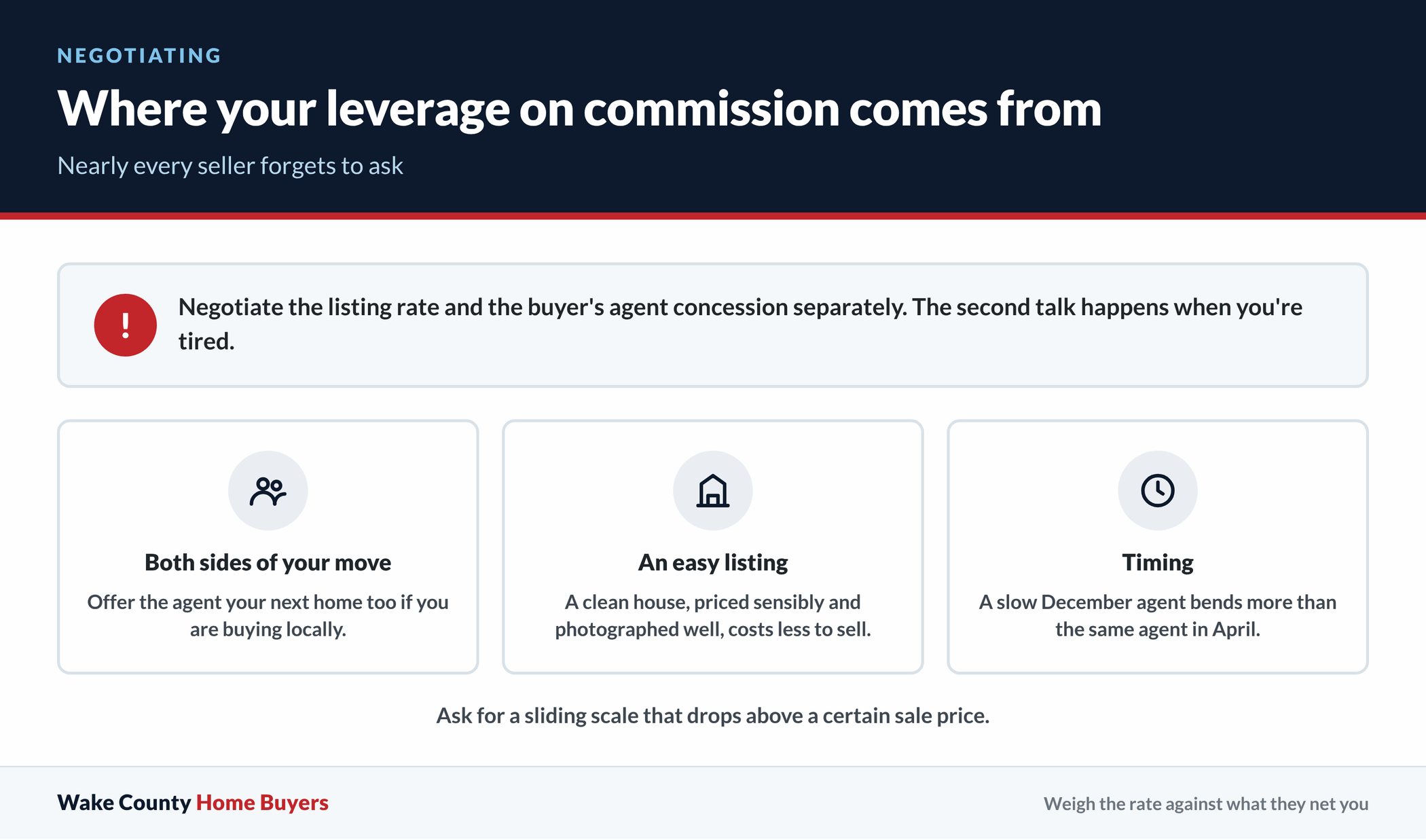
Leverage comes from a few places. Offer the agent both sides of your move if you’re buying another house locally. Hand them a property that’s already clean, priced sensibly and photographed well. Ask for a sliding scale where the rate drops above a certain sale price.
Timing helps too.
An agent in Greensboro or Winston-Salem heading into a slow December will bend more than the same agent in April. Realtors charge what the market lets them, and in a slow month the market lets them charge less.
Ask about the listing term too. A shorter term with a renewal option keeps pressure on performance. If an agent refuses each change you ask for, that tells you how they’ll handle your price talks later.
One caution from the buying side: the cheapest listing agent isn’t always the best financial outcome. A discount broker who underprices your Apex house by fifteen grand costs you more than a full-commission pro who doesn’t. Weigh what realtors charge against what they net you, not on its own.
Are There Extra Closing Costs Beyond Realtor Commission in North Carolina?
North Carolina charges an excise tax on the deed itself, and the seller pays it, not the buyer. Its rate is one dollar for every five hundred dollars of the price, or any part of that. You pay it to the register of deeds in the county where the property sits before the deed can be recorded. Read the statute itself at G.S. 105-228.30. Seven counties can add a local land transfer tax, so coastal sellers in places like Dare or Currituck should check with their county register of deeds.
Recording fees on top of what realtors charge are set by state law. Registers of deeds across the state charge $26 for the first fifteen pages of a recorded deed and four dollars for each page after that.
Then come the payoffs. You’ll pay off your mortgage balance and any HELOC, prorated property taxes up to closing day, and HOA dues or transfer fees if you live in a community with an association. Attorney fees for the closing work get split by contract here, since the state uses attorneys rather than escrow companies.
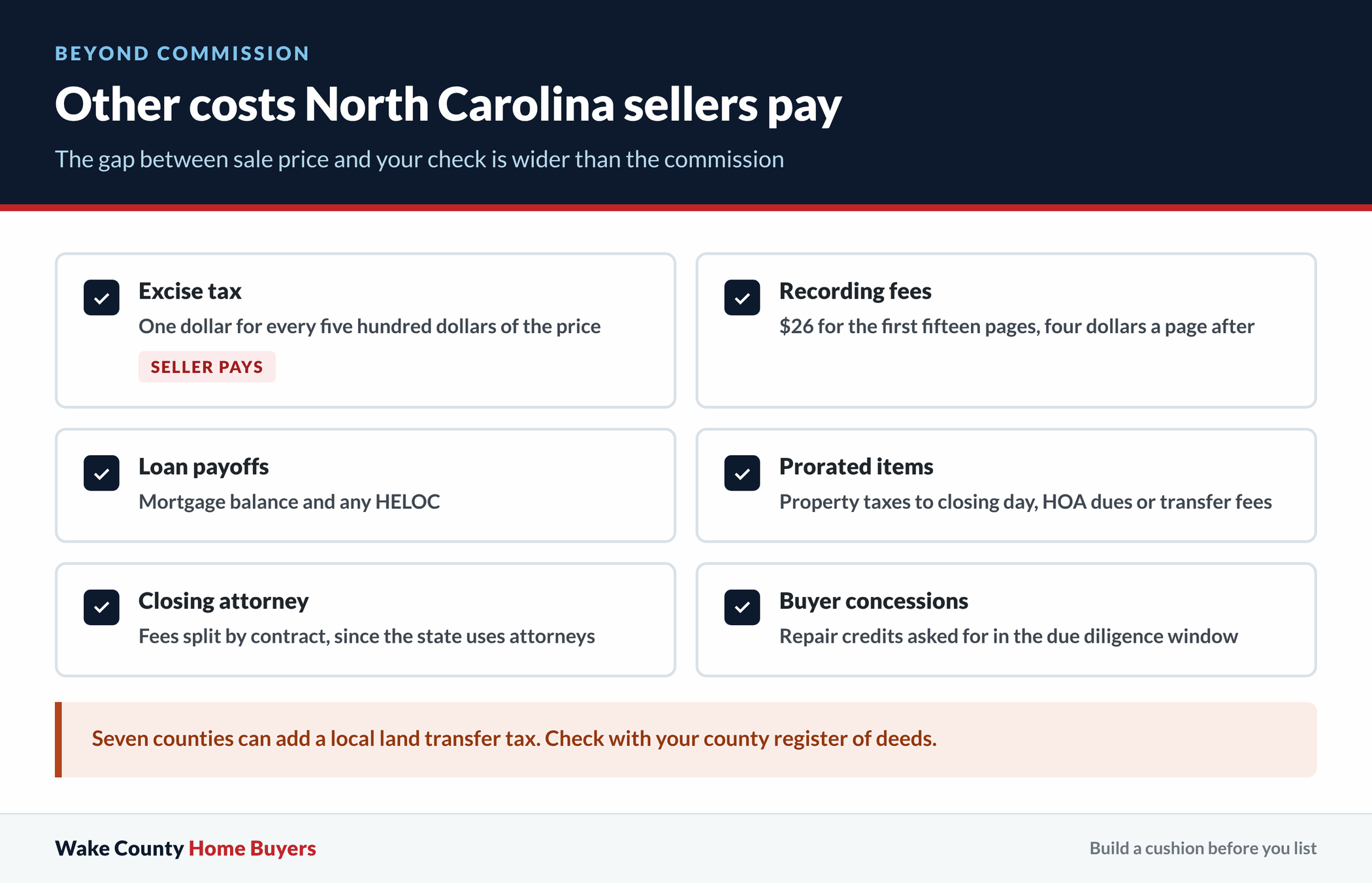
Buyer concessions deserve their own line in your budget. After a home inspection in the due diligence window, buyers often ask for repair credits. A failing HVAC system in a Fayetteville summer turns into a four-figure talk fast.
Add it up and the gap between your sale price and your real check is wider than the fees realtors charge would suggest by themselves. Build that cushion before you list.
How Do Realtor Fees Compare to Selling Without an Agent in North Carolina?
You keep the listing side of what realtors charge. The buyer’s agent still expects payment, and most buyers touring your house will show up with representation and a signed agreement.
For-sale-by-owner works in certain cases. Maybe you already have a buyer lined up. You’re selling to a tenant, a neighbor or a family member. Or your house sits in a tight Chapel Hill or Davidson pocket where demand runs ahead of supply and the house sells itself.
MLS access, syndication and agent networks move properties. A FSBO listing without that reach often racks up more days on market and sells for less, which can erase the savings.
Selling directly to a local buyer removes commission from both sides without putting you in charge of marketing, showings and contract paperwork. A direct offer usually comes in under retail. The tradeoff is speed, certainty and zero repair spending.
You’re better off running your own numbers than taking either side’s word for it. Start from the likely sale price, not the median for your area, and subtract commission, concessions and two more mortgage payments. Then put that next to a direct offer closing in three weeks. Sometimes the two numbers land close enough that the hassle decides it.
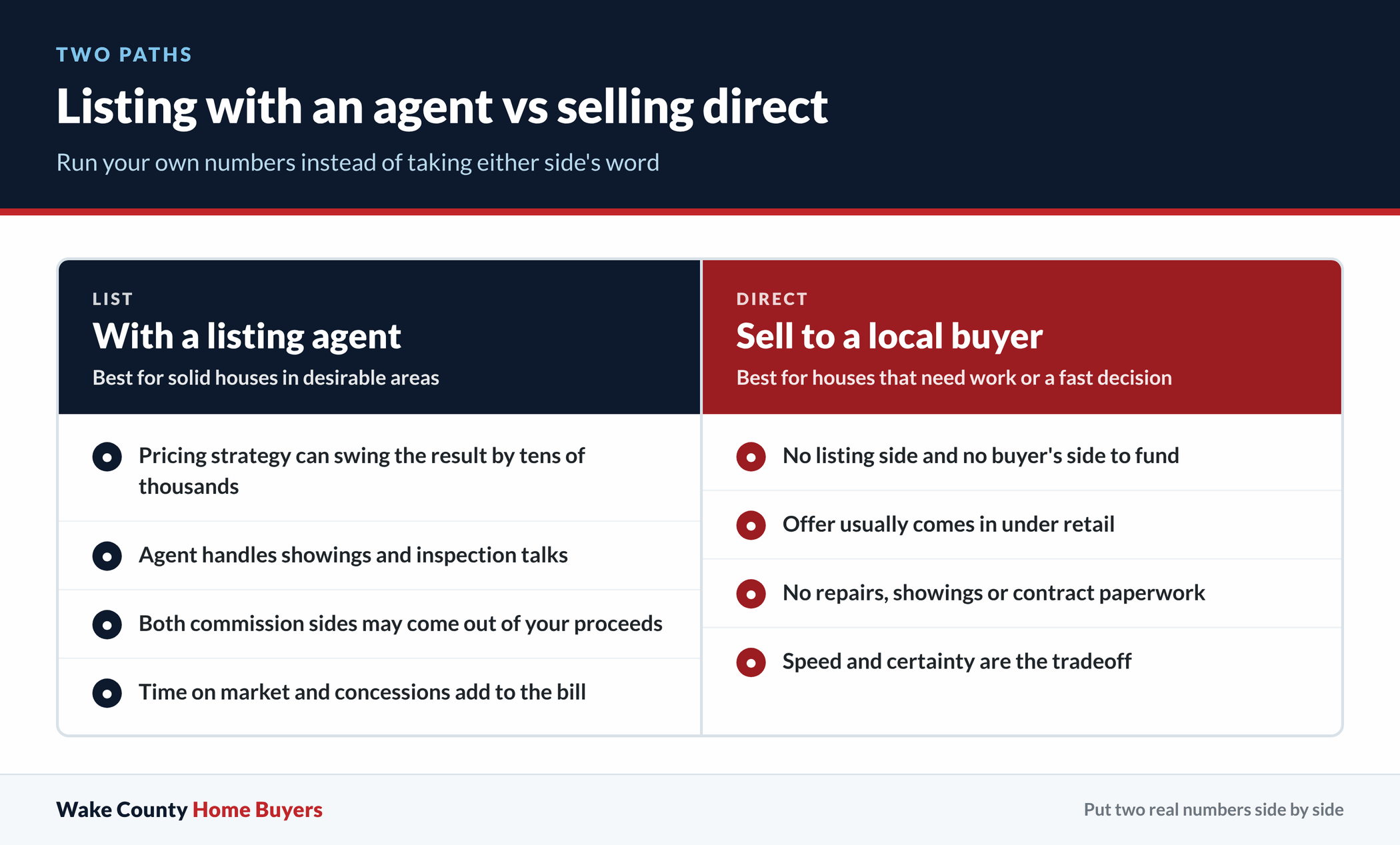
The fees realtors charge only matter next to what they add, so measure both.
Is It Worth Paying What Realtors Charge in North Carolina?
I’ve met plenty of sellers who tried the listing route twice before they called us. Two expired listings is six months of carrying costs, utilities and insurance, plus the slow grind of keeping a house showing-ready while you live somewhere else.
For most sellers with a solid house in a desirable area, an experienced listing agent earns the fee. Pricing strategy alone can swing the outcome by tens of thousands. Good agents also handle inspection talks that would otherwise cost you more than the commission itself.
A property with foundation movement, fire damage or forty years of deferred upkeep doesn’t benefit from professional photos. What it needs is a buyer who’ll take it as it stands. Paying full commission to market a house that retail buyers can’t finance is money burned.
Estate situations land in their own category. A woman in Wake Forest was settling her father’s estate while her mother adjusted to an assisted living community twenty minutes away. She’d been driving out every Sunday to mow a yard she didn’t want anymore. She told me the commission wasn’t the issue. The issue was that she couldn’t give the house another eight months of her life.
So ask yourself plainly: does your house need a marketing campaign, or does it need a decision? A listing that sits through a slow winter can add months on top of the market average, and that’s time to contract, not time to a finished closing.
Sellers who want a straight comparison can get a no-obligation offer from Wake County Home Buyers and set it beside an agent’s net sheet. Two real numbers beat a guess every time. What realtors charge in North Carolina is worth paying when the service brings in more than it costs, and worth skipping when it doesn’t.
Frequently Asked Questions About What Realtors Charge to Sell a House in North Carolina
Does a Buyer Pay Realtor Fees in North Carolina?
Under the rules that took effect in August 2024, buyers are responsible for paying their own agent. They sign a written agreement spelling that out before they tour a single house. In practice, many sellers still agree to cover some or all of that fee as a concession to get the sale closed. Nothing in state law forces either outcome, so it’s a negotiation between you, your buyer and the contract you both sign.
Is a 3% Commission Rate Normal for a Realtor in North Carolina?
Three percent per side used to be what realtors charge by default, and it still shows up in plenty of listing agreements. Recent survey data puts the typical per-side rate a bit below that. Whether that flat rate is fair depends on your price point and your property. On an expensive, move-in-ready home it’s generous, while an agent may truly need it on a hard-to-sell property in a slow market.
Can I Refuse to Pay the Buyer’s Agent and Still Sell My House in North Carolina?
You can. No statute makes you contribute toward the buyer’s side, and your listing agreement controls what you’ve committed to. Just know that refusing may shrink your buyer pool, since a buyer who pays their agent out of pocket has less cash left for your price.
How Does What Realtors Charge to Sell a House in North Carolina Compare to Other States?
North Carolina runs close to the national average, sitting slightly above it in recent agent surveys. You’re not being penalized much by geography. Rates vary far more between brokers inside the state than they do from one state to the next.
Do I Owe Commission If My House Doesn’t Sell in North Carolina?
Usually no. Standard listing agreements only trigger commission at closing, so an expired listing with no sale costs you nothing in agent fees. Watch for a cancellation fee if you end the agreement early. Also read the protection period clause, which can still bind you if you sell soon after to a buyer your agent first introduced.
Who Actually Collects the Excise Tax When I Sell in North Carolina?
Your county register of deeds collects it before the deed gets recorded. In most sales the closing attorney pays it out of your proceeds at the settlement table. If your property sits in one of the counties with an extra local land transfer tax, that office can also confirm the current local rate.
Are Discount Brokerages Worth It in North Carolina?
They can be, especially if your house is in good shape and sits where buyers are already looking. Compare the service list, not just the advertised rate. Ask who handles showings, who writes and negotiates the counteroffers, and who manages the due diligence period. A low rate that leaves you doing the agent’s job isn’t really a discount.
What Realtors Charge Around Raleigh, North Carolina
Most of the houses we buy sit in Raleigh and the rest of Wake County. Realtor.com data on FRED had Wake County listings at a median of 61 days on market in October 2026, about ten days quicker than the statewide pace that month. Anyone weighing a listing against a direct sale in the city can start with how we buy houses in Raleigh.
Compare Realtor Fees and a Cash Offer in North Carolina
If you’re staring at a listing agreement and trying to figure out whether the numbers work, I’m glad to walk through it with you. Bring your mortgage payoff, your rough repair list and what an agent quoted you, and we’ll put a real offer next to it so you can see both sides honestly. No pressure either way, and no obligation if you decide listing is the better road. When you’re ready, contact Wake County Home Buyers or fill out the form below.