
Seventy-one days. The median time a home listing sat before going off the market across North Carolina in October 2026, according to Realtor.com data tracked by the St. Louis Fed. Now picture that same clock ticking while your kitchen ceiling is open to the rafters and the whole house smells like a campfire. Fire damage changes every assumption you had about selling, so the usual advice about fresh paint and curb appeal stops applying the moment the fire marshal clears the scene.
I’ve bought houses across this state for years, including plenty with fire damage. What follows is what I’d tell a neighbor.
What Should I Do After a House Fire in North Carolina?
You need to make three phone calls in the first week, and only one involves real estate. Your insurance carrier comes first, then a board-up crew. Then whoever handles the fire department incident report for your jurisdiction, because that document follows the property forever and buyers will ask for it.
Get copies of everything before memory fades. Photos of the fire damage from multiple angles, the adjuster’s scope of loss, any receipts for emergency mitigation. That gap costs real money at the negotiating table.
Secure the structure fast. An unsecured house invites copper thieves, squatters, and the kind of weather conditions that turn a contained kitchen fire into a total loss.
Last year a family in Clayton called me five weeks before a corporate transfer was supposed to move them to Ohio. Their laundry room had gone up on a Tuesday. The smoke had traveled through the HVAC into every bedroom. Their boxes were already stacked in the garage next to a boat they couldn’t take with them. We got them closed before the moving truck ever pulled up.
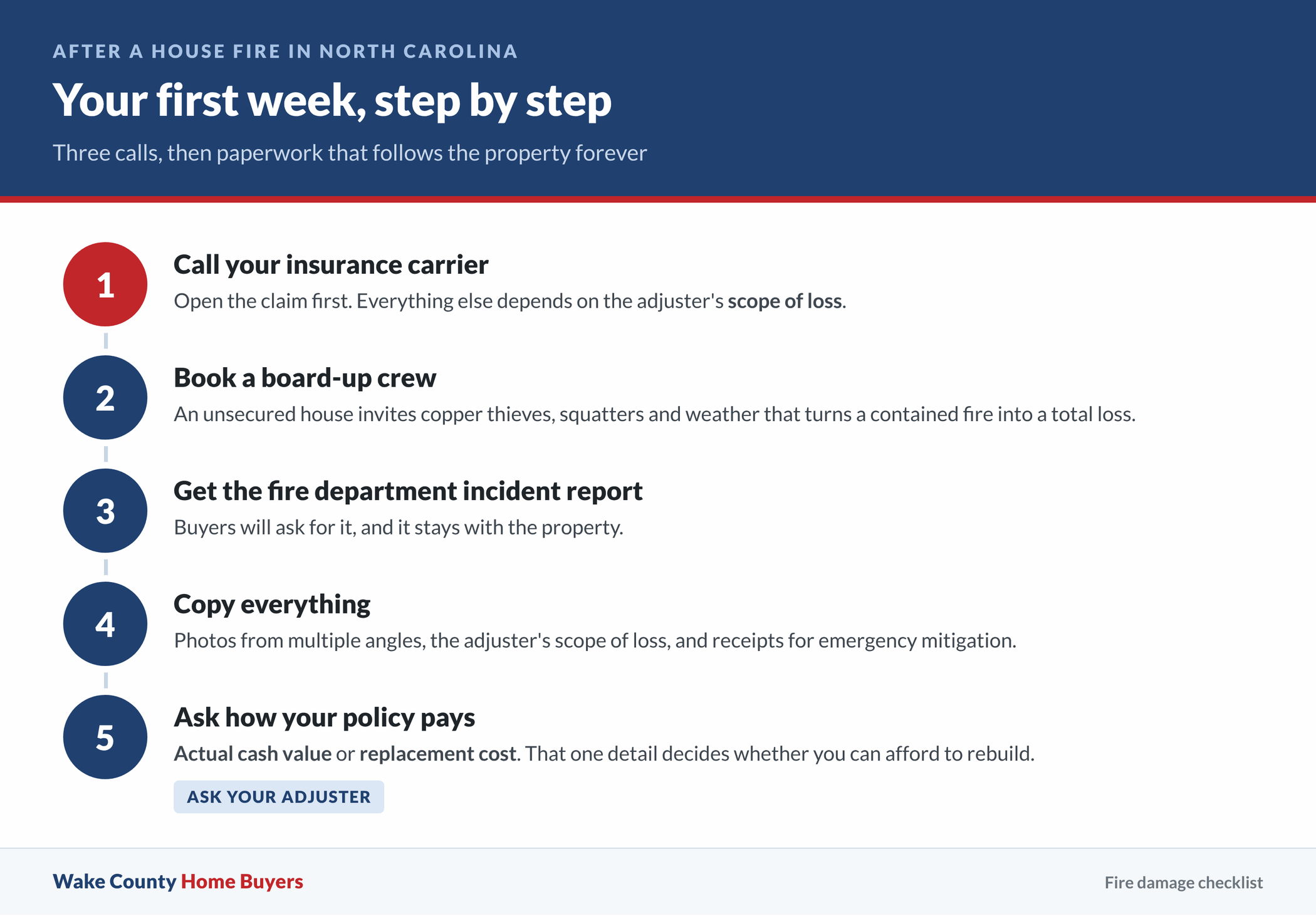
Ask your adjuster whether your policy pays on an actual cash value basis or a replacement cost basis. Their answer decides whether you can afford to rebuild. Homeowners in North Carolina have also watched premiums climb. The statewide base rate went up an average of 7.5% on June 1, 2026. This was the second step of a negotiated settlement that had already raised rates by the same amount in June 2025. A fire damage claim on your record doesn’t make your next renewal any friendlier.
How Does Fire Damage Affect My Home’s Value in North Carolina?
And that’s where the arithmetic gets uncomfortable. A buyer doesn’t subtract the repair estimate from your market value and call it even. They subtract the repair cost, plus a risk premium for everything hidden behind the drywall, plus their own holding costs, plus a margin for the surprises that fire damage always hides.
I’d argue the bigger discount comes from financing, not from buyer squeamishness.
That matters directly for your bottom line. A conventional lender won’t fund a house with an open hole in the roof or a compromised electrical panel. Fewer buyers means less competition, and less competition means a lower price. That’s the mechanism.
Judge offers against that backdrop. Wake County’s median sale price was $459,000 over the three months ending October 2026, down 4.1% year over year, with homes averaging 50 days on the market. Durham ran a bit lower: a $425,000 median over that same stretch, off 1.2% from the prior year. Softer markets give buyers more leverage in every sale, and fire damage amplifies that leverage.
Buyers still weigh location heavily. In the strongest North Carolina submarkets, buyers are paying for the dirt and the address; the house is almost incidental.
Can I Sell a Fire-damaged House in North Carolina?
Yes, you can sell it, and buyers for burned properties are out there right now. No statute in North Carolina blocks the sale of a burned or partially burned house, and these properties trade every single week.
What you cannot do is hide it. Chapter 47E of the General Statutes requires owners to complete the Residential Property and Owners’ Association Disclosure Statement and deliver it to the buyer. The North Carolina Real Estate Commission publishes that form. The form’s structural section now includes questions about fire damage and fire insurance claims.
A repair job doesn’t erase the history. The disclosure form itself states that some issues, including structural problems and fire damage, stay material facts a broker must disclose even after repairs are finished. NC REALTORS® addresses this directly in its legal Q&A on repaired damage, and the guidance leans toward telling buyers rather than staying quiet.
Opposite is true in my experience. A seller who hands over the incident report, the restoration invoices, and clear before-and-after photos usually gets a cleaner contract than one who answers every question with a shrug.
Should something change after you sign the form? State law directs you to give the buyer a corrected statement or fix the problem. You can review the official rule text through the Real Estate Commission’s administrative code. Your closing attorney can walk you through the timing specifics for your transaction, so you’re not guessing at deadlines on your own.
Why Sell Your Fire Damaged House Instead of Repairing It?
An heir in Greensboro inherited her mother’s bungalow four months after an electrical fire gutted the back half. She lived in Virginia, worked full time, and had never managed a contractor in her life.
Rebuilding isn’t just money; it’s a second job with no training and no exit date.
Consider what restoration demands of you. Pulling permits with your county inspections department. Vetting licensed general contractors who specialize in fire damage, not just remodeling. Supervising subs who may not show up on Thursday. All of it while you’re paying a mortgage loan on a house you can’t live in, plus rent somewhere else.
Insurance proceeds rarely cover the full cost of the fire damage. Depreciation holdbacks, policy limits, and code upgrade requirements eat into the check.
Does the restored house recover its full market value? It doesn’t always happen. You spend a year and $60,000 of your own cash, then list it, then disclose the fire history anyway and watch buyers shave their offers. Many don’t, and nobody tells them that before they start.
Selling as is hands off the whole problem to someone else. The buyer absorbs the permit risk, the contractor risk, and the schedule risk. You get a closing date and a check, and the fire damage stops being yours. Companies like Wake County Home Buyers handle exactly these properties around the Triangle, which spares you from assembling a construction team you never wanted.
How Much Does Fire Damage Repair Cost Compared to Selling?
Most restoration estimates you’ll see quoted online are too low for a real house fire in North Carolina.
Industry pricing for 2026 puts fire damage restoration at roughly $4 to $7 per square foot, averaging near $5.50, for smoke and soot remediation, water extraction from the firefighting, and selective repairs. Total projects in 2026 typically land between about $3,100 and $51,200, with a national average near $27,091, per Palm Building’s 2026 cost analysis. Those numbers cover remediation, not a full structural rebuild.
Severe fires price differently. Moderate to major structural damage runs $15 to $50 per square foot, and near-total losses hit $75 or more. Run that last number against a 1,900 square foot Winston-Salem ranch and you’re past $140,000 before anyone picks a paint color.
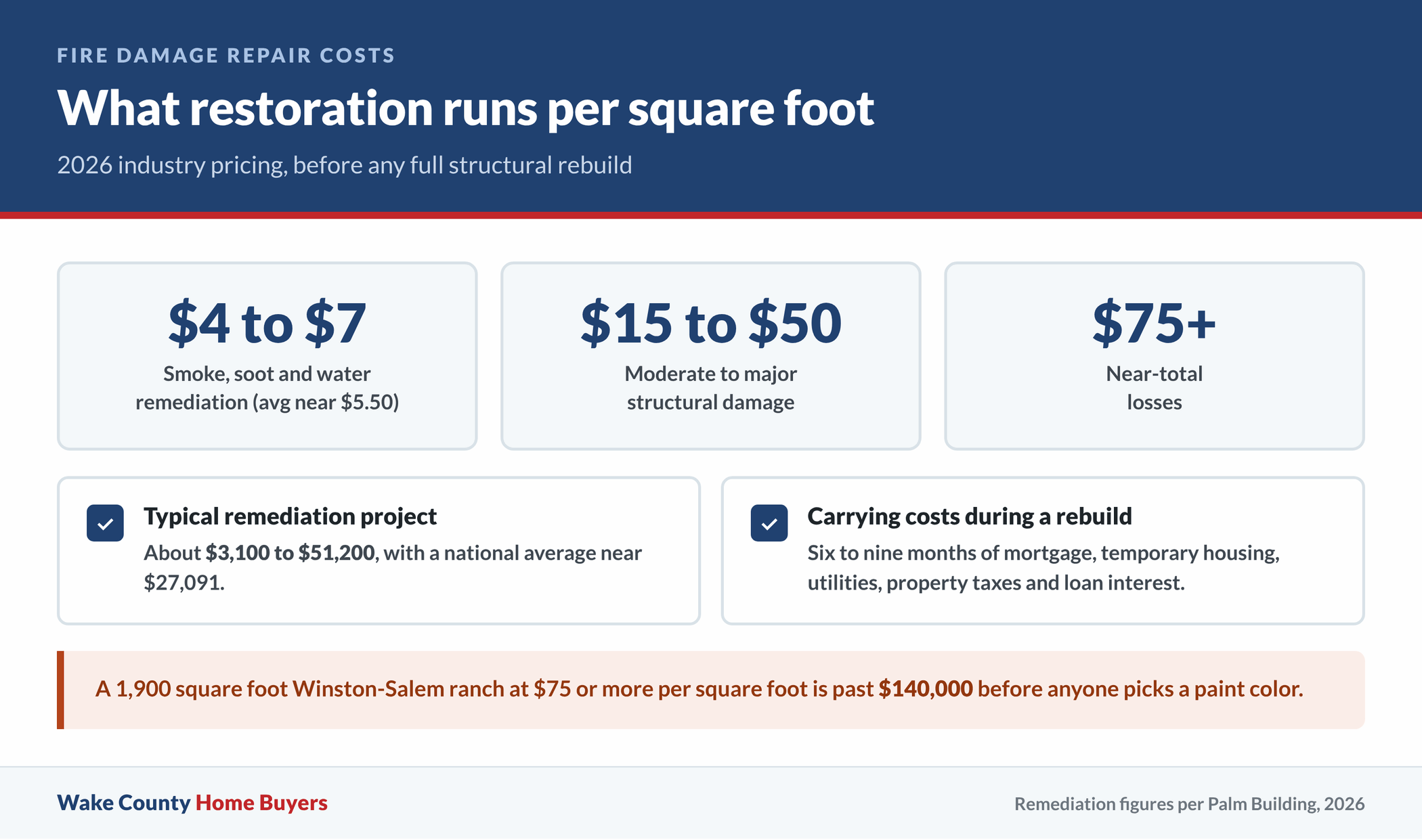
During a six to nine month rebuild, you’ll face mortgage payments, temporary housing costs, utilities on a vacant structure, property taxes, and interest on any private lenders or renovation loans. Many owners lean on those loans to bridge the insurance gap.
You trade some top-line price for certainty and speed.
I’ll put my opinion on the table. If the repair estimate exceeds a third of the home’s after-repair value, and you don’t have construction experience, selling the fire damage to an investor usually nets you more actual money than rebuilding does.
What Are My Options for Selling a Fire Damaged House in North Carolina?
A Fayetteville owner listed her smoke-stained split-level with a real estate agent in spring and sat through two failed closings. She sold to a cash buyer in August for less than her original list price and more than either contract would have netted her after repair demands.
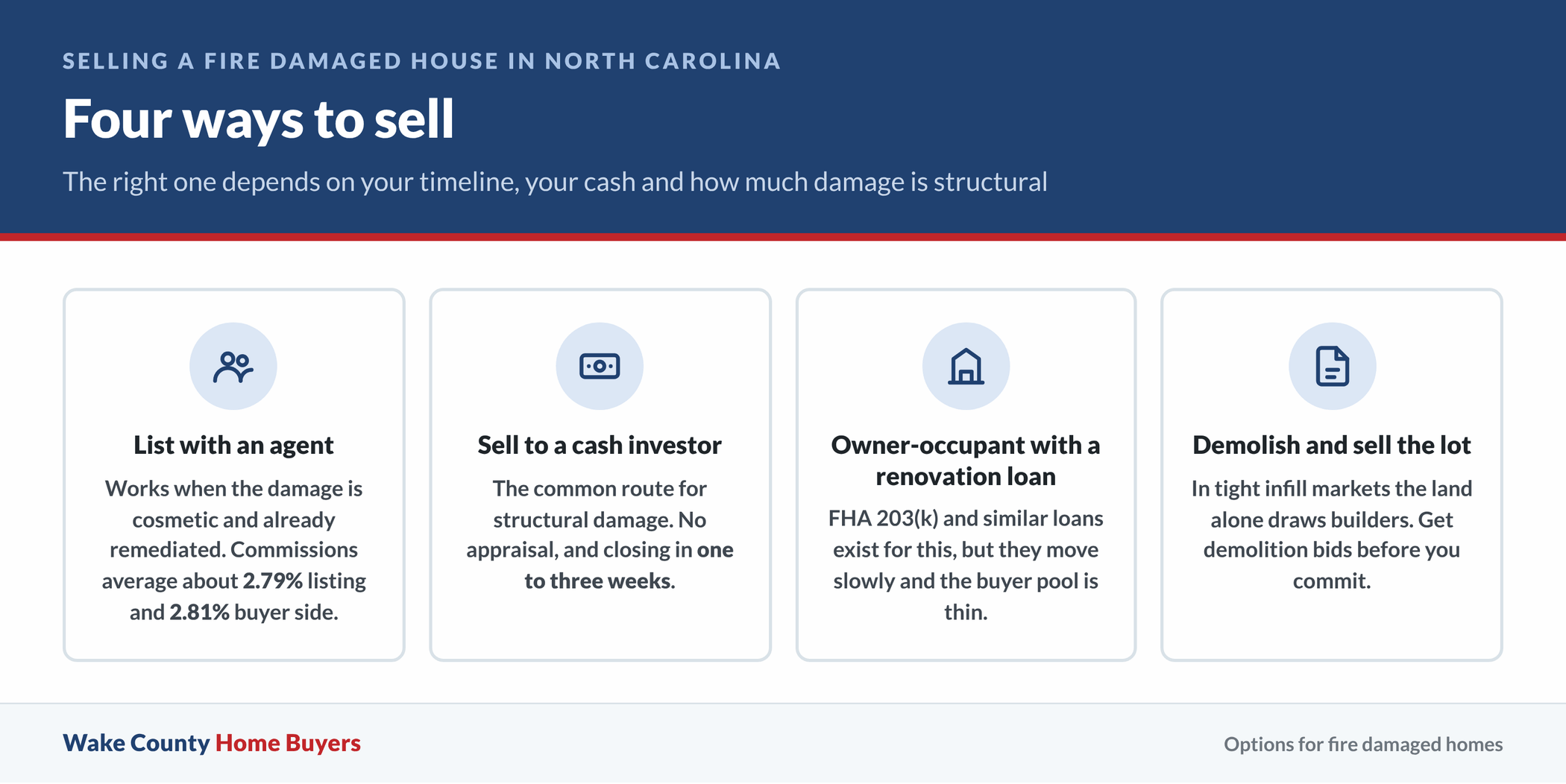
Listing with a realtor works when the fire damage is cosmetic and already remediated. A good estate agent can market a lightly smoke-affected property to conventional buyers, especially if you’ve got the restoration paperwork in hand. Listing and buyer agent commissions in North Carolina average around 2.79% and 2.81% respectively, so you’ll want to budget for that off the top.
Selling to real estate investors is the common route for structural fire damage. These buyers pay cash, skip the appraisal, and close in one to three weeks.
A third option gets overlooked: selling to an owner-occupant using a renovation loan. Most traditional buyers can’t buy a fire damaged property because their lender won’t approve the financing, but FHA 203(k) and similar products exist specifically for this. The catch is timing. Those loans move slowly and the buyer pool is thin.
Fourth, you can demolish and sell the lot. In tight infill markets like Durham’s Old North Durham or parts of Charlotte’s Plaza Midwood, the land alone draws builders. Demolition costs money, so get bids before you commit.
Which one fits depends on your timeline, your cash position, and how much of the fire damage is structural versus surface.
Who Buys Fire Damaged Homes as Is in North Carolina?
For a long time I assumed sellers in this spot mostly wanted the highest number, and I was wrong about that more often than not.
A seller juggling a displaced family and an insurance fight will take a fair offer that closes Friday over a better offer that might close in ninety days.
You’ll find the buyer pool for fire damage in North Carolina breaks into a few groups. Local flippers who rebuild and resell. Buy-and-hold investors adding rentals in markets like Greenville or Hickory. Small builders hunting for teardown lots. Occasionally an owner-occupant with trade skills and a renovation loan.
Vet whoever shows up at your door. Ask how many fire damage projects they’ve completed, who their restoration contractor is, and whether they’ll show proof of funds.
The assignment contract is the thing to watch for. Some “buyers” tie up your property, shop it to a list of investors, and come back asking for a price reduction when nobody bites. Experts in this niche don’t need to do that. Wake County Home Buyers buys directly, which is the standard you should hold any offer to.
You need local knowledge more here than in a standard sale. Someone who’s rebuilt in Johnston County knows those inspectors; someone from out of state is guessing at your permit timeline and will price the uncertainty into your offer.
How to Sell a Fire Damaged House as Is in North Carolina
Skip the documentation step and you’ll pay for it twice: once in a lower offer, and again when a buyer uses an unknown to renegotiate three days before closing.
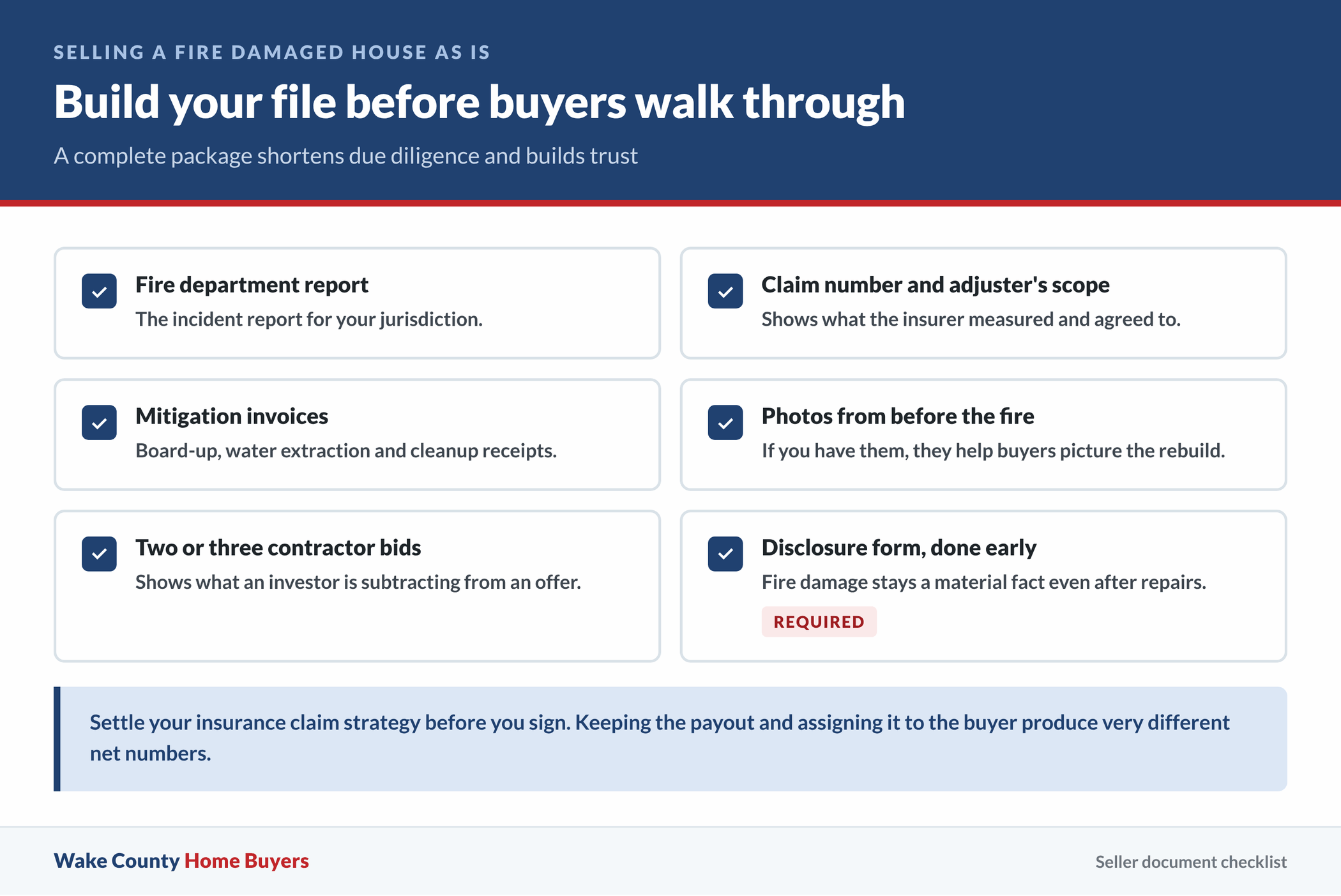
Start with your file. Fire department report, insurance claim number and adjuster’s scope, any mitigation invoices, photos of the structure before the fire if you have them. Hand that package to every buyer who walks through. It shortens due diligence and it builds trust.
Settle your insurance claim strategy before you sign anything. Some sellers take the payout and sell the damaged house separately; others assign the claim proceeds as part of the sale. Those two structures produce very different net numbers, and your closing attorney should look at the contract language either way.
Pull two or three contractor bids even if you never intend to repair the fire damage yourself. Those bids tell you what an investor is subtracting, and they give you something concrete to push back with when an offer feels light.
Complete the disclosure form honestly and early. North Carolina buyers who learn about fire damage after they’re emotionally invested tend to walk; buyers who know on day one and still make an offer tend to close.
A landlord near Mooresville had been covering two mortgages for close to eleven months after a space heater fire ran through the upstairs of his rental. The tenants had moved out immediately. His insurance payout had been spent on a partial rebuild that stalled. The garage was still full of half-used drywall sheets and a pressure washer he’d bought for the job. He’d never said a word about it to anyone outside his family. Selling the property as is ended the bleeding in under three weeks, and he told me the relief hit harder than any check ever had.
Emotional trauma after a fire is real, and dragging out a sale for an extra few thousand dollars isn’t always the winning move.
Frequently Asked Questions About Fire Damage in North Carolina
Does a House Lose Value After a Fire?
Yes, and the drop usually runs deeper than the repair bill alone. Buyers price in the unknowns behind the walls, the financing hurdles, and the permanent disclosure that follows the property. Even a fully restored home carries a history that shows up in offers, though a well-documented restoration with permits and receipts narrows that gap quite a bit.
Do I Have to Tell Buyers About Fire Damage That Was Repaired Years Ago?
You do. North Carolina treats a fire in the home’s history as a material fact, and the state’s disclosure form asks about it directly along with any insurance claims filed. Trying to bury it creates far more risk than disclosing it, since a buyer who finds out later has real legal remedies against you.
Will My Insurance Company Let Me Sell Before the Claim Is Settled?
Usually, but the mechanics depend on your policy and your mortgage servicer, since the lender often controls the claim funds on a damaged property. Talk to both your adjuster and your closing attorney before you accept an offer. Some buyers will take the house and let you keep the settlement; others factor the pending claim into their price.
How Fast Can a Fire Damaged House Actually Close in North Carolina?
Cash sales can wrap up in one to three weeks once title work clears, assuming no probate or lien complications. That’s a fraction of the statewide market timeline mentioned earlier. Financed sales take much longer, and on a structurally damaged house they frequently fall apart at the appraisal.
Is It Worth Rebuilding Before I List?
Sometimes, if your insurance payout covers most of the work and you’ve got the stomach for a long project. Run the numbers against the per-square-foot restoration ranges described above and compare the result to a straight as-is offer. Plenty of owners find the rebuild consumes a year and delivers a smaller net than selling the fire damage to someone who does this professionally.
Can I Sell Just the Land If the House Is a Total Loss?
In a lot of North Carolina markets, absolutely. Builders and investors buy teardown lots in established neighborhoods where the location carries most of the value. Get demolition bids first so you know whether to clear the structure yourself or sell it standing and let the buyer handle it.
If you’re sitting with a burned house and no clear next step, I’m happy to look at it. I’ll tell you plainly what I think it’s worth, even if the answer is that you should list it with an agent instead. Call or send photos whenever you’re ready. No pressure, no obligation, and no hard sell if the timing isn’t right for you.
We Buy Houses With Fire Damage in Raleigh and Wake County
Our team buys burned and smoke-stained homes all over the Triangle, from older neighborhoods near downtown to newer subdivisions. In October 2026, Raleigh listings had a median list price of $512,500 and sat a median of 68 days. Houses with fire damage have a harder time in that market, since buyers can tour plenty of move-in ready homes first. If your property is anywhere in the area, we’d be glad to walk it with you.
Get a Cash Offer for Your House With Fire Damage
Tell us a little about the house and what happened, and we’ll take a look. You can contact Wake County Home Buyers online, or use the form below to send the address and a few photos. There’s no cost and no obligation, and you can take your time deciding.