Four months. A family sat on a brick ranch off Six Forks Road for roughly that long before probate let anyone legally sign a deed. Nobody had warned them that paperwork was the holdup. If you’ve inherited property and you’re trying to figure out how probate works here before the taxes and insurance eat you alive, this walkthrough is for you. I’ve bought houses across Wake County for years, and probate sales are a big slice of what we do.
Who Is Responsible for Probate on a Raleigh Property?
One person carries this, not the whole family, and pretending otherwise wastes months.
The Clerk confirms that choice when a will names an executor. Without a will, an heir steps up and asks to be appointed administrator instead. The Clerk reviews the application and issues Letters Testamentary for an executor named in a will, or Letters of Administration when there’s no will. Until those Letters exist, nobody has authority to list, sign, or convey anything.
Siblings scattered between Raleigh, Charlotte, and three other states will often agree to “handle it together,” but that arrangement collapses by week six. Pick one person, give them the authority on paper, and let the rest of the family weigh in informally.
Not long ago I worked with an out-of-state heir who’d inherited her father’s split-level over in North Hills. She flew in on a Thursday, signed what the estate attorney needed, and let us handle the rest while probate finished running its course.
What’s the executor actually on the hook for during probate? Securing the property, keeping insurance active, paying the property tax bill, filing an inventory of estate assets, handling creditor claims, and eventually submitting a final accounting. In Raleigh, that includes winterizing pipes and keeping the lawn cut, because code enforcement doesn’t care that someone died. Executors who live far from Raleigh usually hire a local probate attorney and a local property manager within the first month. That’s money well spent.
Does Every Estate in Wake County Need Full Probate?
“Do we have to do the whole thing?”
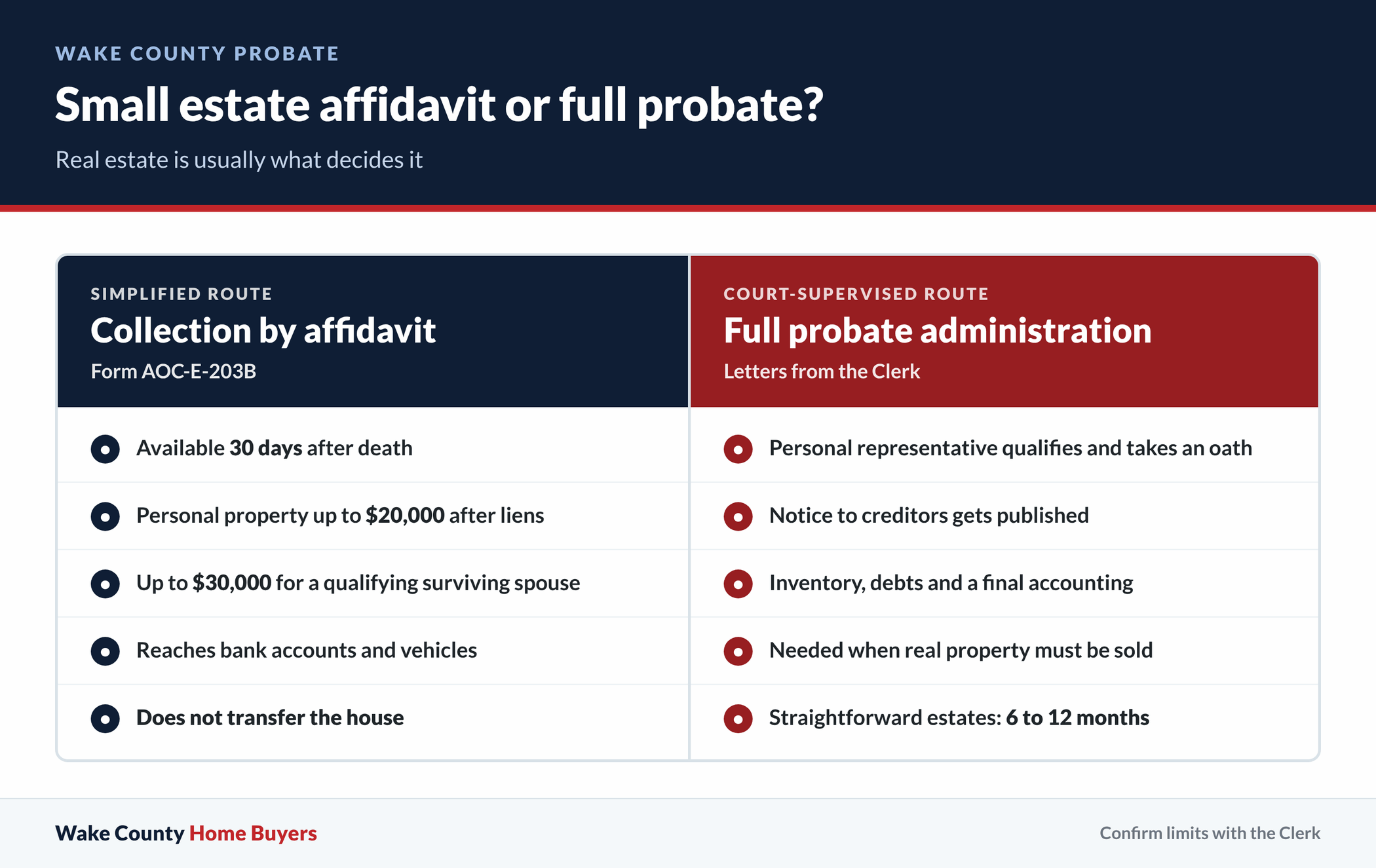
Short answer: no, not always, but real estate changes the math. North Carolina offers a simplified route called collection by affidavit for modest estates. It’s available 30 days after death when the net value of personal property sits at or below the statutory cap. The standard limit is $20,000 in personal property after liens and encumbrances. However, $30,000 becomes available when a surviving spouse fits the statute and receives all covered property.
Here’s where Raleigh families trip. No real estate is transferred by that affidavit. A paid-off bungalow in Mordecai or a 1970s ranch in Longview Gardens falls outside it completely.
Assets that pass outside probate don’t count toward anything. Life insurance with a named beneficiary, a retirement account with a listed heir, a house titled jointly with right of survivorship: those move on their own. I’ve met Raleigh families who opened a full estate they never needed because every single asset already had a beneficiary attached.
Title is one thing you should weigh more than almost anything else. If a deed to a Garner-adjacent property reads as tenants in common, the decedent’s share runs through probate. Pull the deed from the Wake County Register of Deeds before you assume either way.
When real property has to be sold to cover debts, full probate administration is almost certainly in your future. It’s worth talking to the Estates Division or an attorney before guessing. Estate filings held by the Clerk of Superior Court are public records that anyone can inspect, so you can even look at how similar Raleigh estates were handled.
What’s the Difference Between a Small Estate Affidavit and Full Probate?
Families often learn the hard way that the small estate route reaches bank accounts and a pickup truck but not the house on Trawick Road. The whole plan unravels in a single conversation with the Clerk.
You complete Form AOC-E-203B, the Affidavit for Collection of Personal Property of Decedent, file it, and collect.
Full probate administration presents a different animal entirely. The personal representative qualifies, takes an oath, receives Letters, publishes notice, inventories the estate, settles debts, and files a final accounting. Straightforward Wake County estates typically take six to twelve months, with contested or complex ones running longer.
The two differ in cost too. Wake County probate costs include court filing fees, publication for the creditor notice, possible bond premiums, appraisals, and attorney fees. Opening fees generally run in the $100 to $200 range, subject to periodic updates. Call the Estates Division at the Wake County Courthouse for the current schedule rather than trusting any article, including this one.
My opinion, for what it’s worth: families who qualify for the affidavit and still hire a full-service probate attorney are spending money they don’t need to spend. Families with Raleigh real estate who try to skip counsel usually spend more fixing the mess. Match the tool to the job.
One more probate distinction trips people up. The affidavit has a closing requirement; full probate administration has an ongoing reporting obligation to the Clerk until the estate is formally closed. Both need attention. Neither runs itself.
How Do You Open a Probate Case with the Wake County Clerk?
So you’ve decided full probate is the path. Next comes the courthouse.
Estate filings are made with the Wake County Clerk of Superior Court’s Estates Division, on the 12th floor of the Wake County Courthouse at 316 Fayetteville Street in downtown Raleigh. Downtown Raleigh parking being what it is, budget extra time. Applications to qualify as executor or administrator are filed in person. The Clerk’s office doesn’t take probate applications by mail or online. So plan an in-person visit and plan for it to take a while.
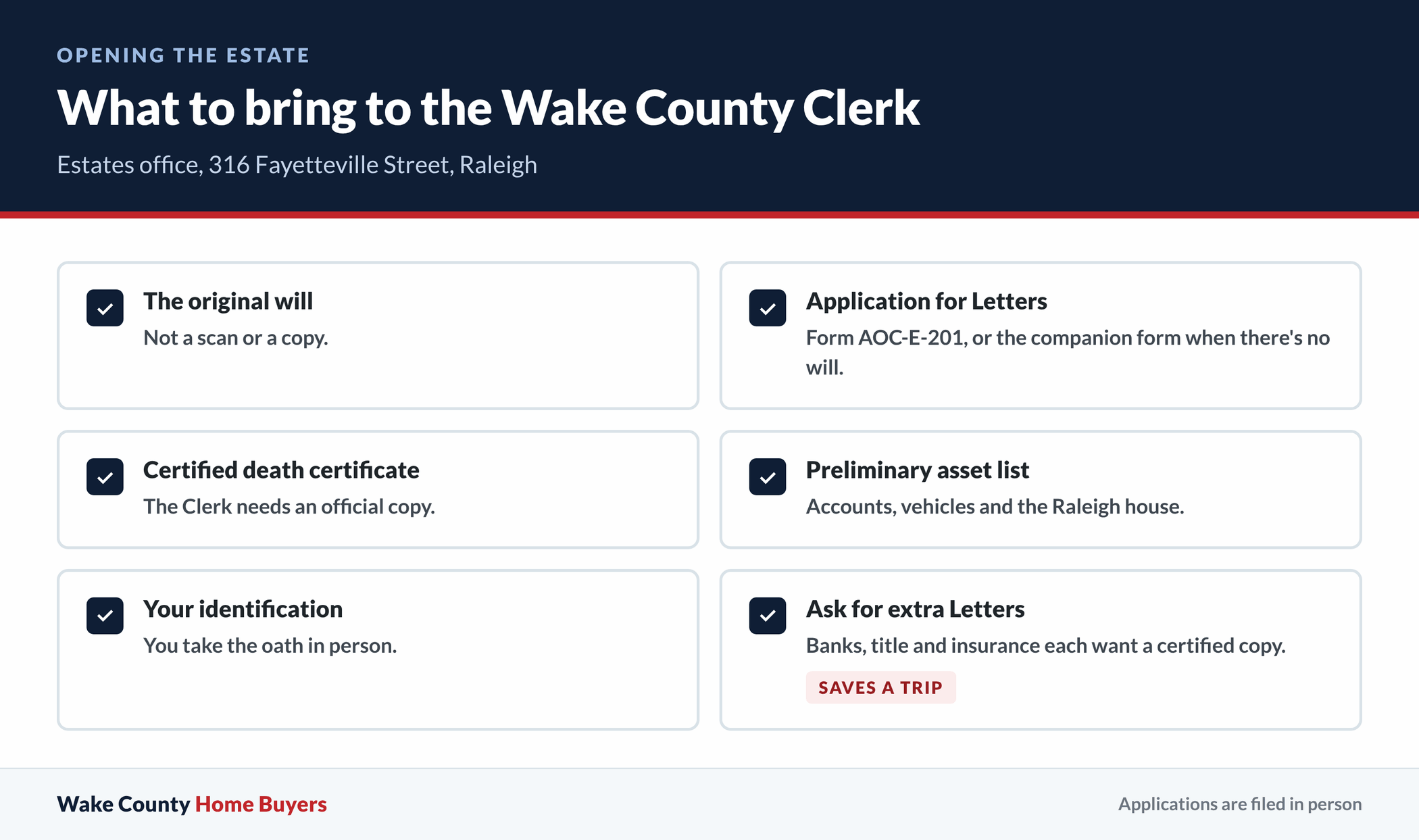
Bring the original will. Not a scan.
The primary form for opening an estate in Wake County is the Application/Petition for Probate and Letters, AOC-E-201, with a companion form used when there’s no will. You’ll also bring a certified death certificate, a preliminary list of assets, and identification. The Clerk reviews the petition, administers the oath, and issues Letters Testamentary or Letters of Administration.
Something worth knowing about this state: probate here runs through the Clerk of Superior Court rather than a judge. That makes it less adversarial than in many other states.
Ask for several certified copies of your Letters before you leave, since banks, title companies, and the insurance carrier will each want one. Going back downtown a second time for copies is an afternoon you won’t get back.
If you’ve already decided the Raleigh house is going to be sold rather than kept, mention that to your attorney at this first meeting. How the estate handles real property shapes the sequence of everything that follows.
What Happens to a House During Probate in Raleigh, NC?
Real property in North Carolina passes to the heirs or devisees at the moment of death, subject to the estate’s right to pull it back for debts. That single rule explains most of the probate confusion I hear.
Meanwhile, the bills keep coming. Hazard insurance on a vacant Raleigh house often gets cancelled or repriced once the carrier learns nobody lives there.
Our climate doesn’t do empty houses any favors. Humid Raleigh summers plus no air conditioning running equals mildew on drywall within weeks. I’ve walked probate houses in Raleigh where the only real damage came from three months of sitting closed up with the power off.
Worth saying a word about market timing. Raleigh’s median sale price was $435,000 in October 2026, with homes going under contract after a median of 47 days. Realtor.com Economic Research measured a citywide median sale price decline of roughly 2.8% year over year as of that same month. A softening market plus a long probate timeline is a combination that erodes value quietly.
Should you rent it out during probate? Usually not. A tenant in a house the estate may need to sell creates a problem you’ll pay a lawyer to unwind later.
What About Creditor Claims Against the Probate Estate?
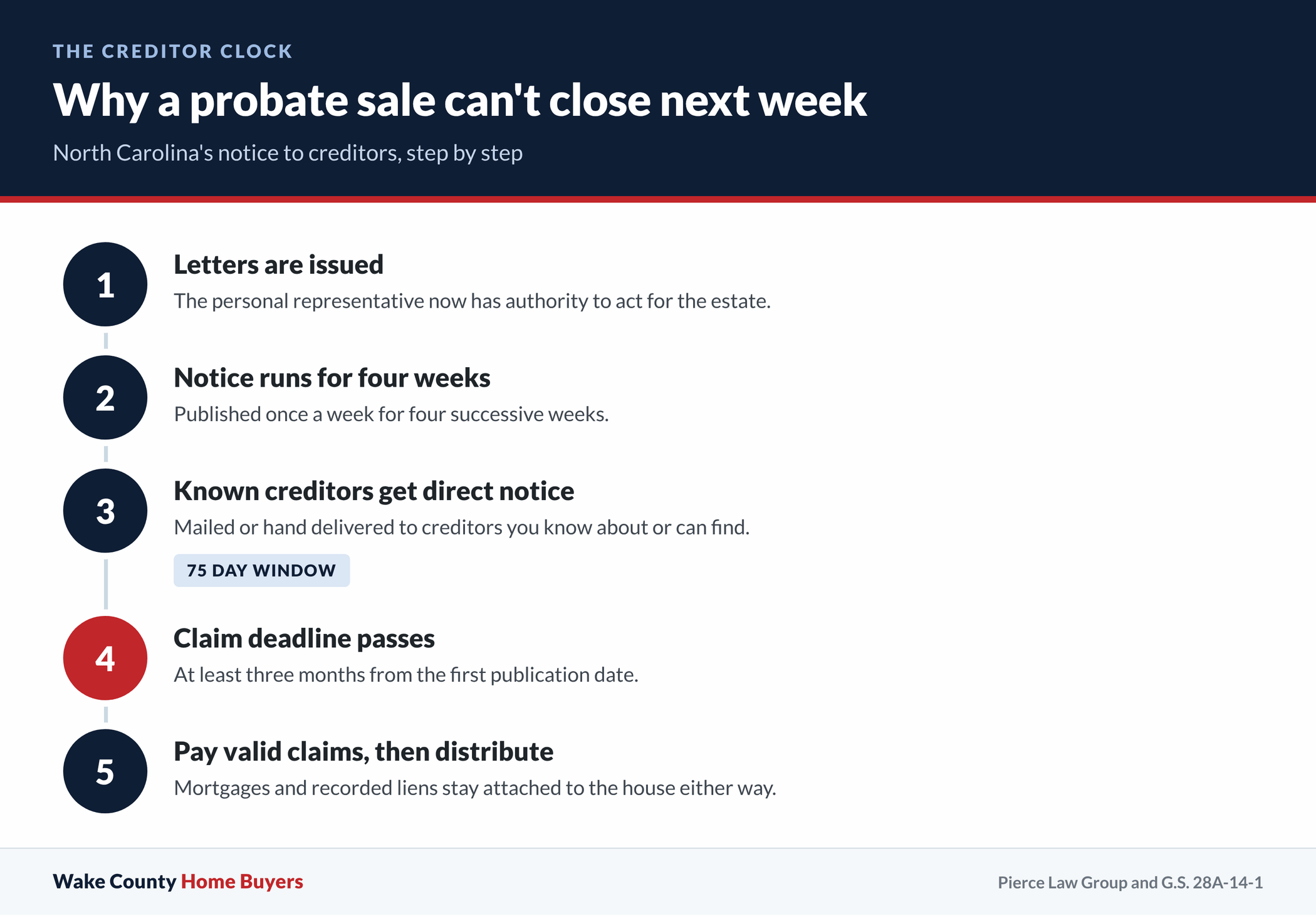
I tell sellers this across the kitchen table all the time: the notice clock is the real reason your sale can’t close next week.
Once Letters are issued, the personal representative publishes notice to creditors. This notice has to set a claim deadline at least three months from the date of first publication, running once a week for four successive weeks. The deadline is measured from the first publication rather than the last. Creditors you know about, or can reasonably find within 75 days of Letters, also get mailed or hand-delivered notice. A creditor who receives that direct notice has until the later of the published bar date or 90 days after the mailing. Pierce Law Group’s breakdown of the three-month notice period is a readable summary if you want the mechanics.
If a creditor misses the deadline, the claim is usually barred, and the personal representative can move ahead with paying valid claims and distributing the estate.
It still surprises Raleigh heirs that secured debt plays by different rules. A mortgage or a recorded lien attaches to the property itself. The non-claim bar doesn’t erase a lienholder’s right to enforce against the collateral. A missed credit card claim can vanish, yet the mortgage on a Five Points cottage stays very much alive.
Medical bills from a long illness are the ones I see swallow Raleigh probate estates. Hospital balances, rehab facility charges, and Medicaid recovery can exceed whatever equity the house holds.
Pull a credit report for the probate estate, gather the mail for a month, and give your attorney the full picture before anyone talks about distributing a dime.
Can You Sell a House Before Probate Closes in Raleigh?
Sign a contract without authority and you’ll kill the sale at closing, because the title company won’t insure it and the buyer walks with their earnest money.
Yes, probate houses in Raleigh get sold before the estate closes, and it happens all the time. What’s required is the right authority behind the signature. Sometimes the personal representative sells under power granted in the will. Sometimes a petition to sell real property goes before the Clerk. Your attorney determines which applies after reading the will and the deed.
Buyer financing is where probate sales die. A mortgage lender working on a 45-day clock has no patience for a Clerk’s approval of uncertain timing. Conventional buyers in Raleigh walk when the closing date moves twice.
That’s a real part of why cash buyers show up in probate situations, since we can wait on the Clerk without a rate lock expiring. Wake County Home Buyers has closed plenty of estate sales where the contract sat patiently while the attorney finished the court piece.
Timing math is worth doing honestly. Raleigh-area MLS data through October 2026 showed 85 days on market until sale, up from 68 days in May 2026. Stack a typical listing period on top of a 30-day financed closing and you’re well past the creditor window anyway. Selling during probate often costs you nothing in time compared with waiting.
Never hand a buyer the keys before closing, not with a lease-back and not with a storage arrangement. I’ve watched that single courtesy turn an easy Raleigh probate sale into a legal headache.
How to Sell a Probate House in Raleigh, NC
Start by establishing value honestly. An appraisal or a broker price opinion gives the Clerk, the heirs, and the IRS a defensible number for the date of death. Skip this step and you’re setting up arguments later among siblings who each have a different fantasy about what the house is worth. Then decide which sale path fits. Listing with a Raleigh agent makes sense when the house shows well, the estate has cash to cover carrying costs, and the heirs can wait. Dated kitchens, roof age, and deferred maintenance pull probate properties out of that category fast, and I’ve seen that gap turn a quick listing into a six-month slog. Raleigh homes have been selling at about 98.69% of asking price with roughly a 1.27-month supply of inventory, which means buyers here still shop condition hard.
Add up the repairs, the months of insurance and taxes during probate, the agent commission, and the price concession a buyer will demand anyway. Compare that total against a direct offer.
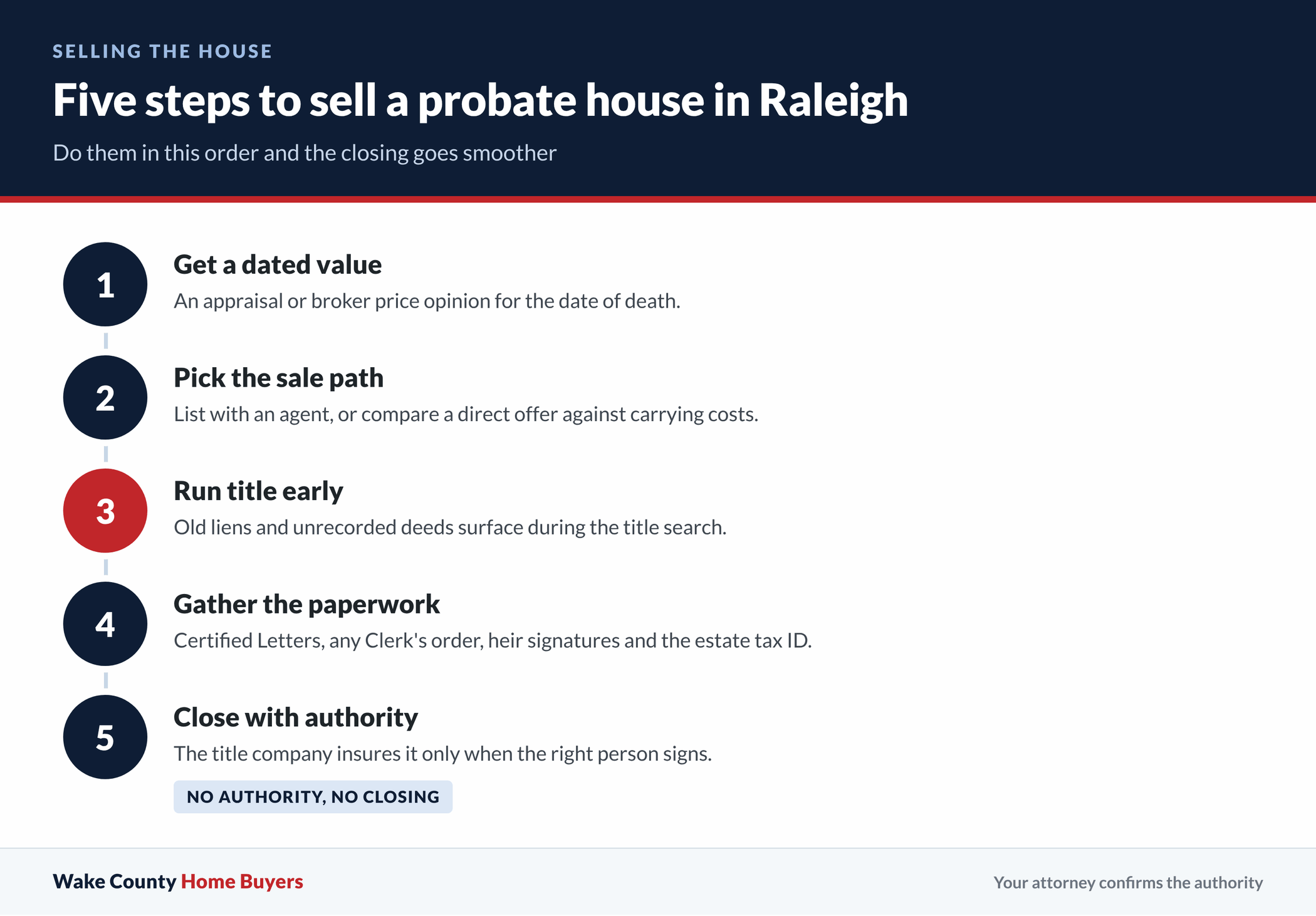
Clear the title issues early. Old liens, a surviving spouse’s interest, an unrecorded deed from the 1980s: these surface during the title search, never before. Ask your attorney to run title the same week probate opens so there’s time to cure anything ugly.
Documentation closes probate sales. Certified Letters, the Clerk’s order if one’s required, heir signatures where needed, and the estate’s tax identification number. A good closing attorney in Raleigh will give you the checklist up front.
If the numbers push you toward a direct sale, Wake County Home Buyers buys probate properties throughout Raleigh in whatever condition they’re in, including the ones full of forty years of belongings.
Frequently Asked Questions About Selling a Probate House in Raleigh, NC
What Does the Probate Process Look Like in North Carolina?
You file the original will and an application with the Clerk of Superior Court in the county where the person lived, qualify as personal representative, and receive Letters. From there you publish notice to creditors, inventory the estate, pay valid debts and taxes, and file a final accounting before the Clerk formally closes probate. North Carolina runs this through the Clerk rather than a trial judge, so it’s paperwork-driven instead of courtroom-driven. Most Raleigh families find the inventory and accounting steps more tedious than difficult.
What Mistakes Do Executors Make Most Often in Probate?
Distributing money to heirs before the creditor period ends is the big one, because the personal representative can end up personally responsible for a claim that shows up afterward. Letting homeowner’s insurance lapse on a vacant Raleigh house ranks a close second. So does treating the property as “ours already” and moving belongings out before the inventory is filed. Missing the published deadline for notifying known creditors creates problems too. Give the Clerk’s office a call or hire counsel rather than guessing on any of it.
Can an Heir Living Outside North Carolina Handle Probate on a Raleigh House?
Yes, though you should expect at least one trip to the courthouse, since the qualification step happens in person. Many out-of-state heirs hire a Raleigh probate attorney to prepare everything in advance so a single visit covers the filing, the oath, and the certified copies. Once you have Letters in hand, most of what follows can be managed remotely by mail and email.
How Long Does Probate Take Before a Raleigh House Can Be Sold?
It depends on how the title reads and whether the will grants the executor power to sell. Some heirs can sign a contract within a few weeks of receiving Letters; others need the Clerk to authorize a sale of real property, which adds time. The creditor notice period described earlier sets the practical floor for distributing proceeds, even when the sale itself closes sooner. Your attorney can usually tell you which track you’re on after reading two documents.
Will Selling an Inherited Raleigh Home Trigger a Big Tax Bill?
Usually not, because inherited property gets a stepped-up basis to its value on the date of death. Sell near that figure and there’s little or no gain to report. Appreciation between the date of death and the closing date is what gets taxed, which is another argument for getting a dated appraisal early. A Raleigh CPA who handles estates can confirm how this lands for your particular situation.
Do We Have to Clean Out the House Before Selling It?
Not if you sell to a direct buyer who takes properties as-is. Plenty of Raleigh probate houses we’ve bought still had furniture, tools, and boxes of paperwork in them at closing. Take the photos, the documents, and the handful of things that matter to your family, and leave the rest. If you’re listing with an agent instead, a full cleanout and some cosmetic work are part of the job.
What If the Heirs Disagree About Selling?
Co-owners who can’t agree sometimes end up in a partition proceeding, which is slow and expensive and rarely leaves anyone happy. Before it gets there, try a neutral appraisal so everyone argues about the same number instead of three different ones. One heir buying out the others is also an option when the financing works. Many Raleigh families find agreement comes easier once there’s an actual offer on the table rather than a hypothetical.
Probate takes longer than anyone wants, the house keeps costing money the whole time, and the decisions land on people who are also grieving. If you’ve got a Raleigh property in probate and you’d like to talk through what your realistic options look like, reach out. We’ll give you a straight answer about what the house is worth and what a sale would involve. Sometimes the right move turns out to be keeping it or listing it with an agent, and we’ll tell you that too. No pressure, no obligation, and no hard sell afterward.
Probate House Sales in Raleigh Right Now
Across the Raleigh metro, the median listing price sat at $445,000 in October 2026, according to Realtor.com data published by FRED. That number is a starting point for a probate house, not a promise, because estate homes usually need work that newer listings don’t.
Talk Through Your Raleigh Probate Sale
If you’re the executor or an heir and want a second set of eyes on the numbers, contact Wake County Home Buyers and tell us about the house. You can also use the form below, and we’ll get back to you with a clear, no-pressure answer.