
A dishwasher line let go on a Tuesday afternoon in a Garner split-level. By the time the owner got home from work, two rooms of hardwood had cupped like potato chips. She hadn’t been gone eight hours. That’s how fast water damage rearranges your plans in North Carolina, whether the source is a hurricane pushing up the Neuse or a supply line nobody thought about. Selling a house with water damage in North Carolina isn’t a dead end. It’s a different path with different math, and the sooner you know which path you’re on, the more money you keep.
How Bad Is the Water Damage to Your North Carolina House?
Most sellers guess the damage at about half of what it really is, and the drywall is why.
Water travels sideways behind walls, wicks up studs and pools under subfloor before a single stain shows in your living room. Only a moisture meter tells you the truth your eyes can’t. Restoration crews across the state will read your walls for free or close to it. That reading is the most useful number you can get before you decide anything about selling.
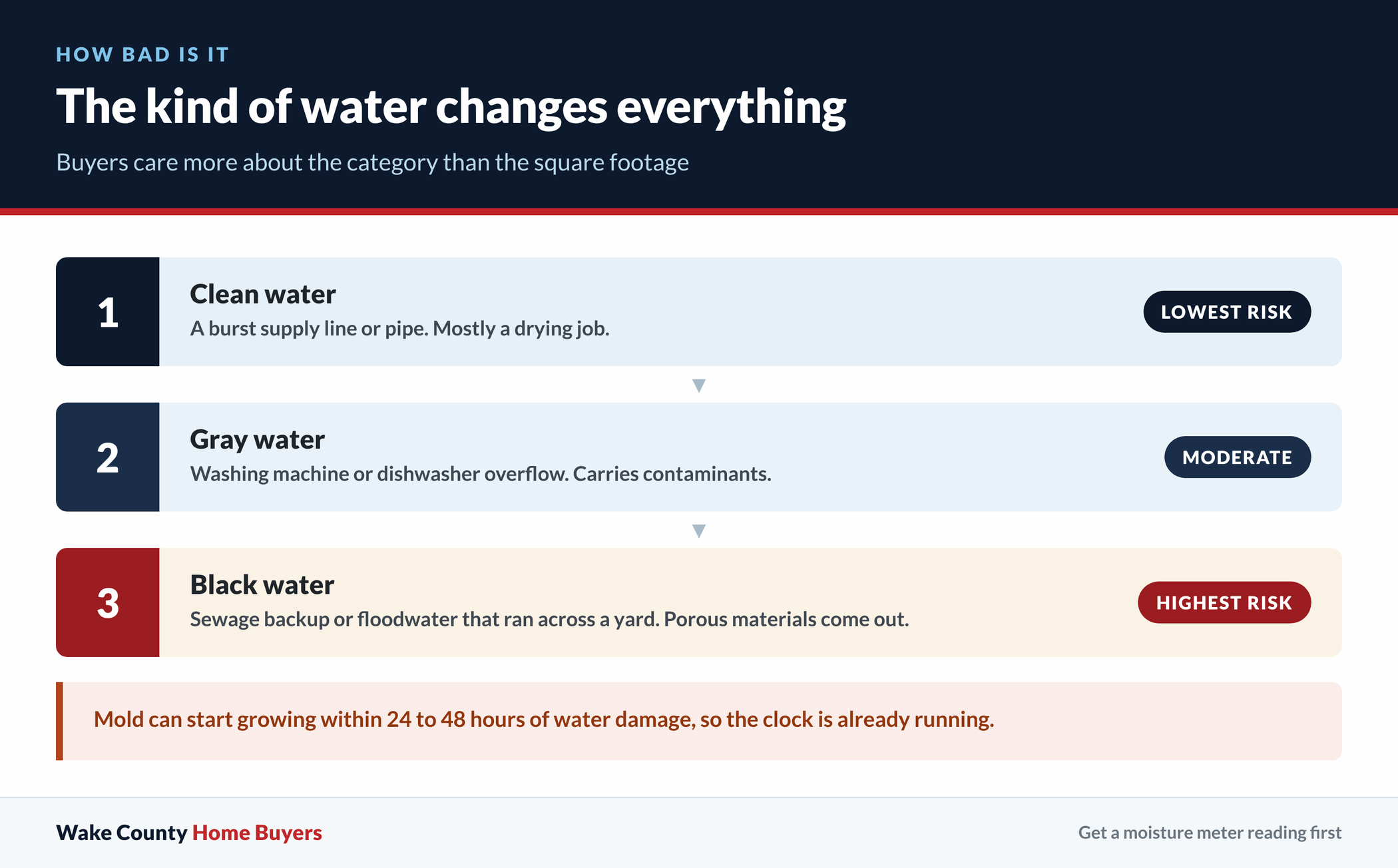
What kind of water it was matters more to buyers than square footage. Clean water from a burst pipe is a drying job, while gray water from a washing machine or dishwasher carries contaminants. Black water, meaning sewage backup or floodwater that ran across a yard, means tearing out porous materials. Mold can start growing within 24 to 48 hours of water damage, so the clock is already running.
Half the houses I walk in the Triangle have crawl spaces, and that’s where the real story lives. Think standing water, rusted ductwork and sagging insulation, plus a musty smell that hits you before your flashlight does. Coastal homes from Wilmington down to Southport face a different version, because raised foundations take on flood events that leave silt lines on the piers.
A couple of years ago I sat at a kitchen table in Fuquay-Varina with a family. Their slow roof leak had turned into a ceiling collapse over the back bedroom. I still remember the smell of damp drywall in that house. The garage was stacked floor to rafters with the furniture they’d pulled out of that room. We bought it as it stood, and they never had to open a wall.
Severity drives every other choice in this article, and guessing at it is how sellers lose money on water damage.
Will Insurance Cover Water Damage Before You Sell Your House?
Use that reading to decide whether you even have a claim worth filing. Sudden and accidental is the phrase your adjuster cares about. Most pipes that burst overnight get covered.
Flooding is its own universe. Standard homeowners insurance in the state doesn’t cover flood damage, which surprises people every hurricane season. Flood needs a separate policy through the National Flood Insurance Program or a private carrier. North Carolina had 128,151 active NFIP policies as of August 31, 2026, based on FEMA data compiled by MoneyGeek. Those cover only about 2.6% of homes in the state, and most of those policies sit in coastal counties.
Sewer and drain backup sits in a third category. It usually needs an endorsement your policy may or may not include.
My unpopular opinion on insurance claims: filing one right before you sell can work against you. A paid claim lands in the CLUE report, and the next buyer’s insurance agency sees it when they quote the property. I’ve watched this trip up sellers who didn’t know a small claim would follow the house. If the payout is modest and the repair is cosmetic, you may be better off handling it yourself and keeping the claim history clean.
Keep photos of the source and the damage, the restoration invoice, and the mold clearance letter if you got one. Buyers here trust paperwork more than a seller’s word that the water damage got fixed properly.
How Much Does Water Damage Lower Your Home’s Value in North Carolina?
What’s the hit going to be?
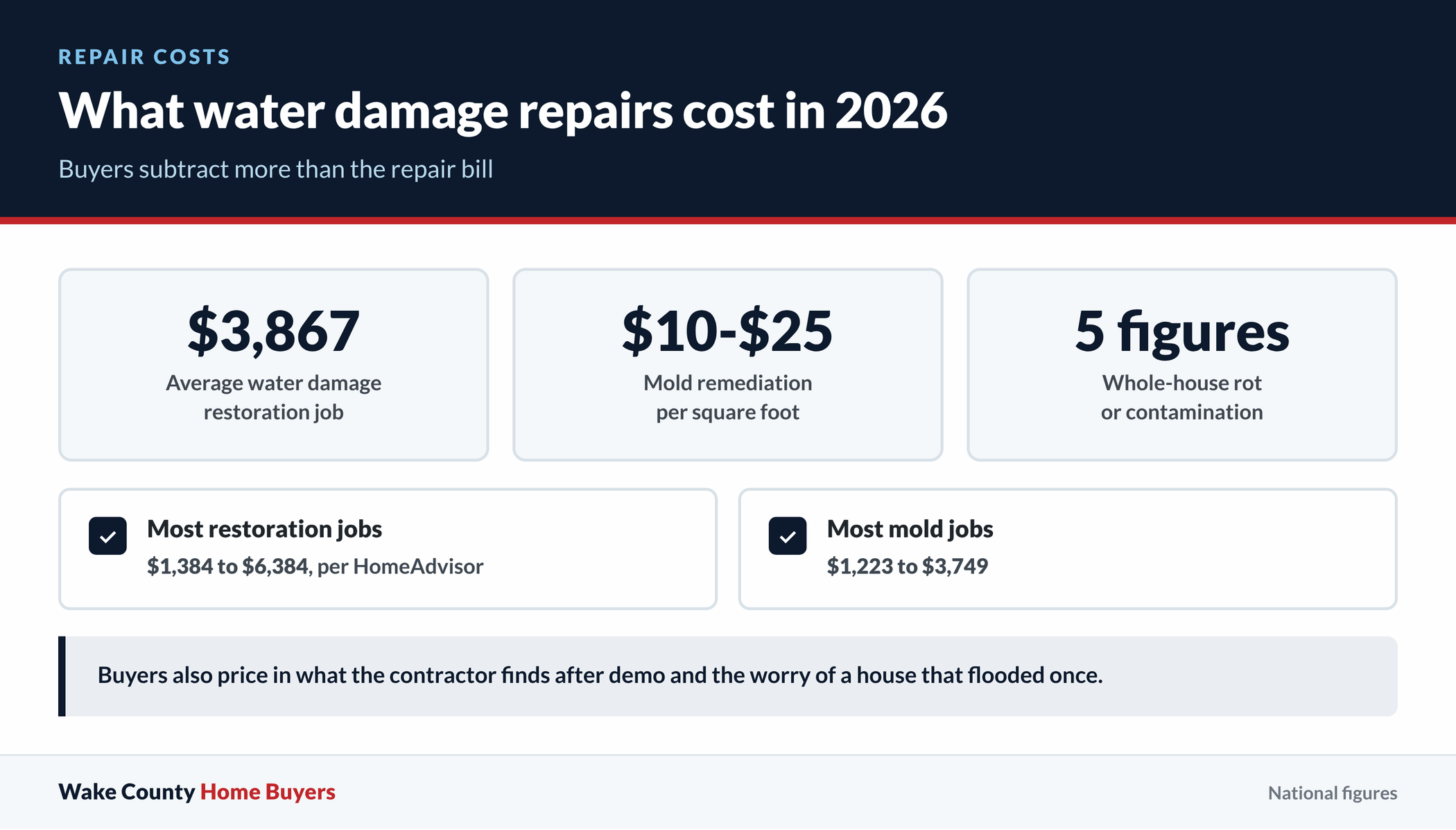
Buyers knock off more than the repair bill for water damage, and that gap is where sellers get frustrated. Someone looking at your house isn’t subtracting a contractor’s estimate. They’re subtracting the estimate, plus a cushion for what the contractor finds after demo, plus a markdown for the worry of living in a house that flooded once.
Start with what the repair would cost. HomeAdvisor puts most water damage restoration jobs in 2026 between $1,384 and $6,384, with a national average around $3,867. Professional mold remediation generally costs $10 to $25 per square foot, and most jobs land between $1,223 and $3,749. Whole-house contamination or structural rot runs into five figures without much trouble.
Now layer on market conditions. The Wake County Register of Deeds put the county’s median sale at $440,000 in August 2026, down $18,500 from July. A cooling market gives buyers leverage, and water damage hands them a script.
Disclosed, unrepaired water damage in North Carolina tends to pull offers down more than the comparative market analysis says it should. I’ve seen buyers price it at close to double the repair bill. The fair middle depends on how recent the damage is and whether a licensed company signed off on the dry-out.
Severity, paperwork and your spot on the flood map drive the discount. A one-time dishwasher leak in Cary reads nothing like repeat flooding in a Special Flood Hazard Area near the Cape Fear.
What Must You Disclose When Selling a Water-Damaged Home in North Carolina?
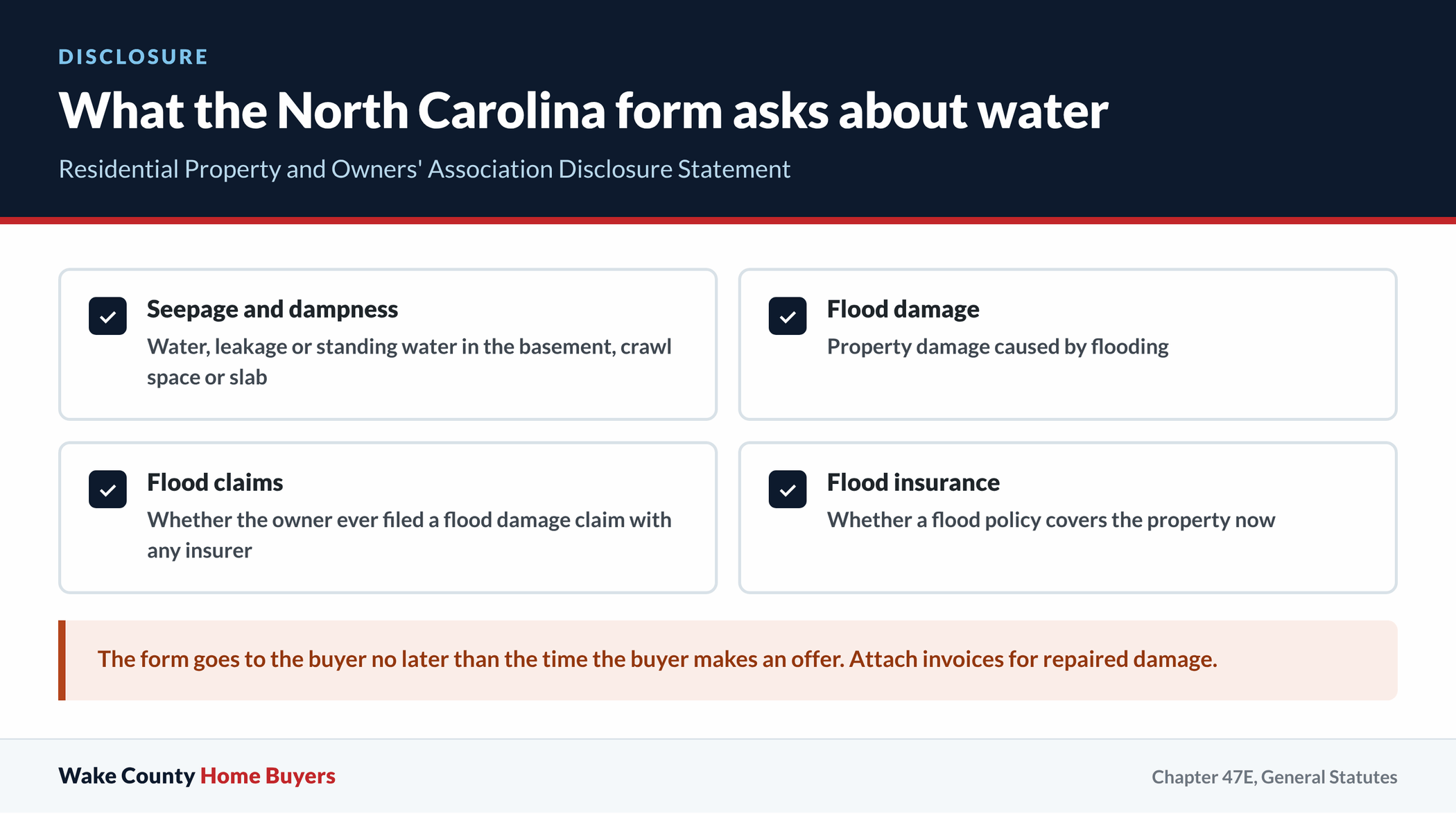
State law sets the paperwork. North Carolina sellers complete the Residential Property and Owners’ Association Disclosure Statement, a form the Real Estate Commission writes and requires under Chapter 47E of the General Statutes. The statute says an owner must give that disclosure statement to a buyer. Sellers either disclose what they know about or state that they make no representations.
Water questions run all through that form. One asks whether there’s water seepage, leakage, dampness or standing water in the basement, crawl space or slab.
Flood history joined the form more recently. Current questions ask about property damage caused by flooding and whether the owner ever filed a flood damage claim with any insurance provider. Another asks whether a flood insurance policy covers the property now. The administrative rule behind the form lists every category it has to cover.
Timing counts too. The disclosure statements this chapter requires go to the buyer no later than the time the buyer makes an offer.
For minor, fully repaired water damage, I’d rather disclose plainly and attach the invoice. An attorney licensed here can help with the exact wording for your situation, and that talk costs far less than the alternative.
Should You Repair Water Damage Before Listing or Sell As-is?
A landlord in Clayton spent a whole spring and most of his savings replacing subfloor and two bathrooms after a tenant’s overflow. Then the buyer’s inspector found wet framing he never knew about.
Repairs make financial sense when the damage is contained, recent and cosmetic. New flooring and fresh paint over properly dried framing can pay for themselves on the open market. Still, a half-fixed house is worse than an honestly broken one. The buyer’s inspector finds the seam between the new work and the old, and then everything you did gets questioned.
Selling as-is makes sense when the scope keeps growing, when you can’t finance the work, or when timing is the limit. Think estate situations, divorces, job moves or a pending foreclosure.
Run the numbers honestly. Say a contractor quotes you fifteen thousand for water damage repair and the as-is offer gap is twelve thousand. You’re paying three thousand dollars plus months of carrying costs for the privilege of doing the work yourself. Not a close call.
One pattern I keep seeing across the state: sellers start repairs and run out of money halfway. They end up selling a torn-apart house for less than they’d have gotten before the first demo day. Finish or don’t start.
Mold is the fork in the road. Visible mold growth scares regular buyers and their lenders, and remediation has to be done by a qualified company with paperwork at the end. Our team at Wake County Home Buyers buys houses in exactly that condition. That way you have a real number to compare against your contractor’s bid before you commit either way.
What Are Your Options for Selling a Water-Damaged House in North Carolina?
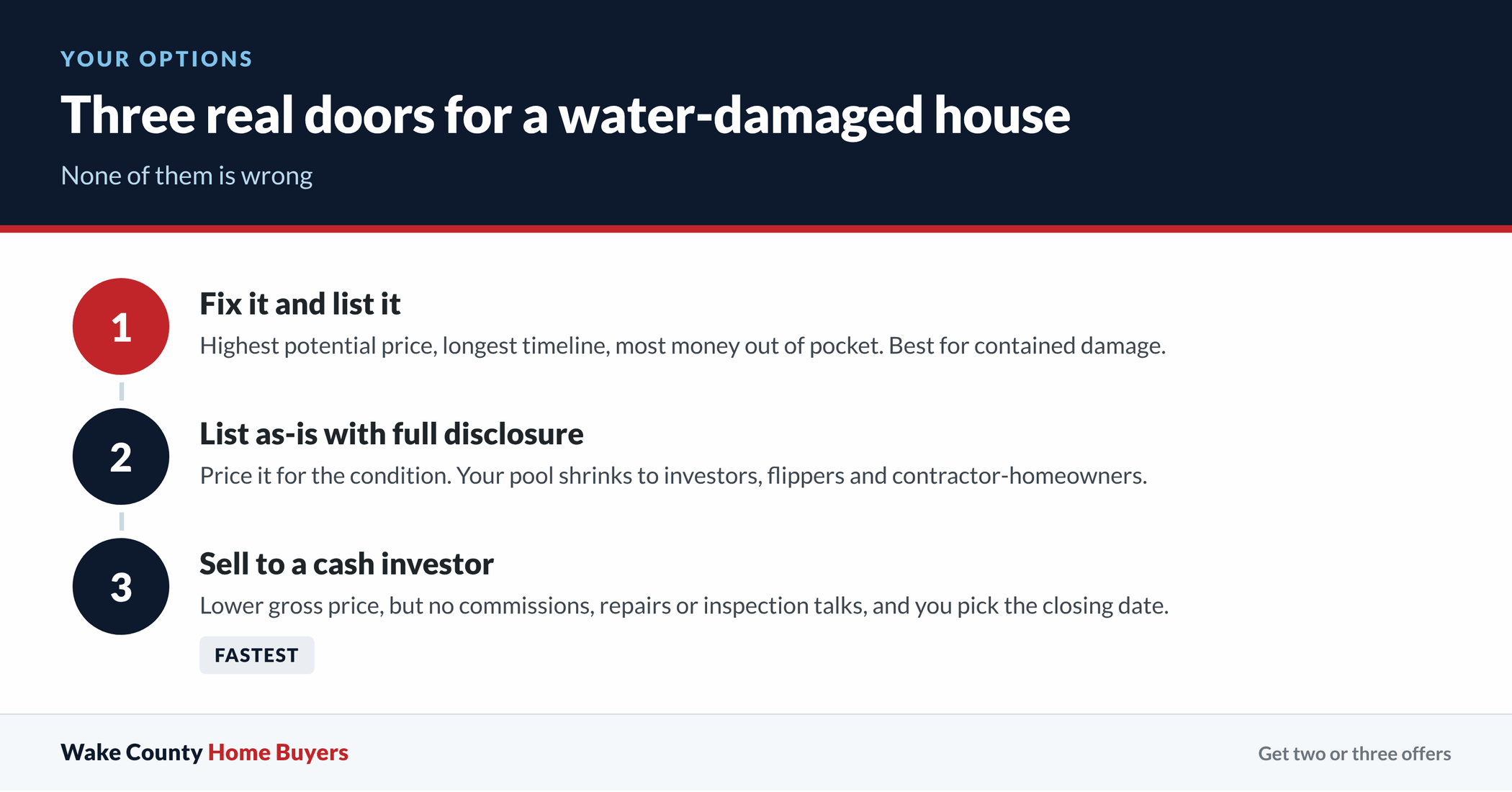
You’ve got three real doors here, and none of them is wrong.
Door one is to fix it and list it. You get the highest potential price, the longest timeline and the most money out of pocket up front. It works well for contained water damage in a desirable area. Listing agent commission in North Carolina averages around 2.79%, with buyer’s agent commission near 2.81%, so budget for both sides plus closing costs.
The second door is to list as-is with full disclosure and price it for the condition. Your pool shrinks to investors, flippers and the occasional contractor-homeowner.
Third door: sell directly to a cash investor. You get a lower gross price, but no commissions, no repairs, no inspection negotiations and a closing date you choose.
So ask yourself one question. Can you afford the repairs and the wait? If the answer is yes and the damage is modest, list it. When the answer is no, stop pricing repairs and start pricing speed.
Auction is a fourth option on paper, though I rarely recommend it for water-damaged property.
A note on iBuyers: most algorithm-driven buyers either won’t quote a house with water damage or will quote it and then gut the offer after inspection. For that reason I’d rather see investors who’ve walked the place. Local investors who see the property in person give you a number that holds up in this market. Get two or three offers before you accept any of them, including one from a company that buys water damage houses regularly.
How Do Cash Buyers Handle Water-Damaged Properties in North Carolina?
Accept the wrong cash offer and you’ll find out at day twenty-five that it was never a cash offer at all. By then your other prospects have moved on.
Real cash buyers walk the house themselves, often with a contractor, and they price from their own repair numbers instead of a desktop estimate. A serious buyer of water damage property in North Carolina already knows what crawl space encapsulation costs in Johnston County. They know what full mold remediation runs in a 1960s Raleigh ranch too.
Watch for the assignment play. Some “buyers” put your house under contract, then shop that contract to real investors. If nobody bites, they renegotiate or vanish. Ask directly whether they’re closing in their own name.
Pricing works backward from after-repair value. First the buyer estimates what the house sells for restored, subtracts the repair budget, subtracts holding and selling costs, then subtracts a profit margin. What’s left is your offer. Good buyers will walk you through those four numbers if you ask, and if they won’t, that’s worth noticing. At Wake County Home Buyers, we handle water damage properties across the region and we’ll explain the math behind an offer instead of just handing you a figure.
Inspection contingencies separate the serious from the rest. If a buyer’s contract gives them unlimited inspection rights and an easy exit, you’re holding a free option, not a sale.
Closing costs are negotiable and often paid by the buyer. Our state uses attorneys for real estate closings, so you’ll sit down with a licensed closing attorney no matter who buys your house with water damage.
How Fast Can You Sell a Flooded or Water-Damaged Home in North Carolina?
Attorney-handled closings and title searches set the real floor on speed. The floor is usually a week or two even when the buyer has cash in the bank. No investor closes a North Carolina property in forty-eight hours, whatever the billboard says.
Compare that to the listing timeline. Median days on market statewide hit 71 in October 2026, according to Realtor.com data tracked by the St. Louis Fed. You can review that series on the FRED database. Add thirty to forty-five days for a financed buyer’s closing and you’re looking at three and a half months from list to funds. Water damage stretches that further, because the first contract tends to fall apart at inspection.
Cash timelines run differently. Title search, attorney prep and deed recording are the only hard steps. Two to three weeks is realistic for most water damage sales in North Carolina. Probate, liens or an unreleased mortgage from 1998 can add time, and heir property adds the most.
What speeds things up on your end? Put the deed, the latest tax bill, your mortgage payoff contact and the restoration paperwork in one folder before anyone makes an offer.
An heir settling her father’s estate in Wendell called me after two agent listings had expired back to back with zero offers. The house had taken on water through a failed roof valley years earlier, and nobody had touched the stained ceilings. Her father’s workbench and a half-finished canoe were still in the garage. We closed without her climbing a single ladder.
Frequently Asked Questions About Selling a Water-Damaged House in North Carolina
Do I Have to Tell Buyers About Water Damage That I Already Repaired?
Yes, if you know about it. The state disclosure form asks about past damage and past flood insurance claims, not just current problems, so a repaired leak still belongs on the form. Attach the restoration invoice and any mold clearance papers. Disclosed-and-documented reads far better to a buyer than discovered-at-inspection.
Can I Sell a House in North Carolina with Active Mold?
You can. Regular and government-backed lenders will likely balk, which shrinks your buyer pool to cash buyers and renovation-loan borrowers. Price the house for the condition, disclose what you know, and expect offers that account for remediation plus the unknowns behind the walls.
Will a Buyer’s Lender Reject My Home Because of Water Damage?
It happens a lot. Appraisers note active water intrusion and visible mold, and underwriters frequently require repairs before funding. It’s the biggest reason water-damaged listings fall out of contract here, and it’s why sellers in that spot end up at the cash-buyer table anyway.
Is It Worth Filing an Insurance Claim If I’m Selling Soon?
The size of the loss decides it. A large, clearly sudden event is worth claiming. Smaller ones may cost you more in claim history than they return in payout, since future buyers’ insurers review that record when quoting the property.
How Do I Price a Water-Damaged House in North Carolina?
Start with recent sales of similar homes in your neighborhood, then subtract a contractor’s written repair estimate plus a cushion for hidden damage. Ask a local agent for a comparative market analysis and a cash buyer for an as-is offer. Then compare the two net numbers after commissions and carrying costs. The gap between them is your real decision.
Does Water Damage Have to Be Repaired Before Closing?
Not for a cash sale. Any buyer taking the house as-is accepts it in its current condition, and nothing in the state’s disclosure rules makes you fix what you disclose. Financed sales are a different story, since the lender, not the buyer, usually sets that requirement.
Water-Damaged House Sales in Raleigh, North Carolina
Most of the water-damaged houses we buy sit in Raleigh and the towns around it. Realtor.com data on FRED had Wake County listings at a median of 61 days on market in October 2026, and that’s for houses buyers can finance. Homeowners in the area can talk to cash home buyers in Raleigh who walk the property themselves.
Get a Straight Answer on Your North Carolina Water Damage
If you’re staring at a water-damaged house and trying to figure out whether to fix it, list it or let it go, I’m glad to walk through the numbers with you. Bring your contractor’s estimate if you have one, or bring nothing if you don’t. We’ll talk it through, you’ll get a straight answer about what your house is worth in both directions, and you can decide on your own timeline. No pressure, no obligation. When you’re ready, reach out to our team or fill out the form below.