A tax bill doesn’t lock your front door. Owing back taxes in North Carolina doesn’t strip you of the right to sign a deed, and it doesn’t freeze your ability to find a buyer. What it does is add a line item to your closing statement and a clock to your decision making. I’ve bought houses from Rocky Mount to Hendersonville where unpaid property tax was sitting on the parcel, and almost every one of them closed without drama. The sellers who got hurt were the ones who waited.
What Happens If You Don’t Pay Back Taxes on a North Carolina House?
“How long before they take it?”
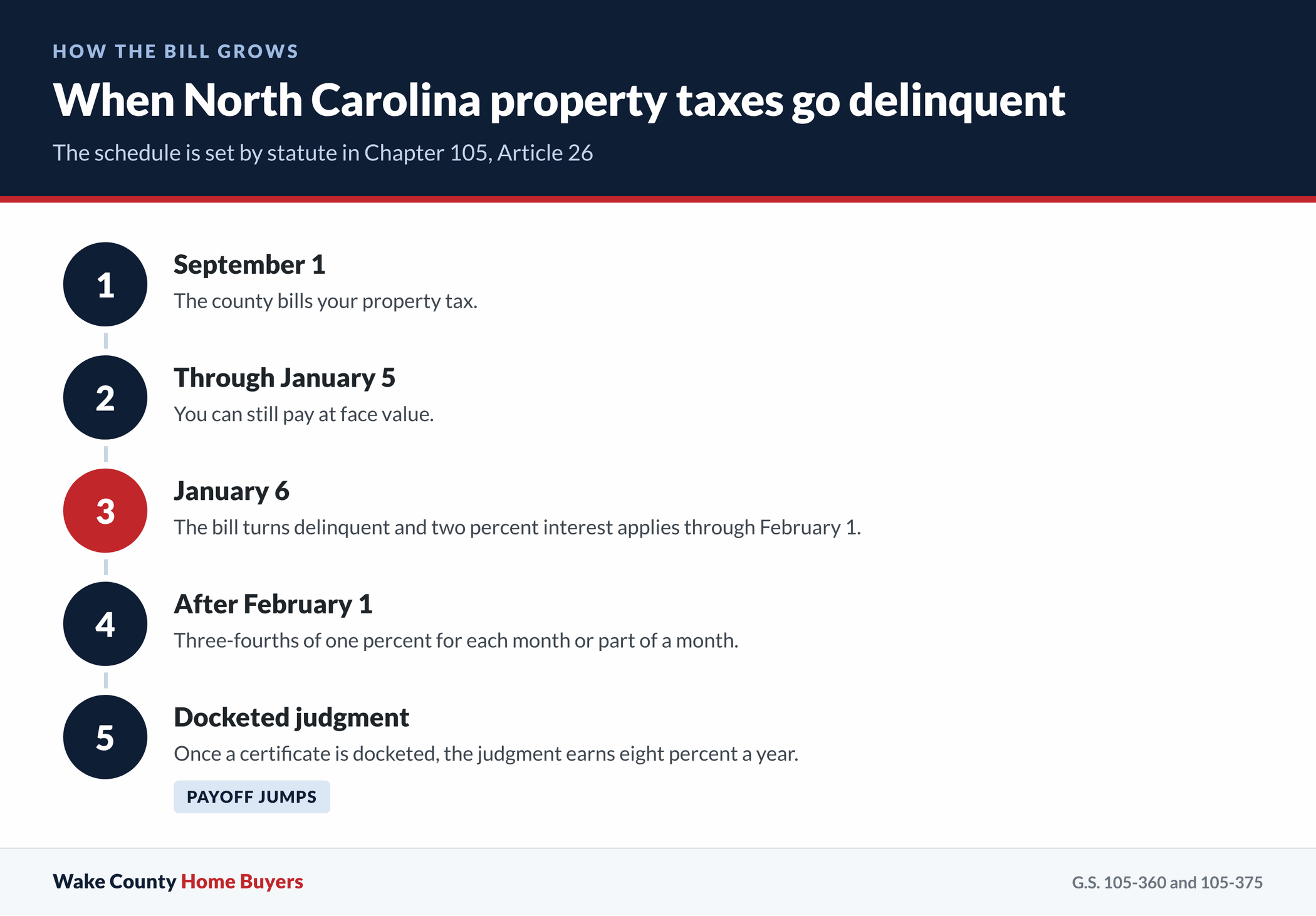
The question I get most, usually in a voice that’s been rehearsing it for weeks. North Carolina bills property tax on September 1, and you can pay at face value right up through January 5. On January 6 the bill turns delinquent and interest starts at two percent for the period January 6 to February 1. Then three-fourths of one percent applies for each month or fraction of a month after that until the back taxes, accrued interest, and any penalties are paid. That rate is set by statute and you can read it yourself in Article 26 of Chapter 105.
Money isn’t the only cost, though. Time is.
Counties don’t all move at the same speed. Many of the state’s counties wait until an account runs one to three years behind before they file a tax foreclosure. Each county makes that choice, and it isn’t a rule you can count on. Your collector can pursue other remedies well before that. Once a foreclosure actually starts, the county has two routes, and they don’t run on identical timelines.
Something worth sitting with: a property tax lien outranks almost everything else recorded against your house. These liens generally take priority over other liens, including mortgages and deeds of trust, so lenders pay close attention to them. A mortgage servicer sometimes pays the delinquent bill itself for this reason and then bills you for it, which turns a county problem into a mortgage default problem overnight.
Early last year I bought a rental from a longtime landlord in Kannapolis who was three months behind on his mortgage, with a foreclosure auction date already on the calendar. He’d been holding that duplex since the mills were still running, and the back taxes had stacked up quietly underneath the mortgage mess. We closed before the sale date, paid both off at the table, and he walked away with money instead of a judgment.
Can You Sell a House with Back Taxes Owed in North Carolina?
No statute in this state blocks the sale. You keep every right you had before the bill went unpaid, including the right to list it, auction it, or hand the deed to a cash buyer on a Tuesday afternoon.
The practical mechanics are simple. Your closing attorney orders a tax certification from the county. On the settlement statement the delinquent amount shows up as a payoff on the settlement statement, and the proceeds clear it before anything reaches your pocket. North Carolina closings run through attorneys rather than title companies, so a decent one handles delinquent tax payoffs weekly.
Where this gets uncomfortable is equity. Owe more in combined mortgage, back taxes, and liens than the house will bring, and somebody has to cover the gap.
Does the market give you room to work? For the most part. Over the three months ending October 2026, Wake County homes sold at a median of $459K, down 4.1% year over year. They spent an average of 50 days on the market compared to 46 a year earlier. Statewide the pace is slower: Realtor.com data compiled by the St. Louis Fed put North Carolina’s median days on market at 71 in October 2026, up from 58 in June.
Add a month and a half of escrow to a seventy-day marketing window and you’re looking at four months minimum.
One correction I’d offer to common advice: paying off the back taxes before you list isn’t automatically smart. If you’re selling anyway, that money does the same job at closing, and draining your savings to clear a county bill leaves you with nothing for a deposit on the next place.
How Much Back Taxes Are Owed on Your North Carolina Property?
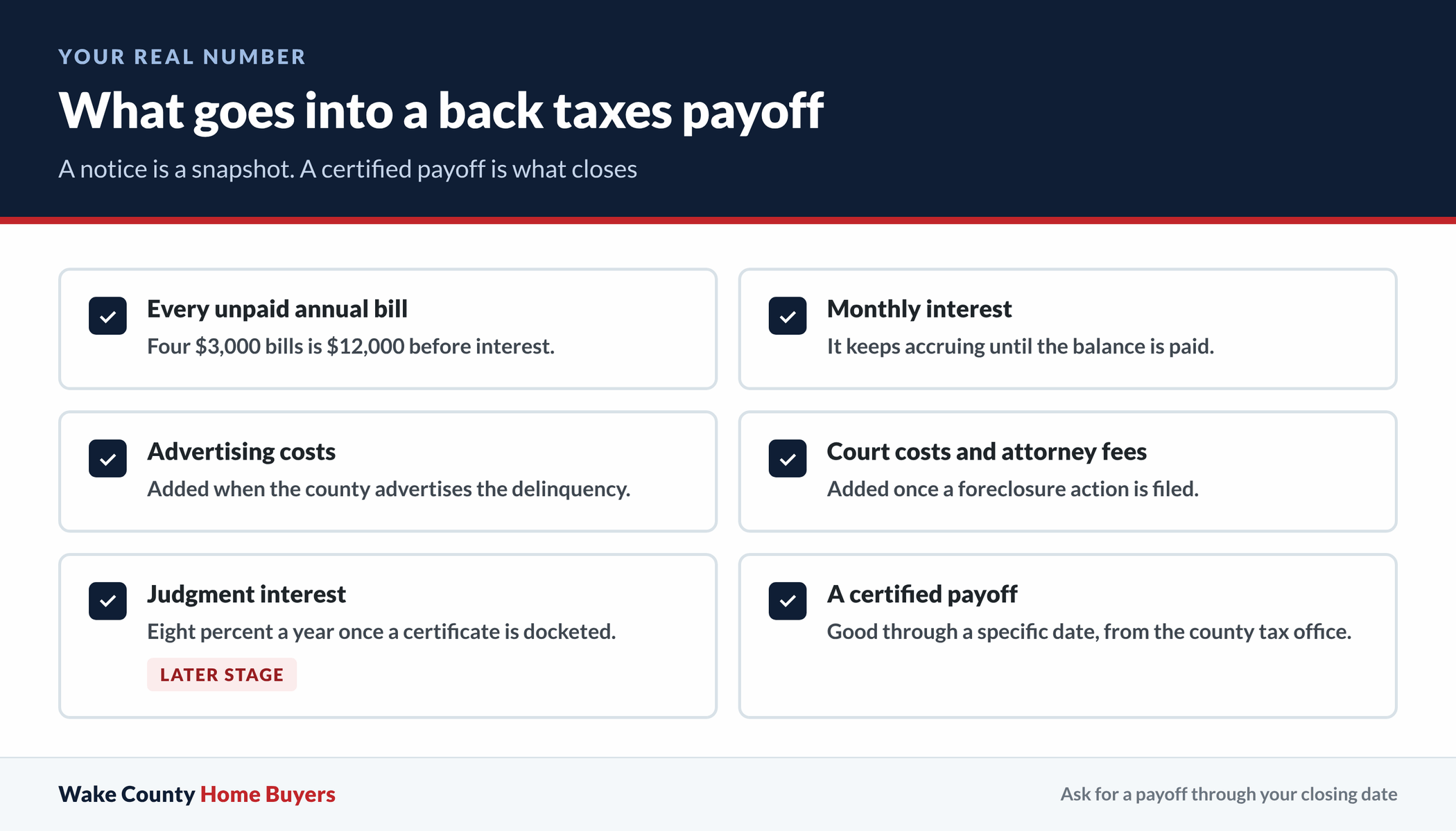
You might be thinking the county already told you, because a letter showed up. That letter’s a snapshot, not a payoff. Interest keeps being added every month the balance sits, so a notice printed in March understates what you’ll owe in July. The figure a closing attorney needs is a certified payoff good through a specific date.
Call your county tax office directly and ask for a payoff figure through your anticipated closing date. Wake, Mecklenburg, Guilford, Buncombe, New Hanover: every one of them can produce this, usually same day.
Gather the full picture while you’re at it, because back taxes rarely travel alone. Multiple years of unpaid bills, accrued interest, advertising costs, and attorney fees if a foreclosure action has already been filed all land in the same payoff. Once a tax foreclosure complaint is filed, the county can no longer levy on or attach your personal property for those same taxes.
Here’s the shape of it in one scenario. Four separate annual bills of $3,000 each means $12,000 in principal before a dollar of interest. Layer on the monthly interest for the years each bill has been sitting, add court costs if a case is open, and that’s your floor rather than your ceiling.
Has a judgment already been docketed in your case? Once the county dockets a certificate, the back taxes and everything added to them turn into a judgment against the property, and that judgment earns interest at eight percent a year. That’s a different number than the monthly rate, applied at a different stage, and it’s why the exact posture of your case changes your payoff more than any estimate off a website.
What to Gather Before You Sell a House with Back Taxes in North Carolina
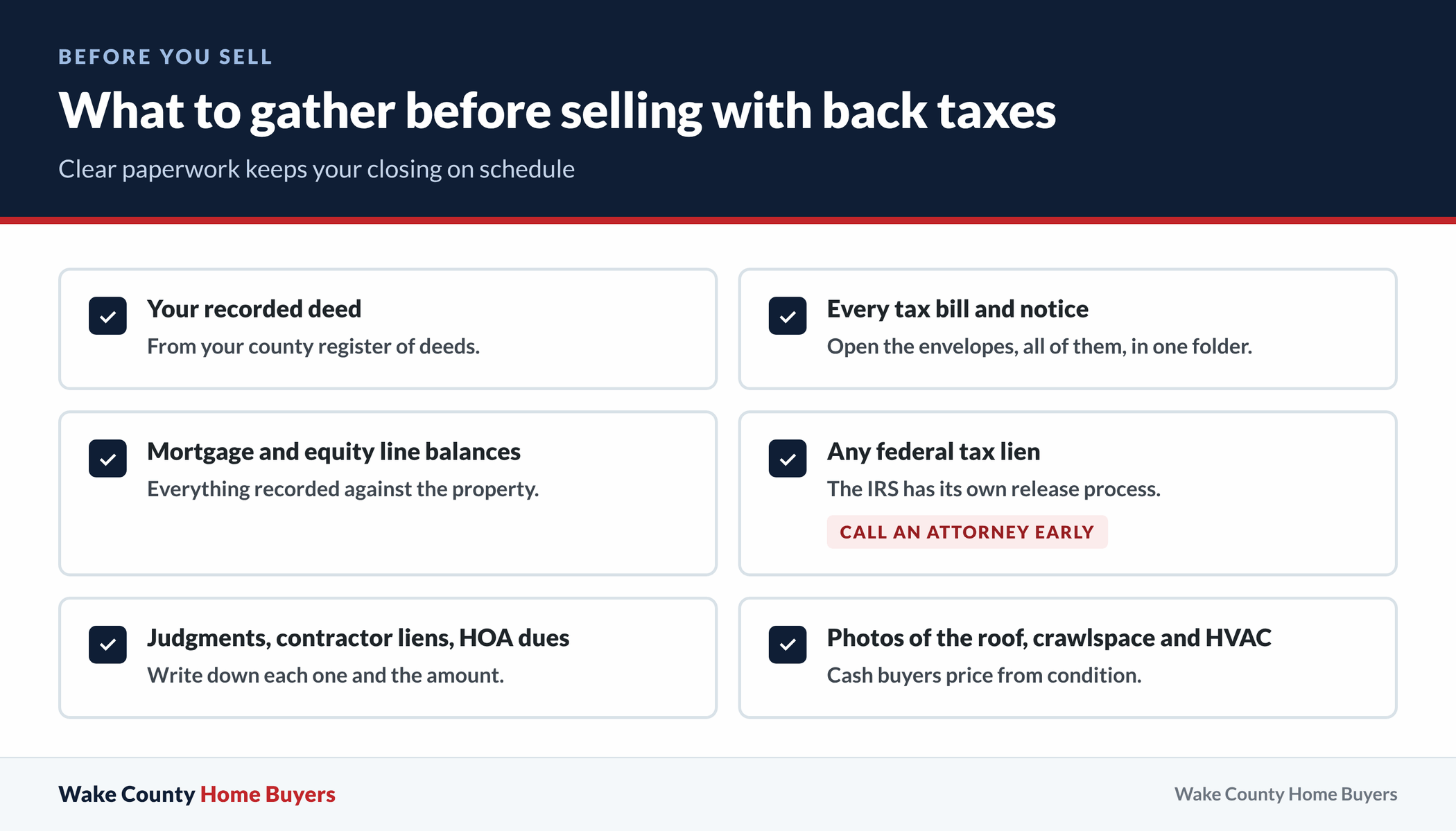
Pull your deed first. Not the mortgage, the deed: the recorded instrument showing who owns the property and how title is held. Your county register of deeds keeps these, and most North Carolina counties have them searchable online at no cost. I’ve had closings stall for weeks over this exact issue: if the house came through an estate and probate administration was never completed, the heirs may not have clean title yet. This slows a closing considerably.
Then the tax bills. Every year, every notice, every certified letter from the county, in one folder.
A seller in Greensboro once handed me a shoebox with four years of unopened envelopes. We sorted it on her kitchen counter, and two of those envelopes were the thirty-day notice the collector had mailed. She hadn’t known a case was pending. Open your mail, even the mail you’re dreading.
Beyond the county debt, write down everything else recorded against the real property: mortgage balance, home equity line, any federal tax lien from the IRS, judgments from creditors, contractor liens, HOA assessments. A federal tax lien isn’t handled the same way a county tax lien is at closing, and the IRS has its own process for releasing or subordinating one. When a federal tax lien exists, loop in an attorney early rather than discovering it a week before closing.
Cash buyers price from condition, and clear pictures of the roof, the crawlspace, and the HVAC mean you get a real number instead of a lowball placeholder.
Start with the Address of Your North Carolina House with Back Taxes Owed
Every meaningful number attached to your situation keys off the parcel, not your name. Tax account, assessed value, lien history, zip code comps: all of it starts with the street address and parcel identification number.
Look the parcel up in your county’s online tax records. There you’ll see the assessed value, the tax rate applied, current and prior year balances, and usually a flag if the account is in a foreclosure queue.
Value varies hard across North Carolina. The same back taxes balance can mean something completely different depending on where the house sits. Durham’s median sale price over the three months ending October 2026 was $425K, down 1.2% from a year earlier, with homes averaging 49 days on market versus 40 the year before. Drive ninety minutes east toward Wilson or Goldsboro and both the prices and the buyer pool change shape completely.
A $9,000 delinquent balance against a Cary house with plenty of equity is an inconvenience. The same balance against a mobile home on half an acre outside Lumberton can swallow the whole sale.
Once you know the address, the assessed value, and the payoff, you can calculate something useful: your actual net. Subtract the mortgage, the back taxes, the excise tax, and estimated closing costs from a realistic sale price. This one number tells you if you’re choosing between options or racing a deadline.
Wake County Home Buyers runs this math for free on any North Carolina property, including the ones outside Wake County. You’re welcome to use it as a sanity check even if you ultimately list with an agent.
Is a Cash Sale the Right Fit for Your North Carolina Back Taxes Situation?
If your county has already docketed a judgment, a traditional listing is probably too slow.
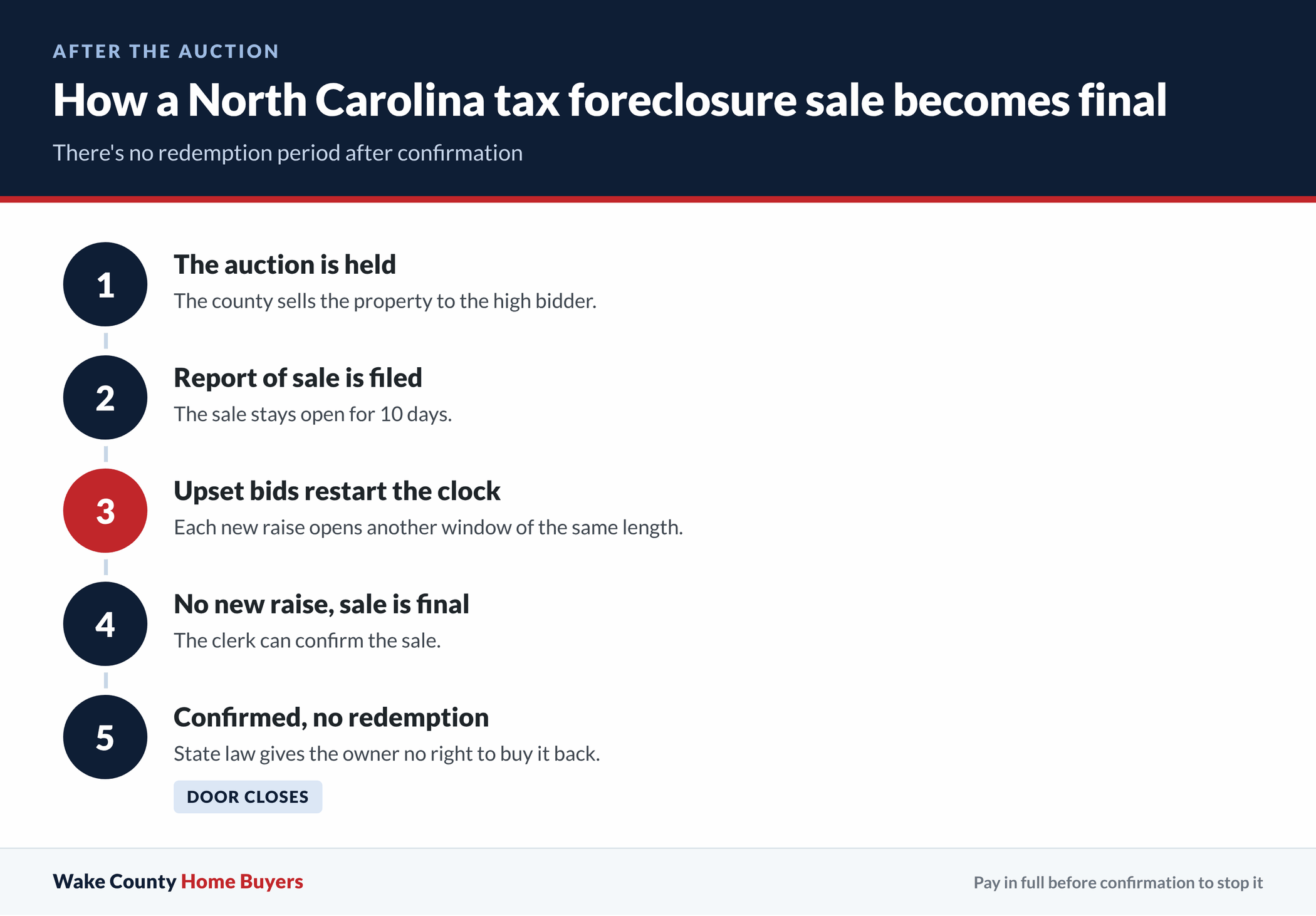
Timing is the entire argument for a cash sale here. Once a tax foreclosure sale happens, North Carolina doesn’t leave the door open long. After the auction the report of sale is filed and the sale stays open for 10 days. Each upset bid starts a fresh period of the same length. The sale is final only when one of those windows passes with no new raise. Once the sale is confirmed, there’s no post-sale redemption period.
A cash buyer skips financing, which removes the single biggest source of delay in a residential closing. There’s no appraisal contingency, no loan commitment letter, no underwriter deciding your crawlspace moisture reading is a dealbreaker. Most of our back taxes closings in North Carolina land somewhere between ten days and three weeks, driven mainly by how fast the attorney gets the tax certification back from the county.
What you give up is price. Any cash offer accounts for repairs, holding costs, and the buyer’s margin, so it lands below what a fully renovated listing would fetch in a strong market.
Don’t compare a cash offer against list price alone. Compare it against list price minus commissions, minus repairs, minus four more months of accruing interest on the back taxes, minus the risk of the sale happening without you. Run that comparison and cash wins sometimes and loses other times, which is exactly how it should work.
More Ways to Sell a North Carolina House with Back Taxes Owed
For years I assumed a Chapter 13 bankruptcy filing was a last resort that meant you’d already lost. Wrong on both counts.
Chapter 13 lets a homeowner restructure debts, including delinquent property tax, into a court-supervised repayment plan, and filing generally halts collection activity while the plan is in place. For somebody with steady income who wants to keep the house, that’s a real path rather than a defeat. A bankruptcy attorney can tell you in one consultation whether you qualify.
Ask your county tax collector about a payment plan, too. Collectors have discretion, and plenty would rather set up installments than pay an attorney to foreclose.
Listing with a real estate agent still makes sense when you’ve got equity, time, and a house that shows well. Charlotte homes sold at a median of $415K over the three months ending October 2026, down 1.3% year over year, averaging 63 days on market against 56 the prior year. If your back taxes balance is small relative to your equity, that extra time usually pays for itself.
Sometimes it doesn’t. A widow in Mount Airy watched two separate listings on her late husband’s place expire with zero offers across nine months, which happens often with rural acreage and dated kitchens. The delinquent taxes kept growing the whole time. When she finally called us we closed in under three weeks with his table saw still sitting where he left it. Wake County Home Buyers buys in that condition regularly, no cleanout required.
Selling to a family member or investor directly is another route, as long as the deed gets prepared properly and the back taxes get paid at recording.
Frequently Asked Questions About Back Taxes and Selling Your North Carolina House
Can I Sell If the County Has Already Filed for Tax Foreclosure?
Yes, right up until the sale is confirmed. Once a case is open, your payoff grows to include court costs and attorney fees, so ask the tax office for a fresh certified figure through your closing date. Fast buyers matter here, because you need the closing done before the bidding window described above runs out. Bring the case number to your closing attorney on day one so they can coordinate with the county’s lawyer and stop the clock cleanly.
Will the County Foreclose If I’m Only One Year Behind on Back Taxes?
It can, though many counties wait longer before filing, as described earlier. Counties decide that for themselves, and the collector can use other tools like attaching wages or bank deposits long before any foreclosure. Call the tax office as soon as you fall behind and ask exactly where your account stands. Ask in writing whether a payment plan is available, because plenty of offices will set one up for an owner who calls early instead of waiting for a summons.
Can You Get Your Property Back After a North Carolina Tax Sale?
You have a window, and it closes hard. Paying the full amount owed (taxes, interest, penalties, and costs) stops the process at any point before the sale is confirmed. Confirmation can’t happen until the bidding period described earlier runs out with no new raise. After confirmation, state law gives you no redemption right at all. This is the single strongest argument for acting while the house is still clearly yours to sell.
Can a Family Member Pay My Back Taxes to Stop a Foreclosure?
Yes. Your county cares that the back taxes get paid, not who pays them. Paying the bill doesn’t give a relative any ownership in the house unless you sign a deed, so put any repayment arrangement in writing. Should they expect a share of the property in return, have an attorney draw that up before money changes hands. Keep the receipt from the tax office too, since it’s the cleanest proof of who paid what and when.
Does the Buyer Take Over Your Back Taxes When You Sell?
Usually no. In a normal closing the delinquent balance gets paid off from your proceeds, and the buyer receives clear title. A buyer can agree to take the property subject to the back taxes and pay them afterward. It sometimes makes sense when a seller has little or no equity, but it has to be spelled out in the contract. Either way, the county’s lien stays attached to the real property until somebody pays it.
How Fast Can You Close on a North Carolina House with Back Taxes?
Speed depends almost entirely on how quickly the county produces a certified payoff and whether title turns up anything unexpected. With a cash buyer and a responsive tax office, closings in the two-to-three week range are routine across North Carolina. Add complications like an open probate, a federal tax lien, or multiple heirs who need to sign, and you should plan on longer.
If you’re sitting with a stack of county notices and no clear idea which option fits your situation, we’re glad to talk it through. No pressure, no obligation, and no hard feelings if you decide listing with an agent or working out a payment plan makes more sense for you. Reach out to Wake County Home Buyers when you’re ready, and we’ll give you straight numbers you can compare against anything else on the table.
Back Taxes on Raleigh Homes
Most of the back-tax calls we take come from around Wake County. The median listing price across the Raleigh metro was $445,000 in October 2026, according to Realtor.com data published by FRED, and that gives many owners more equity to work with.
Get a Clear Plan for Your North Carolina Back Taxes
When county notices are piling up, contact Wake County Home Buyers and we’ll help you map out the payoff and your options. You can also use the form below for a no-pressure answer.