
Seventy-one days. The median number of days a listing sat on the market across North Carolina in October 2026 is nine days longer than the same stretch a year earlier. If you’re wondering how long your own sale will take, that number is your starting point, not your answer. I’ve bought houses in this state for years, and the gap between the fast sales and the slow ones has rarely been wider than it is right now.
How Long Does It Take to Sell a House in North Carolina?
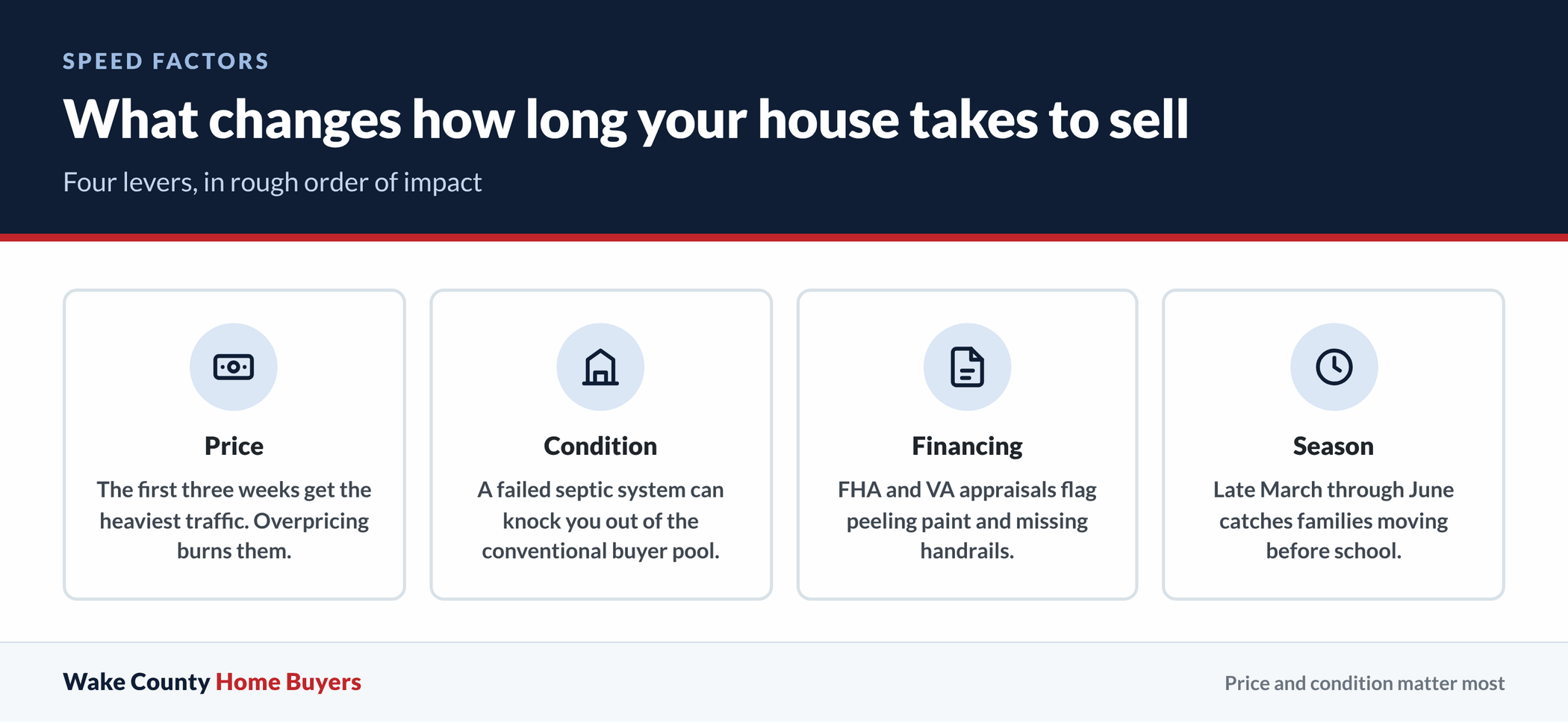
Budget about three months from the day you list to the day you hand over keys. Realtor.com data compiled by the St. Louis Fed put the statewide median at 71 days on market for October 2026. That figure only covers the marketing half of the job, so it doesn’t tell the whole story. Tack on the contract-to-close stretch and you’re looking at roughly 100 to 115 days for a typical financed sale.
Where you live changes the math more than anything else you control. Charlotte homes sold for a median of $415,000 over the three months ending October 2026 and took about 63 days to go under contract, up from 56 a year prior. Durham’s median landed at $425,000 in that same window, with homes going pending in roughly 49 days, because the Triangle just moves quicker than Charlotte does. Mountain towns and coastal stretches run on their own clock entirely.
Early last year I bought a brick ranch in Kernersville from three siblings whose mother had just moved into assisted living. The garage still had her husband’s woodworking bench bolted to the floor. They’d listed it on a Thursday and pulled it down six weeks later. None of them lived closer than Virginia, and the drive down every other weekend was wearing them out faster than the carrying costs were.
How long the sale takes in North Carolina depends heavily on which of three things you refuse to bend on: price, condition or timing. You rarely get all three.
What’s the Average Time on Market for North Carolina Homes?
Statewide averages are close to useless for an individual seller. They blend a Wilmington beach cottage with a Rocky Mount starter home and hand you a number that describes neither.
Still, you need a baseline for how long homes sit, so here’s one worth trusting. Redfin recorded a statewide median sale price of $368,456 in October 2026, down 1.1% year over year, with 11,747 homes sold that month and a median of 67 days on market. When two reputable sources land within four days of each other, that tells you the market has genuinely slowed.
Inventory explains most of how long homes sit right now. NC REALTORS reported 5.98 months of supply in their October 2026 housing report, with the median sales price at $368,990 and sales volume down 19% from the prior year. You can read the NC REALTORS October report yourself.
Six months of supply is the textbook dividing line between a seller’s market and a buyer’s market. We’re sitting right on it.
Wilmington’s median days on market hit 55 for the three months ending September 2026, against just 32 a year earlier. Apex, meanwhile, went from 34 days to 44 over the three months ending October 31, 2026, with a median sale price of $559,611. A beach town nearly doubling its wait while a Wake County suburb adds just ten days shows the same state can hold two very different worlds.
Sellers here who priced for a 2022 market are the ones sitting longest. I’ve watched it happen in Greensboro and in Cary both.
What Factors Affect How Fast Your House Sells in North Carolina?
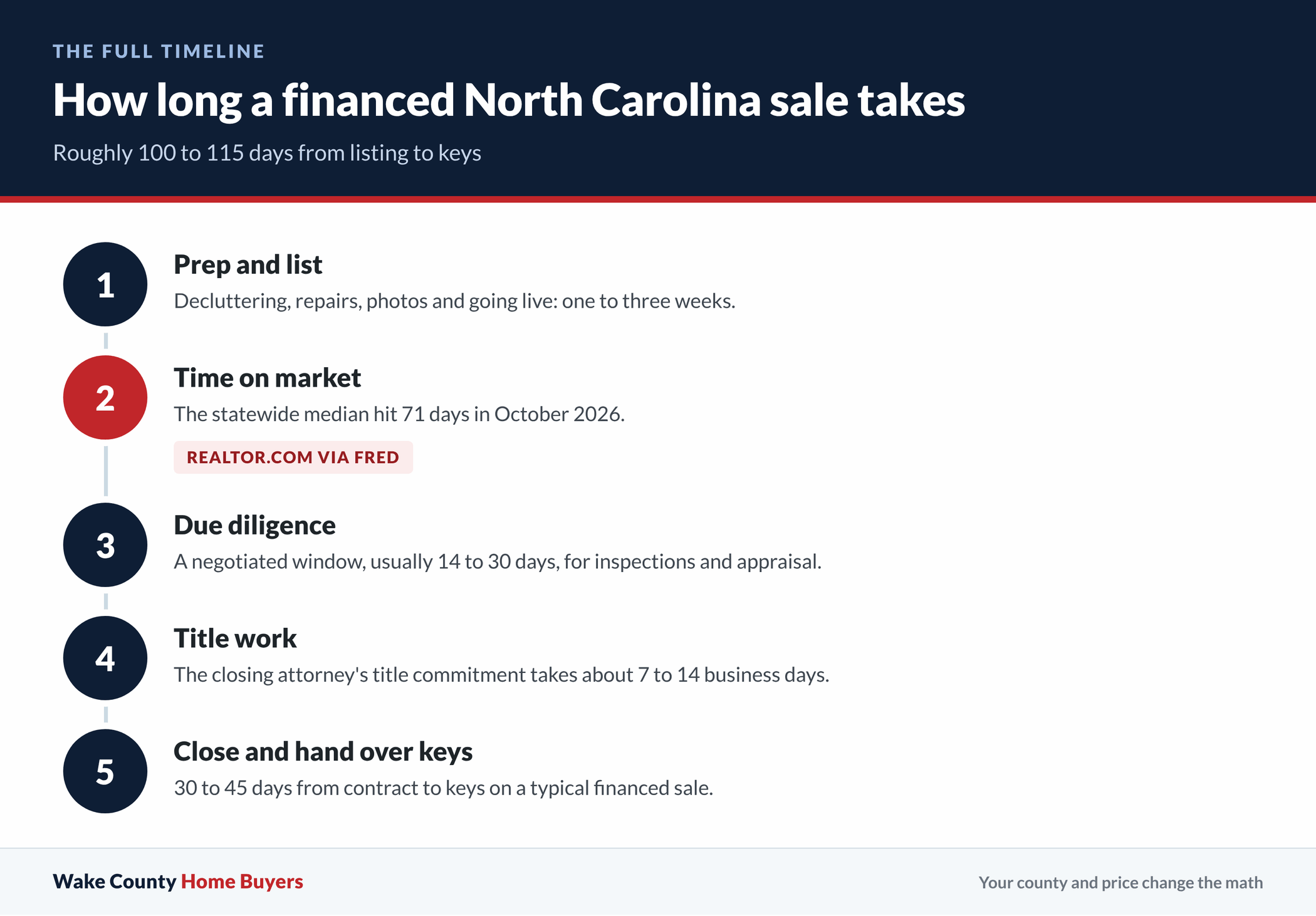
Condition drives how long a sale takes more than anything except price. Financed buyers shopping the state’s market want something they can move into, because their down payment already drained the repair budget. I’ve seen a dated kitchen slow a sale down a few weeks. A failed septic system can knock you clean out of the conventional buyer pool.
Price is the lever everyone underestimates. Overpricing by five percent doesn’t cost you five percent. It costs you the first three weeks, when your listing gets its heaviest traffic, and then you’re negotiating from a stale position with buyers who noticed the price drop.
Financing type changes how long a sale takes too. FHA and VA loans bring appraisal standards that flag peeling paint and missing handrails, adding repair rounds nobody planned for.
A three-bedroom near Research Triangle Park moves differently than the same house forty minutes out in Franklin County, even at identical prices. School assignment, commute, and HOA dues all tighten or loosen the buyer pool.
People credit season too much, but it’s real. Listings that hit the North Carolina market between late March and June catch families trying to move before the school year, and that compresses how long the marketing phase runs.
How Long Does Each Step of the Selling Process Take?
You might be thinking the slow part is just waiting for an offer. It isn’t, and that assumption costs sellers weeks of planning.
Prep work comes first, and it’s the phase people chronically underestimate. Decluttering, minor repairs, photos, and getting the listing live typically eats one to three weeks. Add a month if a cleanout is involved.
Then the marketing window opens, and nobody can promise how long it stays open. Your days-on-market clock varies enormously by submarket.
Once an offer arrives, North Carolina runs a process unlike most states. The buyer pays a non-refundable due diligence fee directly to the seller, separate from earnest money. In return, the buyer gets a broad right to terminate during the due diligence period. An attorney must prepare the deed and conduct the closing. The due diligence window is negotiated, usually landing somewhere between 14 and 30 days, and buyers use it to inspect, appraise, and lock down financing.
Title work moves on its own track as the rest of the sale comes together. The closing attorney orders a title search and issues a commitment, generally within 7 to 14 business days. Old liens, unreleased mortgages, or missing heir signatures can take anywhere from one week to six or more to clear, and the attorney flags them in that commitment.
Sellers who ask how long the whole chain takes are really asking how many of these steps can run in parallel. Here, more of them overlap than you’d guess, which is why the total isn’t just the sum of the parts.
How Long Does Closing Take in North Carolina Once You Accept an Offer?
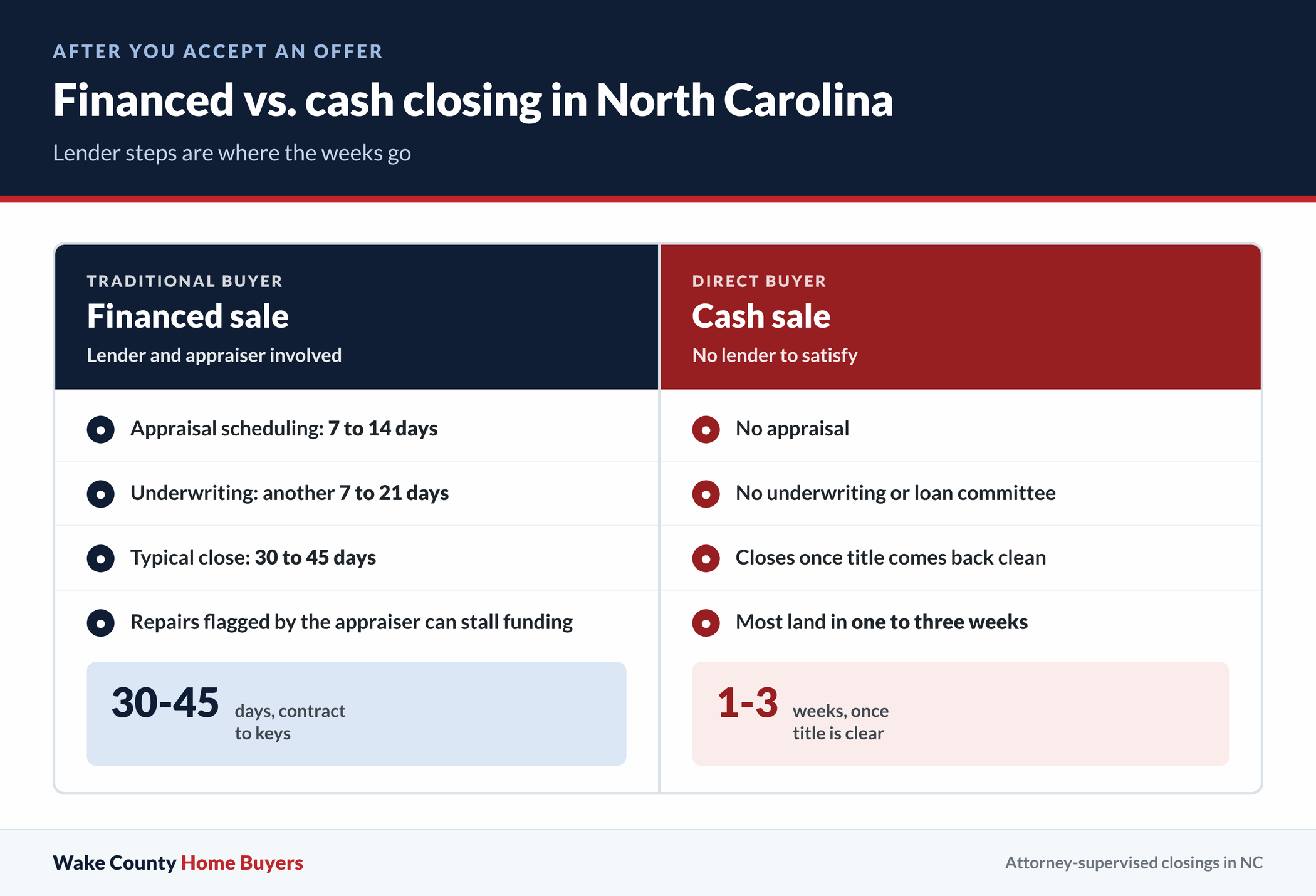
Thirty to forty-five days. Your agent quotes that number, a fair estimate for a clean financed sale. A typical closing here runs 30 to 45 days from contract acceptance to keys on a financed sale, and plenty of transactions land right in that band.
In my experience buying houses, lender delays are the most common culprit I see. Appraisal scheduling alone can run 7 to 14 days, and underwriting adds another 7 to 21 days after that appraisal clears. Stack those sequentially and you’ve burned five weeks before anyone discusses a closing date.
Our attorney-closing requirement is a feature, not a bug, though it does set the pace. North Carolina law requires a licensed attorney, or a title company supervised by one, to handle title examination, deed preparation, fund disbursement, and recording with the Register of Deeds. Your date can’t be hit by skipping steps, which that attorney can’t do.
Paying cash changes the arithmetic. Cash sales in North Carolina can close in roughly two weeks because there’s no appraisal, no underwriting, no loan committee. That’s the whole reason a direct buyer like Wake County Home Buyers can commit to a date and keep it.
One pattern I keep seeing: sellers plan their move-out around the contract’s closing date, then scramble when it slips eleven days. Build in slack for how long the lender takes. Ask your closing attorney early how long their title work typically takes in your county, since the Register of Deeds offices and attorney workloads differ across North Carolina.
Does Selling As-is Change Your Timeline in North Carolina?
A landlord in Gastonia had a tenant move out and leave a kitchen floor soft enough to feel underfoot. Three agents told him to spend eighteen thousand first; he sold as-is instead and closed before the month ended.
As-is doesn’t mean no inspection. Buyers still inspect during their window, and the home is sold as-is under North Carolina law by default anyway. What changes is who absorbs the repair risk and how many buyers stay in the pool.
Here’s where as-is genuinely shortens how long a sale takes: you skip the prep phase altogether. No contractor scheduling, and no waiting on a roofer in August.
As-is on the open market and as-is to a direct buyer, though, are different animals. List a rough house with an agent and you’ll attract financed buyers whose lenders won’t fund a property with active leaks or electrical hazards. Those sales collapse during due diligence, and you’re back to day one with a listing that now looks damaged.
Selling as-is to a cash buyer removes that failure point. There’s no lender to satisfy and no appraisal to clear, which is why those closings land in the one-to-three-week range rather than the two-month range.
You’ll take less than a fully renovated comparable would fetch in the same North Carolina neighborhood. Whether that discount is worth the certainty depends on your carrying costs, your timeline, and how much repair money you’ve got sitting around.
Do the math on how long you can carry four more months of mortgage, taxes, insurance, and utilities before deciding. That number surprises people.
Can You Sell a House Faster in a Slow Market?
Slower markets reward sellers who act decisively and punish the ones who wait for last year’s price. Wake County homes took a median of 50 days to sell over the three months ending October 2026, up from 46 the year before. Four extra days isn’t a collapse. It’s a market asking you to be realistic.
Price it right on day one. Not “we’ll start high and come down,” which is the single most expensive habit I see in North Carolina sellers.
Buyer concessions move faster than price cuts in a soft market. Offering to cover a rate buydown or a portion of closing costs often pulls in a buyer who was sitting on the fence over their monthly payment. It costs less than a ten-thousand-dollar price reduction and it closes quicker.
Flexibility on how long the due diligence period runs helps too. A buyer who needs more than two weeks isn’t being difficult; they’re trying to line up inspections during a busy stretch. Fighting that over a week rarely pays.
Buyers weigh photography and listing quality more now than when inventory was scarce. With more than fifty thousand active listings statewide in October 2026, buyers scroll past anything that looks dim or cluttered.
And some situations simply don’t fit a listing. Inherited property with deferred maintenance, a divorce with a court deadline, a job transfer to Charlotte starting in three weeks: those sellers need certainty about how long the process takes. They need this more than they need the top dollar. That’s the conversation I have most often.
How Do You Speed Up the Sale of Your Home?
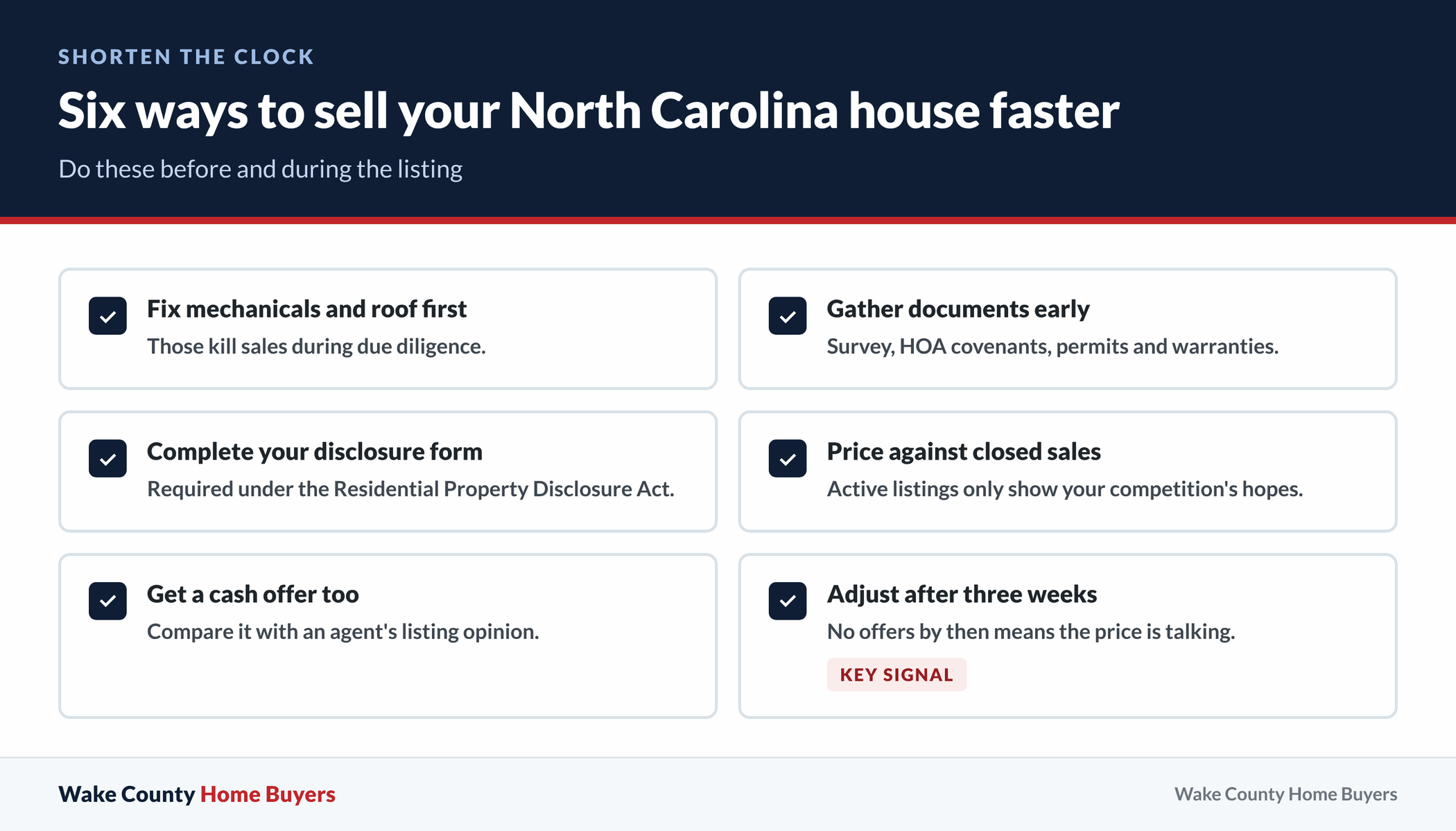
For a long time I told sellers that fresh paint and new carpet were the fastest return on a pre-listing dollar. I was wrong about the ordering. Mechanical issues and roof condition should get fixed first, because those are what kill sales during due diligence. Cosmetic work on a house with a bad HVAC just buys you a prettier failed contract, which I’ve watched happen more than once.
Gather documents before you list: survey, HOA covenants, permits for any additions, warranties on recent work. Under the Residential Property Disclosure Act, you complete a disclosure form, and having the paperwork ready keeps your closing attorney from chasing you mid-transaction. Consumer guidance sits on the North Carolina Real Estate Commission bulletins site.
Price against what’s closing, not what’s listed. Active listings tell you about your competition’s hopes; closed sales tell you what buyers actually paid.
A seller in Monroe called me three months behind on her mortgage with an auction date already on the calendar. She’d been trying to refinance for weeks with nothing to show for it. The only thing left in the garage was a chest freezer she couldn’t move alone. We closed in eleven days, ahead of the sale date, and she walked away with equity that would have evaporated at auction.
Pre-foreclosure, probate, and major deferred maintenance all shorten how long you can wait before options start closing off. If you’re on that clock, get a direct cash offer in hand alongside an agent’s listing opinion. Comparing two real numbers beats guessing at one.
Frequently Asked Questions About How Long It Takes to Sell a House in North Carolina
How Long Does a Due Diligence Period Last in North Carolina?
There’s no fixed length. You and the buyer negotiate it in the offer, and most windows land in the range described earlier. How long you agree to matters, because the buyer can walk away for any reason until it ends and keep their earnest money. A shorter window helps you, but a buyer who can’t finish inspections in time may ask for an extension anyway.
What’s the Hardest Month to Sell a House in North Carolina?
Late December through January is the toughest stretch across most of North Carolina. Buyer traffic thins out around the holidays, relocation activity pauses, and the listings that stay active tend to accumulate days on market without much to show for it. If you can wait until February or March, you’ll generally find a deeper buyer pool and a shorter marketing window.
Which Problems Make a House Take Longer to Sell?
Structural and systems problems hurt worst: foundation movement, an aging roof, failed HVAC, or water intrusion. Those scare off financed buyers and tank appraisals, and they’re why some houses sit while a nearly identical one down the street sells in a month. Unpermitted additions and septic or well issues run a close second, particularly outside city limits where county health department approvals come into play.
How Long Does It Take to Sell a House That Needs Major Repairs?
Longer, if you list it. Lenders often won’t fund a house with active leaks or electrical hazards, so you either fix those first or wait for a buyer who can work around them. Repairs add their own weeks of contractor scheduling before the listing even goes live. Selling as-is to a cash buyer is the one route where condition barely changes how long the sale takes.
How Long Does It Take to Sell a House in North Carolina for Cash?
Cash sales skip the two longest delays in a traditional transaction: lender underwriting and appraisal. Once a title search comes back clean, closing can happen as soon as the attorney’s office has the deed and settlement documents prepared. Most cash closings in North Carolina land between one and three weeks, and a seller with a hard deadline can usually get the date they need.
How Long Should I Wait Before Dropping My Price?
Three weeks of showings with no offer is your signal. The listing’s strongest exposure happens early, so a price that hasn’t produced activity by then is telling you something, and sitting another month rarely changes the outcome. A meaningful adjustment that puts you in a new search bracket does more than a small token cut.
If you’re weighing how long you can realistically wait, talk it through with someone who’s done this a few hundred times. Reach out to Wake County Home Buyers. We’ll give you a straight read on your options, including the ones that don’t involve us. No pressure, no obligation, and no hard sell if listing turns out to be the better move for you.
How Long Raleigh Sales Are Taking Right Now
Prices give you a feel for the local pace. Across the Raleigh metro, the median listing price was $445,000 in October 2026. The number comes from Realtor.com data published by FRED, and Triangle sellers are pricing against that number every week.
Find Out How Long Your North Carolina Sale Could Take
Want a real timeline for your house instead of a statewide average? Contact Wake County Home Buyers and tell us about your property, or use the form below. We’ll walk you through both a listing timeline and a direct sale, side by side.