A pause button isn’t a delete button. One thing I can tell a homeowner who calls me about a mortgage in forbearance is more useful than anything else. Because the paperwork feels like relief, the balance keeps growing underneath it. Across North Carolina, I talk to people who assumed their servicer wiped the missed payments off the books. Nobody wiped anything.
Selling is allowed. Your deed of trust doesn’t freeze when you enter a payment pause, and I’ve watched plenty of North Carolina homeowners close normally despite still being enrolled in forbearance. What changes is the math, the timing, and who you need on the phone before you sign anything.
Can You Sell a House While in Forbearance in North Carolina?
Yes, and the industry guidance backs it up. Nothing in a forbearance agreement strips away your right to list the property, and no provision prevents you from putting it on the market. You still own the house. Forbearance is an agreement about payment timing, not a transfer of control.
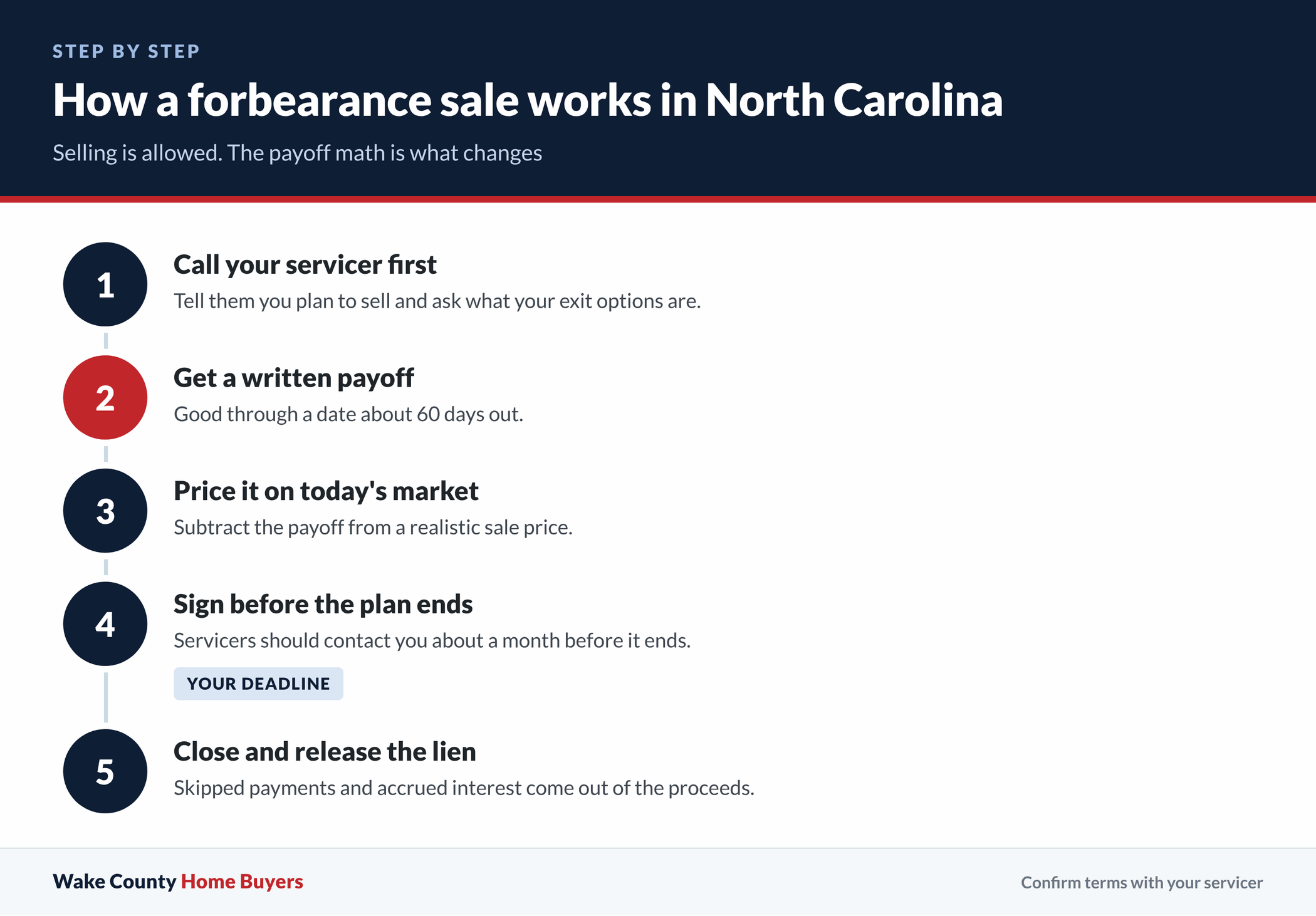
People get tripped up by the payoff statement. When your closing attorney orders it, that document includes every skipped payment plus any accrued interest and fees your servicer has tacked on. The pause doesn’t erase the obligation to repay what you missed, and sale proceeds typically cover the remaining balance including those deferred amounts.
Call your servicer before you call anyone else. Ask for a written payoff good through a date about 60 days out, because North Carolina closings rarely happen in two weeks when a lender is involved.
Early last year a retired couple in Garner called me eight months into a forbearance plan on their ranch house. The garage was so full of fishing gear and paint cans you couldn’t open the side door, and the payoff statement had every skipped payment stacked on top of the balance. We bought it as-is before the plan ended, and the deferred amount came out of the proceeds at the closing table.
Forbearance adds one wrinkle a regular sale doesn’t have: a servicer who needs to be looped in. Approval, in the sense of permission to sell, isn’t the point, it’s coordination, so the payoff figure is right and the lien releases cleanly at the Register of Deeds.
Don’t let a forbearance plan expire while you’re mid-listing. Federal guidance says servicers should contact you roughly a month before your plan ends, and I’d treat that call as your deadline to have a contract signed.
What Is Your North Carolina Home Worth Right Now?
Before: a seller in Fuquay-Varina priced at what a neighbor got in 2024. After: three price cuts, 90-plus days of carrying costs, and a forbearance plan that ran out underneath him.
Pricing off memory is the most expensive mistake I see in forbearance situations. North Carolina’s market softened through 2026, and your equity cushion is smaller than the one your neighbor had two years ago.
The numbers tell the forbearance story on their own. Wake County’s median sale price was $459K over the three months ending October 2026, down 4.1 percent year over year, with homes averaging 50 days on market versus 46 a year earlier. Charlotte told a similar story: a median of $415K for the same October 2026 window, down 1.3 percent from the prior year. Statewide, per Realtor.com data tracked by the St. Louis Fed, the median days on market hit 71 in October 2026, climbing steadily from 58 in June.
Seventy-one days is just the listing window. Add 30 to 45 more for a financed buyer’s closing, so a traditional sale in North Carolina can stretch past three months from sign to settlement. Your timeline matters enormously when forbearance has an end date stamped on it.
Get a real number before forbearance runs out, not a guess. A local agent’s comparative market analysis costs nothing. We’ll also walk a property and give a straight valuation, and I’d rather someone list with an agent for more money than sell to us for less.
Pull your most recent mortgage statement and subtract the payoff from a realistic sale price. The whole decision is that subtraction.
How Much Equity Do You Need to Sell a North Carolina House in Forbearance?
“Do I have enough?” That’s usually the first question, and the honest answer depends on numbers only your servicer can confirm.
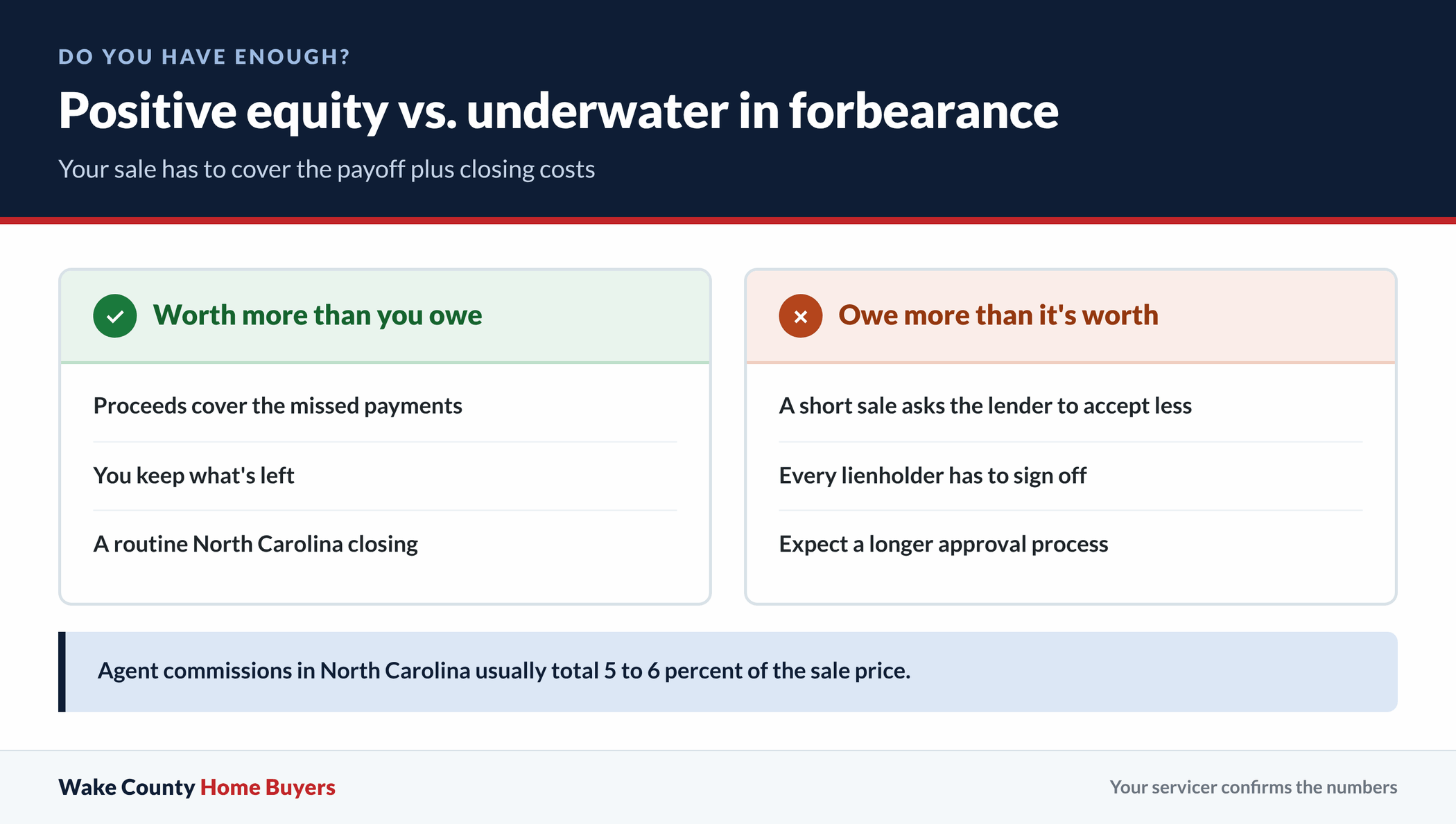
Start with the forbearance floor. Your sale has to cover the loan payoff including deferred amounts, plus closing costs. In North Carolina, sellers typically pay both agent commissions, usually totaling 5 to 6 percent of the sale price. Then there’s the excise tax, attorney fees, and whatever repair credits a buyer manages to negotiate after inspection.
Run that against a Durham example. Durham’s median sale price was $425K over the three months ending October 2026; commissions alone on a house at that price run roughly $21,000 to $25,500. If your payoff sits within $30,000 of your value, listing traditionally probably won’t leave you anything.
Positive equity makes a forbearance sale routine. When your home is worth more than the loan balance, proceeds cover the missed payments and you keep the rest. Underwater is a different animal, so a short sale means asking your lender to accept less than the full balance. The Consumer Financial Protection Bureau notes that every lienholder on the property has to sign off.
One pattern repeats in my work: sellers in forbearance wildly overestimate what repairs will return. Spending $18,000 on a kitchen to chase $12,000 in price is common, and it burns weeks you don’t have, which I’ve watched sink sales that were otherwise fine. Selling as-is to a direct buyer like Wake County Home Buyers often nets the same figure with none of the risk.
Thin equity after forbearance isn’t automatic defeat. It just narrows your options to the ones that close fast.
What Are the Pros and Cons of Selling During Forbearance?
A $15,000 equity cushion can mean the difference between walking away with cash and losing everything to foreclosure. Selling during forbearance beats waiting for the servicer to decide your future, assuming you have any equity at all.
The upside is control. You pick the closing date, you pick the buyer, and you walk away with whatever’s left instead of watching a trustee auction your house on courthouse steps. Choosing to sell keeps the timing and terms in your hands, so equity in the property can fund your next move.
Credit is the forbearance piece sellers underweight. Those skipped payments may already be reported, depending on how your plan was structured and when it started. Selling stops the bleeding; it doesn’t rewind the reporting.
The downside list is real too. You lose the house and whatever appreciation might come later, and in a North Carolina market where prices dipped through 2026, you might be selling into weakness rather than strength. Long stretches of forbearance can eat into the equity you’d otherwise walk away with, which is exactly why waiting another six months to decide rarely helps.
Moving out of a forbearance house costs money. Deposits, movers, maybe a rental in a tight market: budget that before you celebrate a sale price.
Have you priced what a comparable rental runs in your town right now? In parts of Wake and Mecklenburg counties, that monthly number lands uncomfortably close to the mortgage payment you’re trying to escape. So a forbearance exit that drops you into a more expensive housing situation isn’t much of an exit.
Weigh all of it against the alternative in the next section, because foreclosure carries costs that don’t show up on any settlement statement.
Is Forbearance Better Than Letting Your House Go to Foreclosure?
I used to think the two sat on opposite ends of a spectrum. Really, one often leads straight into the other if nothing changes financially.
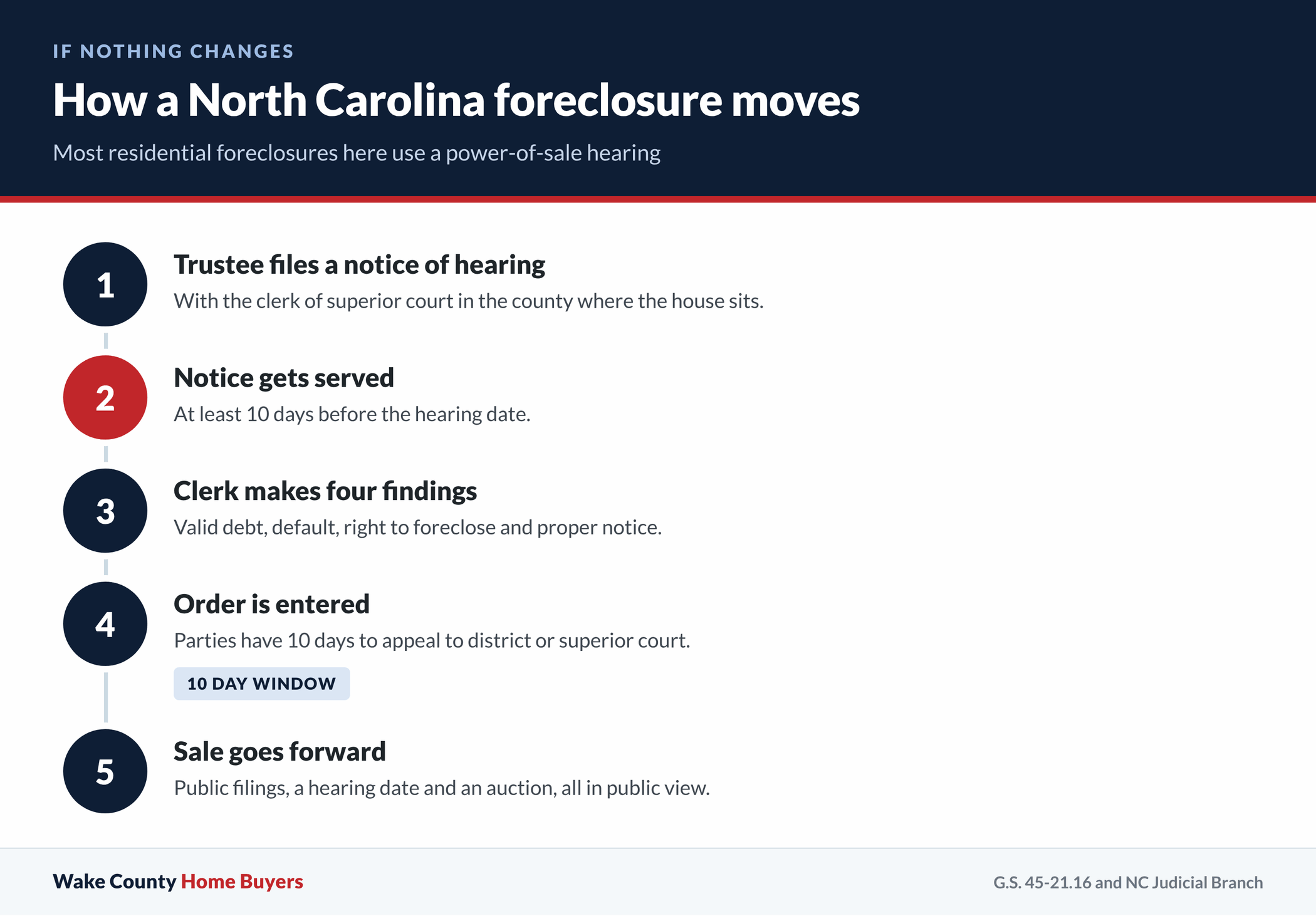
North Carolina’s process deserves explaining, because our rules differ from most states. Nearly every residential foreclosure here runs through a power-of-sale hearing. A trustee files a notice of hearing with the clerk of superior court in the county where the property sits. The sale can’t proceed without that clerk’s authorization, per the North Carolina Judicial Branch.
Under the statute, that notice has to be served at least 10 days before the hearing date; you can read the text at the General Assembly’s site.
Before authorizing a sale, the clerk has to find four things. Those are a valid debt held by the party foreclosing, a default, a right to foreclose under the instrument, and proper notice to everyone entitled to it. After an order is entered, parties have a 10-day window to appeal to district or superior court.
So forbearance buys time that foreclosure doesn’t. That’s its genuine value, and it’s why I tell people to request it early rather than silently skipping payments.
Where forbearance stops helping is when income hasn’t recovered by the time the plan ends. A pause that ends with a lump-sum demand you can’t meet just relocates the crisis three months forward.
Selling during forbearance keeps you out of the clerk’s office for good. No public filing, no hearing date, no auction. Your neighbors in Cary or Concord never know anything happened.
What Are Your Options Besides Selling Your Home in Forbearance?
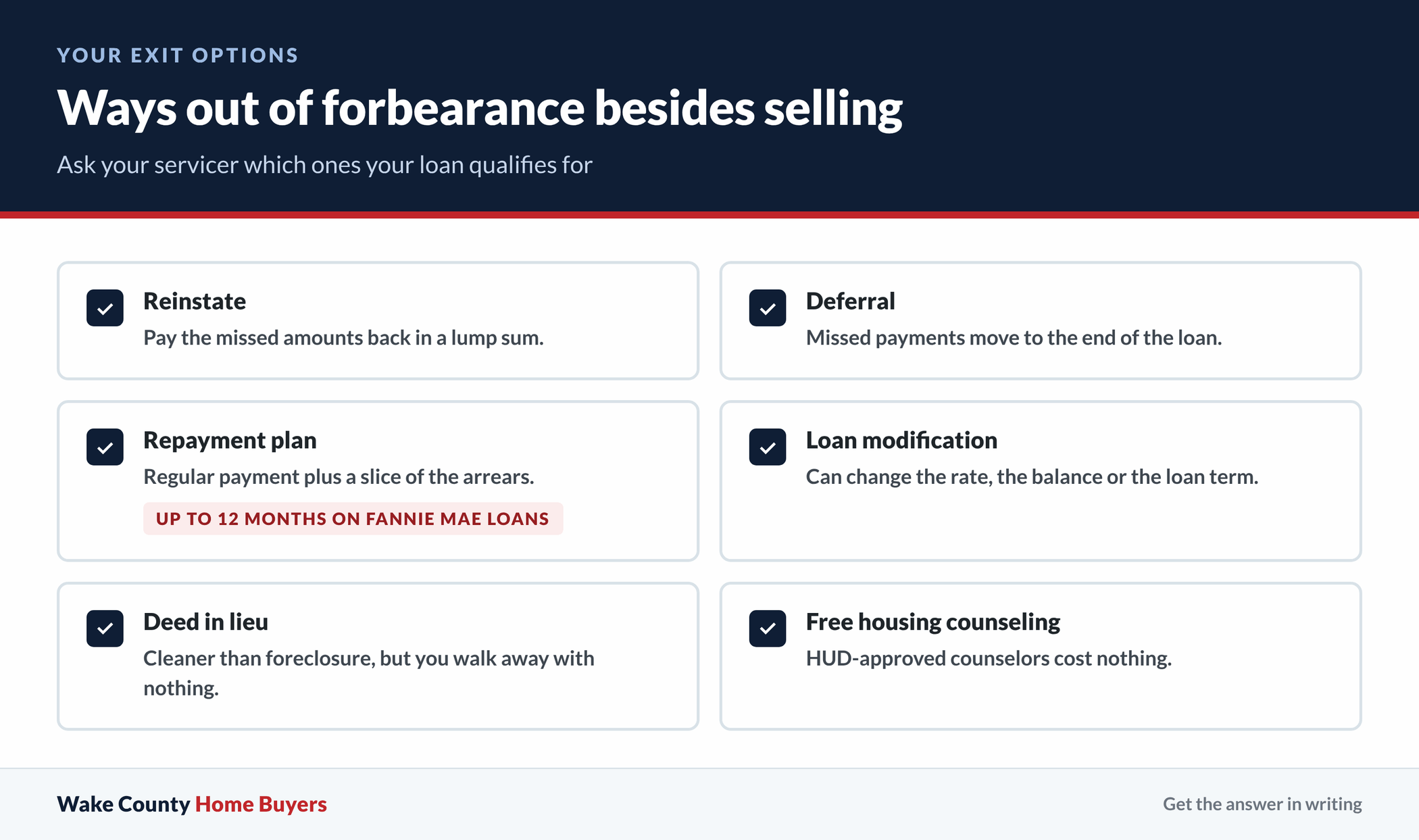
Servicers hate that this myth persists, since getting out doesn’t require one giant payment. Missed payments can be moved to the end of your loan through what’s commonly called a deferral, which leaves your monthly payment unchanged.
Modification is the heavier forbearance exit tool. A modification can change your interest rate, your principal balance, or the length of the mortgage. So qualifying takes documentation and patience. I’ve seen the review process run longer than planned as the forbearance clock keeps ticking.
Repayment plans split the difference. You pay your regular amount plus a slice of the arrears each month, and on Fannie Mae loans those plans can run up to 12 months.
Free forbearance help exists and almost nobody uses it. HUD-approved housing counselors cost nothing, the CFPB maintains the directory, and they’ll read your specific forbearance terms and explain your choices. Start with the CFPB counselor finder before you pay anyone for advice about your North Carolina mortgage.
Renting the house out during forbearance is the option I’d push back on hardest. Landlording when you’re financially stretched turns a bad year into a bad three years, especially with a tenant, a repair budget, and a deferred balance all competing for the same dollars.
Deed-in-lieu of foreclosure means handing ownership to the lender instead of going through the court process. It’s cleaner than foreclosure. Still, it leaves you with nothing, which is why a sale with even modest equity beats it nearly every time.
Can You Buy a House in North Carolina After Coming Out of Forbearance?
Get this wrong and you’ll sign a lease you didn’t need, or worse, make an offer that dies at underwriting three weeks in.
Whether a lender approves your next loan after forbearance comes down to how the missed payments got resolved. If you enrolled as a precaution but kept paying, there’s no waiting period at all, and fully reinstating by repaying the missed amounts in a lump sum also clears you immediately. For borrowers who used a repayment plan, deferral, or modification, the Federal Housing Finance Agency set eligibility at three consecutive on-time payments after exiting.
Timing counts from a specific point. That clock starts with your first payment after the forbearance plan ends, not from the day you called your servicer.
Government-backed loans follow their own tracks. FHA borrowers generally need three consecutive payments after forbearance, and a cash-out refinance requires twelve. Ask a North Carolina lender to pull your specific loan type before you assume anything; the rules shifted several times since 2020.
Selling first simplifies all of it. Close the chapter, bank the proceeds, then qualify fresh with a clean payment history and a down payment in hand.
A man called me on a Tuesday afternoon from Kannapolis after his employer moved his role to another state. Five weeks to be out, a brick split-level with a sagging back deck, and a forbearance plan that was about to convert to a repayment schedule he couldn’t carry from two states away. We closed before his start date.
Compressed timelines like his are common with job transfers, and it’s the scenario where a direct buyer earns their spread. If your situation looks like that, Wake County Home Buyers can usually give you a number within a day or two.
Frequently Asked Questions About Selling a House in Forbearance in North Carolina
Homeowners call expecting their servicer to block the sale, and then the servicer turns out to be the easiest party in the transaction. The friction almost always comes from the payoff math instead: a deferred balance nobody accounted for, or a buyer’s lender dragging past the plan’s end date.
Can I Sell My House If I’m in Forbearance?
You can. A forbearance plan is an arrangement about when you pay, not a restriction on your right to transfer the property, and North Carolina closings happen this way regularly. Request a written payoff statement from your servicer early so the missed payments and any accrued charges are reflected before you agree to a price.
How Long Can a Mortgage Stay in Forbearance?
It depends on your loan type and your servicer, and the pandemic-era maximums that circulated online no longer apply to most new plans. Terms are commonly granted in short increments with possible extensions on review, so ask your servicer for the exact end date of your current period in writing. A HUD-approved counselor can read the agreement with you if the language is murky.
How Long After Forbearance Does Foreclosure Start in North Carolina?
There’s no single countdown, since it depends on whether you resolve the arrears and how quickly your servicer moves to loss mitigation. What’s predictable is the North Carolina procedure once a trustee does file. The clerk hearing, the required findings, and the short appeal window described earlier all happen in public view at the county courthouse. If you’ve received anything referencing a hearing, call a real estate attorney that week rather than waiting.
How Do I Get Out of Loan Forbearance?
Contact your servicer and ask which exit paths your loan qualifies for, then get the answer in writing. Reinstating, deferring the missed amounts to the end of the loan, setting up a repayment plan, or modifying the loan are the usual routes, and each one resolves the arrears differently. If none of them fit your income, selling while you still hold equity keeps the decision yours instead of the court’s.
Will Selling During Forbearance Hurt My Credit?
The sale itself doesn’t damage your credit. Any missed payments reported during forbearance may already appear on your report, but paying the loan off in full at closing stops further delinquencies from stacking up. That’s a meaningfully better outcome than a completed foreclosure, which lingers far longer on your file and makes your next North Carolina mortgage harder to get.
Do I Need My Lender’s Permission to Sell During Forbearance?
Not for a standard sale where proceeds cover the full payoff. You do need the servicer’s cooperation to produce an accurate payoff figure and release the lien at closing, which is routine. Approval only becomes a real hurdle when you’re underwater and asking the lender to accept less than it’s owed.
If you’re weighing a sale, a deferral, or just trying to figure out what your house would bring in this market, we’re glad to talk it through. No pressure, no obligation, and no hard feelings if you decide listing with an agent or keeping the house is the better call. Reach out to us at Wake County Home Buyers whenever you’re ready, and we’ll give you straight numbers you can use however you want.
Forbearance Sales Around Raleigh
Most of the calls we get on this come from Wake County. Listings across the Raleigh metro took a median of 64 days to sell in October 2026. The figure comes from Realtor.com figures published by FRED, so plan your listing against your plan’s end date.
Get Clear Numbers on Your North Carolina Forbearance Sale
If your plan’s end date is getting close, contact Wake County Home Buyers and we’ll run the payoff math with you. You can also use the form below, and we’ll follow up with straight numbers and no pressure.