
Two names on a deed can outlast a relationship by years. I’ve watched it happen across Wake, Durham, and Mecklenburg counties: one person moves out, one person stays, and the house just sits there collecting interest and resentment. If your ex refuses to sell, you’re not stuck forever, even when it feels that way at 2am. North Carolina gives co-owners real leverage, and most people never find out what that leverage is until a lawyer explains it. Let’s walk through it together.
Why Does Your Ex Refuse to Sell the House After a Breakup or Divorce?
Why would anyone turn down free money sitting in home equity? Because it’s almost never about the money.
A parent who doesn’t want to pull a child out of a school district in Cary or Chapel Hill will dig in hard, and that instinct isn’t irrational. School assignment drives a lot of behavior in North Carolina, where our school systems run county-wide.
Then there’s the interest rate. Somebody holding a three percent mortgage from 2021 looks at today’s market and sees a payment that doubles if they move.
Some exes figure out the leverage fast. An ex who knows you want out will stall because stalling costs you more than it costs them. When they’re living in the house rent-free while you pay half the mortgage from an apartment in Garner, time is their friend.
Early last year, a divorced couple called me about the brick ranch near Kannapolis they still owned together. He’d moved out, she was living there, and the mortgage was three months behind with an auction date already on the calendar. The garage was still full of his woodworking tools, and neither of them could agree on who got what. That’s the pattern I keep seeing: the dispute isn’t about the house, it’s about everything the house represents.
Sometimes your ex refuses to sell because they genuinely believe they’ll qualify for a refinance next year. Other times they just can’t face packing. Figuring out which of these you’re up against changes your whole strategy, because grief responds to patience and leverage responds to filing fees.
What Does North Carolina Law Say When an Ex Refuses to Sell Shared Property?
Can your ex really stop you from selling? North Carolina law says no. Nobody can be forced to stay a co-owner of real estate in North Carolina against their will, and that single rule is the most powerful thing in your corner.
You’ll find partition law tucked into Chapter 46A of the General Statutes. The court can order an actual partition, a sale, a combination of the two, or another arrangement the statute allows. Under § 46A-26, though, it may not force a cotenant to remain in cotenancy over that person’s objection. Read that again if your ex won’t budge on selling and keeps insisting you have no say.
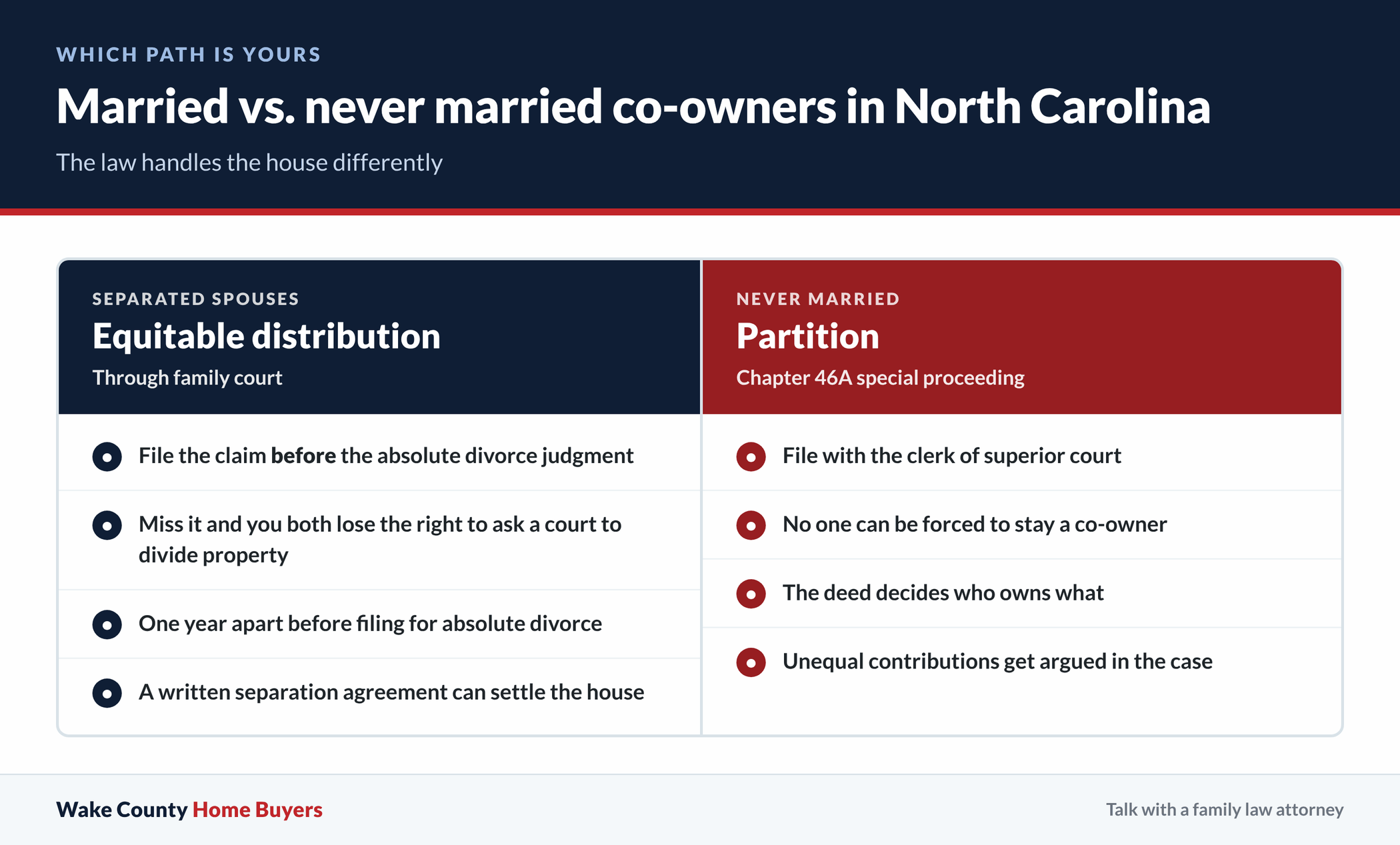
Married couples follow a different track. Separated but not divorced? Then the house gets handled through equitable distribution instead of partition, and the timing here is brutal if you miss it. The equitable distribution claim must be filed before the absolute divorce judgment is entered. If neither spouse files that claim before the divorce is finalized, both of you permanently lose the right to ask a court to divide marital property. I’ve talked with homeowners in North Carolina who got a quick uncontested divorce to “keep it simple” and torched their property rights doing it.
Spouses must live separate and apart for one year, with at least one intending the separation to be permanent, before filing for absolute divorce in North Carolina. That year isn’t dead time. It’s when the house problem gets solved, through a written separation agreement or a filed claim.
Never married? You go straight to partition, which is the cleaner path even though it feels more aggressive.
What Can You Do When Your Ex Refuses to Sell the House in North Carolina?
A seller in Winston-Salem called me after fourteen months of unanswered texts about listing the house. She had a lawyer on retainer, a stack of certified letters, and no deed signature. In my experience buying houses, letters rarely move anyone, so what finally moved the needle was a written offer with a closing date attached.
Start by putting something concrete in front of your ex. Real numbers, a real timeline, and a real consequence change the conversation.
Keep a running record of what you’ve put into the place. Every mortgage payment, insurance premium, tax bill, and repair you’ve covered alone matters later, because contribution claims come up in partition cases. Keep receipts, email records, and bank statements; your lawyer will want them organized, not reconstructed from memory.
Mediation deserves more credit than it gets. North Carolina family courts lean on it heavily, and a neutral third party in a room for four hours resolves things that eighteen months of hostile texting won’t.
Could you sell just your half? Technically yes, your undivided interest is yours to transfer, but almost nobody wants to buy into a co-ownership fight.
What usually works best: offer your ex a buyout, a listed sale, or a partition filing, in that order, in writing. When your ex refuses after seeing all three laid out plainly, you’ve documented a good-faith effort that plays well in front of a clerk. Folks at Wake County Home Buyers field these calls constantly from people who just need a straight answer about what the property is worth before they decide which option to pick.
How Do You Buy Out an Ex Who Refuses to Sell the House in North Carolina?
A couple in Fuquay-Varina spent nine months deadlocked over a split-level with a finished basement. She refinanced in her own name, he walked away with a check, and both of them stopped losing sleep.
When your ex refuses to sell to a stranger, a buyout often works. You pay them their share of the equity, they sign a deed, and nobody steps into a courtroom.
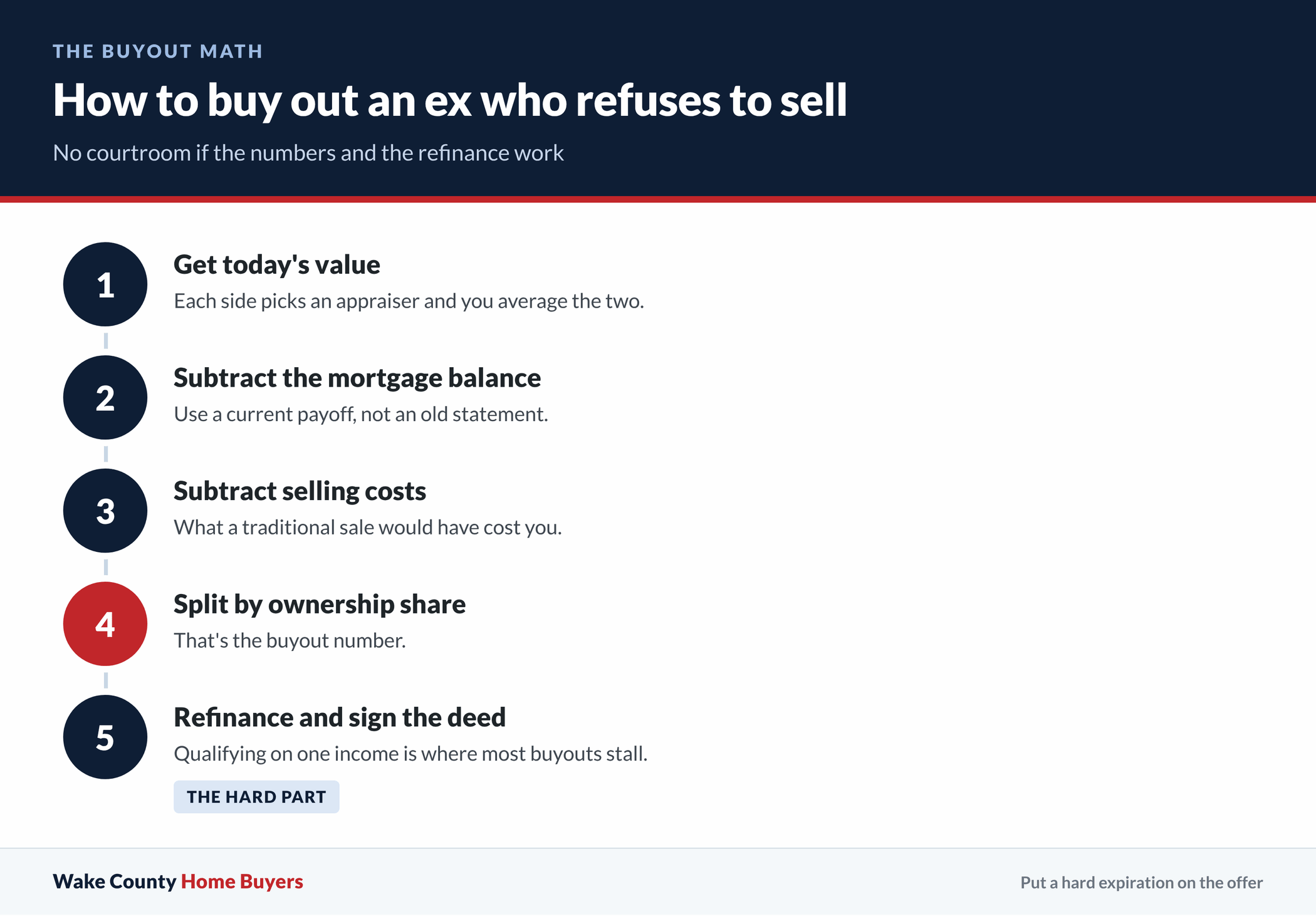
Weigh the arithmetic more than the emotion. Take the current market value, subtract the mortgage balance, subtract selling costs you’d incur in a traditional sale, then split what’s left according to your ownership percentages. In Wake County, the median sale price over the three months ending in October 2026 was $459,000. This was down 4.1% from a year earlier. A 2021 valuation in your head isn’t close to accurate anymore.
Refinancing is the hard part. Qualifying for the full mortgage on one income, at current rates, knocks out a lot of buyouts before they start.
Here’s where a buyout quietly fails: the refinance drags, the deadline slips, and your ex uses the delay as proof you were never serious. Put a hard expiration on the offer.
Each side picks an appraiser, you average the two numbers, done. When the two appraisals land far apart, a third appraiser or a mediator can break the tie. Either one costs far less than letting a court set the number for you.
Can You Force a Sale If Your Ex Refuses to Sell in North Carolina?
And that’s precisely where partition comes in, because a buyout only works if someone has the cash and the credit.
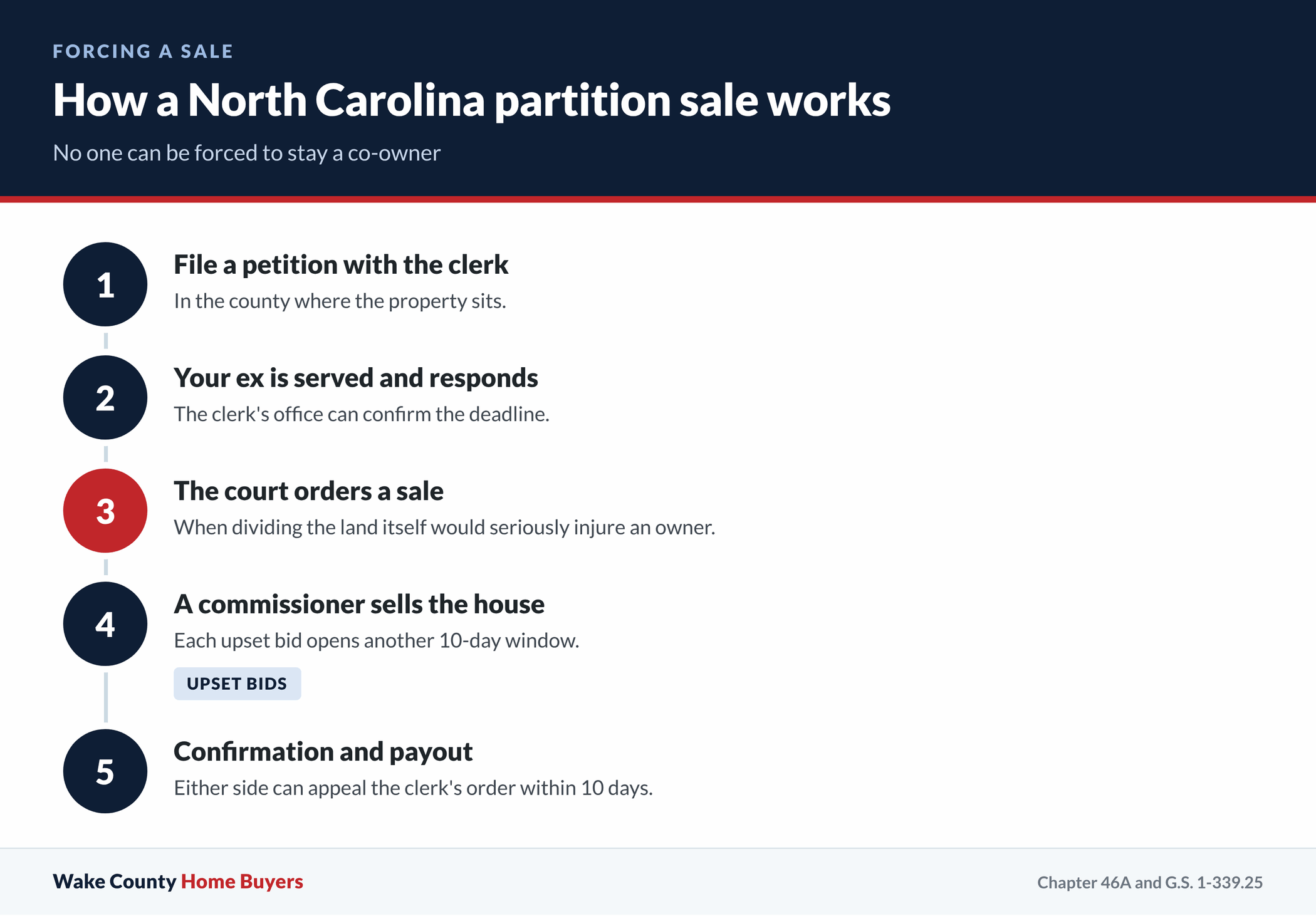
Yes, you can force it. Any co-owner can petition the clerk of superior court in the county where the land sits. This starts a special proceeding that can end in partition in kind or a partition by sale with the cash divided. You obviously can’t physically divide a single-family house in North Carolina, so sale is the realistic outcome.
The legal standard isn’t automatic, though. Under § 46A-75, the court may order a partition sale only if it finds by a preponderance of the evidence that dividing the land itself would seriously injure one of the owners. In my experience buying houses, meeting that standard for a three-bedroom ranch in Greensboro is straightforward.
Your ex then gets a short window after service to respond, and the clerk’s office in your county can confirm the exact deadline and procedure for your filing.
Appeal rights exist too. An unhappy co-owner may appeal the clerk’s order to Superior Court within 10 days.
My honest take: filing is often what ends the fight, not what starts a war. When your ex won’t sell and then receives a served petition, the posturing tends to evaporate within a month, since few people want to keep fighting once paperwork is involved. Many of these cases settle before any hearing, because the other side finally understands that “no” was never a permanent answer in North Carolina.
Is a Partition Action Your Only Option When an Ex Refuses to Sell?
No, and I’d push back on any advice that treats court as step one.
Splitting a property this way isn’t free. Under § 46A-3, the court may allocate reasonable attorneys’ fees depending on the nature of the work and the benefit to the co-owners, but that allocation is the clerk’s call, not yours. Budget for the possibility that you eat your own legal bill.
The sale process has a wrinkle that surprises people. After the commissioner files the report of sale, a 10-day upset bid period opens. If a qualifying upset bid comes in with the required deposit, another 10-day period kicks off, continuing until the bidding finally stops. You can read the mechanics yourself in the statute on the General Assembly’s site.
So what else is on the table? One is a written agreement where one party stays for a fixed term, then sells. Another is a deferred-sale arrangement tied to a child’s graduation. A third is a cash sale to an investor who’ll buy both interests at once and handle the paperwork, which sidesteps the commissioner process when both of you will sign.
Statewide, homes aren’t moving quickly right now. Median days on market in North Carolina hit 71 in October 2026, up from 58 in June of the same year. A listed sale isn’t the fast option it was three years ago, and that timeline affects whether waiting out your ex makes sense.
Two or three thousand dollars of mediator time beats a year of filings. When your ex won’t budge out of pride rather than strategy, a neutral room often does what a petition can’t.
What Happens to Your Mortgage If Your Ex Refuses to Sell the House?
Say your divorce decree makes your ex responsible for the payment. Your lender has never read that decree and isn’t bound by it. The note is a contract between you and the bank, and a family court judge in North Carolina can’t rewrite it.
One missed payment knocks a good score down by a lot, and I’ve seen people discover the damage while applying for a car loan, months after the fact.
Your debt-to-income ratio carries that full mortgage payment too. Buying a new home in Asheville or Wilmington gets harder, because underwriters count the entire obligation against you even when someone else is paying it.
Only two things actually release you: a refinance into your ex’s name alone, or a sale that pays off the note.
Want the uncomfortable question? If your ex refuses to sell and stops paying, how many months of payments can you cover before your own finances crack?
Charlotte’s market gives some context for what’s at stake. The median sale price there over the three months ending October 2026 was $415,000, down 1.3% year over year. Equity that erodes while a stalemate drags is equity nobody gets to split.
Protect yourself by setting up payment alerts with the servicer and asking for duplicate statements. Knowing about a missed payment on day three beats finding out on day ninety.
How Long Does It Take to Resolve a Case Where Your Ex Refuses to Sell?
Guess wrong on the timeline and you’ll make decisions you can’t undo. Think signing a lease you can’t afford, or turning down a job in another state because you think the house closes next month.
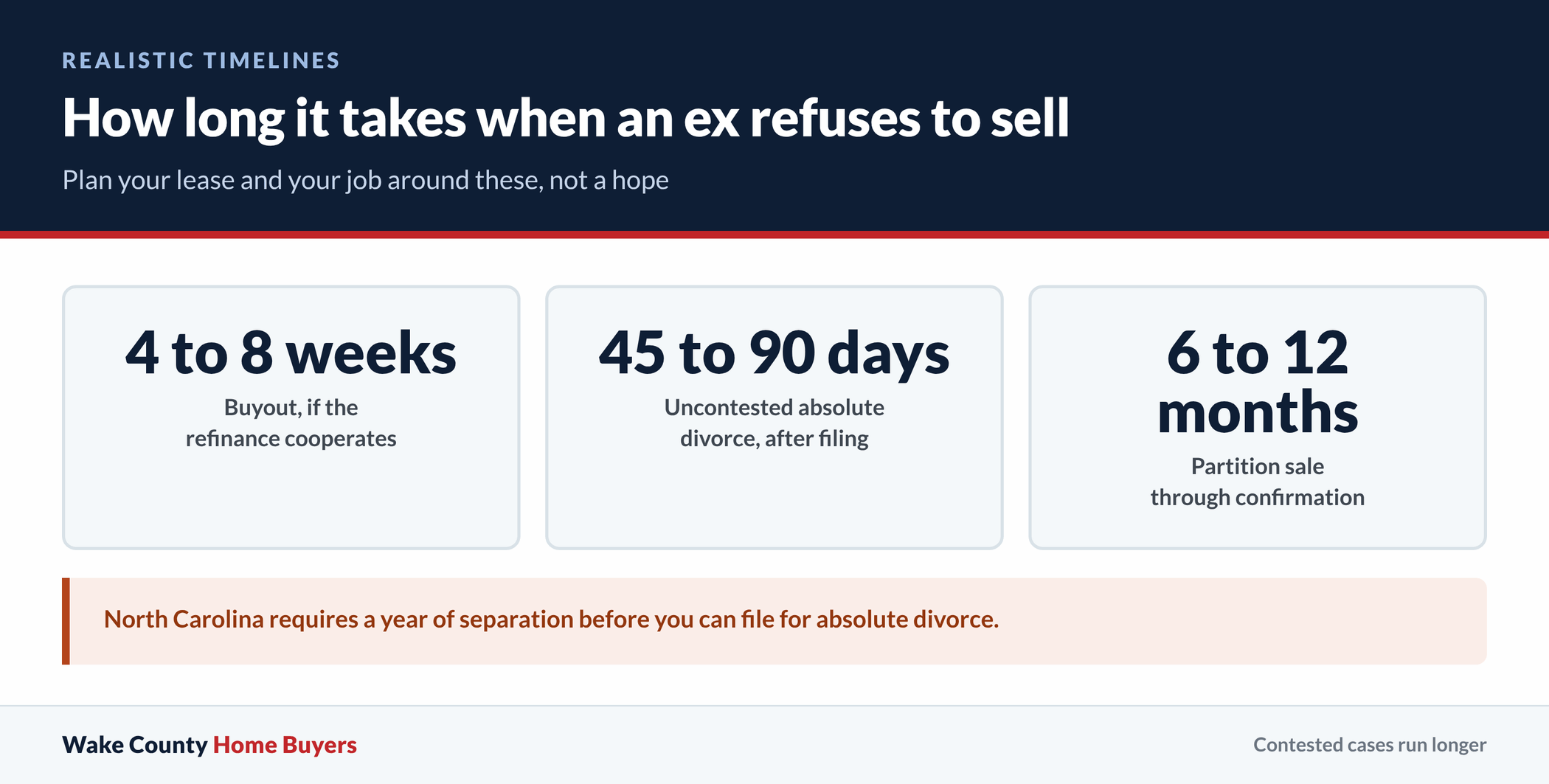
A buyout takes four to eight weeks if the refinance cooperates, longer if it doesn’t.
The court’s calendar decides the pace of equitable distribution. Remember that North Carolina requires that year of separation before an absolute divorce filing. An uncontested absolute divorce typically takes 45 to 90 days from filing to judgment once service and the 30-day answer period are accounted for. Contested property cases stretch well past that.
A partition sale runs through filing, service, the answer window, a hearing before the clerk, appointment of a commissioner, marketing, the sale, upset bids, confirmation. Six months is optimistic. A year isn’t unusual when your ex contests every step.
Durham’s numbers show what a market sale adds on top. Homes there went for a median of $425,000 over the three months ending October 2026, down 1.2% from the prior year, and sat an average of 49 days on the market. Add closing time and you’re near three months from list date to funded sale, assuming no financing hiccups.
A landlord in Hickory reached out after almost a year of quietly covering two mortgages, hers plus the one on the duplex she still co-owned with a former partner who wouldn’t discuss selling. She’d been doing it every first of the month without telling her family, and the tenant’s lease on the upstairs unit was about to renew for another twelve months.
Her expensive mistake wasn’t the duplex. It was waiting eleven months to ask anyone what her options were.
Frequently Asked Questions About What to Do When Your Ex Refuses to Sell in North Carolina
Can I Just Stop Paying the Mortgage If My Ex Refuses to Sell in North Carolina?
Please don’t. The lender holds you personally responsible regardless of any court order splitting the debt, so missed payments wreck your credit alongside your ex’s and can push the property toward foreclosure. If you genuinely can’t carry it, talk to a family law attorney about asking the court for an order addressing the payments, and talk to your servicer about what relief they offer.
Does My Ex Have to Move Out During a Partition Case in North Carolina?
Generally no. Co-owners share equal rights to possess the property, so a partition filing by itself doesn’t evict anyone living there. You may have a claim for a share of the fair rental value or for reimbursement of carrying costs you covered alone, and your attorney can tell you whether the facts support it.
What If My Ex Refuses to Sell and We Never Married?
Your path is simpler in one respect: you skip the family court entirely and file a partition special proceeding with the clerk of superior court in the county where the property sits. Nothing about marital property division applies to you. Whoever is on the deed owns what the deed says they own, and unequal contributions to the down payment get argued as part of the case.
Can a Cash Buyer Purchase the House While My Ex Refuses to Sell?
A buyer can only close if everyone on the deed signs, so a cash sale works when your ex is willing but slow, not when they’re a hard no. That said, a cash offer with a two-week closing window sometimes converts a reluctant co-owner into a cooperative one, because it removes the repair and showing hassles they were dreading. If you want to see what a direct offer on a North Carolina property looks like before deciding, it costs you nothing to ask.
Will the Court Make My Ex Pay My Attorney’s Fees?
Sometimes, in partition cases, the clerk can allocate reasonable fees among the co-owners based on how the work benefited everyone. It’s discretionary, not guaranteed, and it’s a poor reason to file. Go in prepared to cover your own costs, and treat any fee allocation as a bonus.
How Is Equity Split If One of Us Paid More Toward the House?
Courts in North Carolina look at ownership interests first, then at contribution claims for mortgage payments, taxes, insurance, and improvements. Documentation decides these arguments. Bring bank records and receipts rather than recollections, and understand that routine maintenance usually counts differently than a new roof.
Staring down a shared house and a co-owner who won’t budge? You don’t have to sort it out alone. We’ve helped plenty of folks across North Carolina figure out where the property actually stands and what a sale would net, whether they end up listing, buying out, filing, or selling direct to us. Reach out whenever you’re ready for a straight conversation about your options. No pressure, no obligation, and no hard feelings if you decide to wait.
Shared Houses Around Raleigh
Many of the calls we get where an ex refuses to sell involve houses in Wake County. The median listing price across the Raleigh metro was $445,000 in October 2026, according to Realtor.com data published by FRED, so there’s often real equity on the line for both of you.
Talk Through Your North Carolina Co-Owner Situation
If your ex refuses to sell and you want to know what the house would net, contact Wake County Home Buyers for a straight read on your options. You can also fill out the form below, and we’ll follow up with no pressure.