A tenant calls you about a water heater at 9 p.m. You’re in Ohio. The house is in Garner. This gap between where you sleep and where your property sits is what makes selling from out of state feel heavier than it should. I’ve bought houses from owners in California, Florida, New Jersey, and one guy stationed overseas, so I’ve seen just about every version of this problem. The mechanics work. What people stumble over is sequencing: what to sign, who handles the closing in North Carolina, and which tax form someone has to file after the sale closes.
Who Needs to Sell a House in North Carolina While Living in Another State?
Heirs make up the biggest group I meet. A parent passes, the estate opens in Mecklenburg or Buncombe County, and the kids live in three different time zones.
Then there are the job transfers. Research Triangle Park pulls people in, but it also sends them out, and a promotion to Atlanta or Austin rarely waits for a house to sell.
Military families rotate through Fort Bragg and Camp Lejeune constantly. Orders come, the family goes, the house stays.
Landlords burn out too. Someone bought a rental in Winston-Salem in 2015, moved to Virginia, and spent eight years coordinating repairs by phone. Eventually they’d rather have the cash than the headache.
Not long ago I worked with two adult children whose mother had moved into assisted living near her daughter in Richmond, Virginia. Her old house in Clayton sat empty for most of a year, and the family had quietly been covering her mortgage alongside their own, never admitting to each other how stretched they’d gotten.
Every one of these owners has the same real problem. The house keeps costing money while they figure out what to do, and distance makes every decision slower. Out of state ownership isn’t the crisis; drift is.
What Are Your Options for Selling a North Carolina House From Out of State?
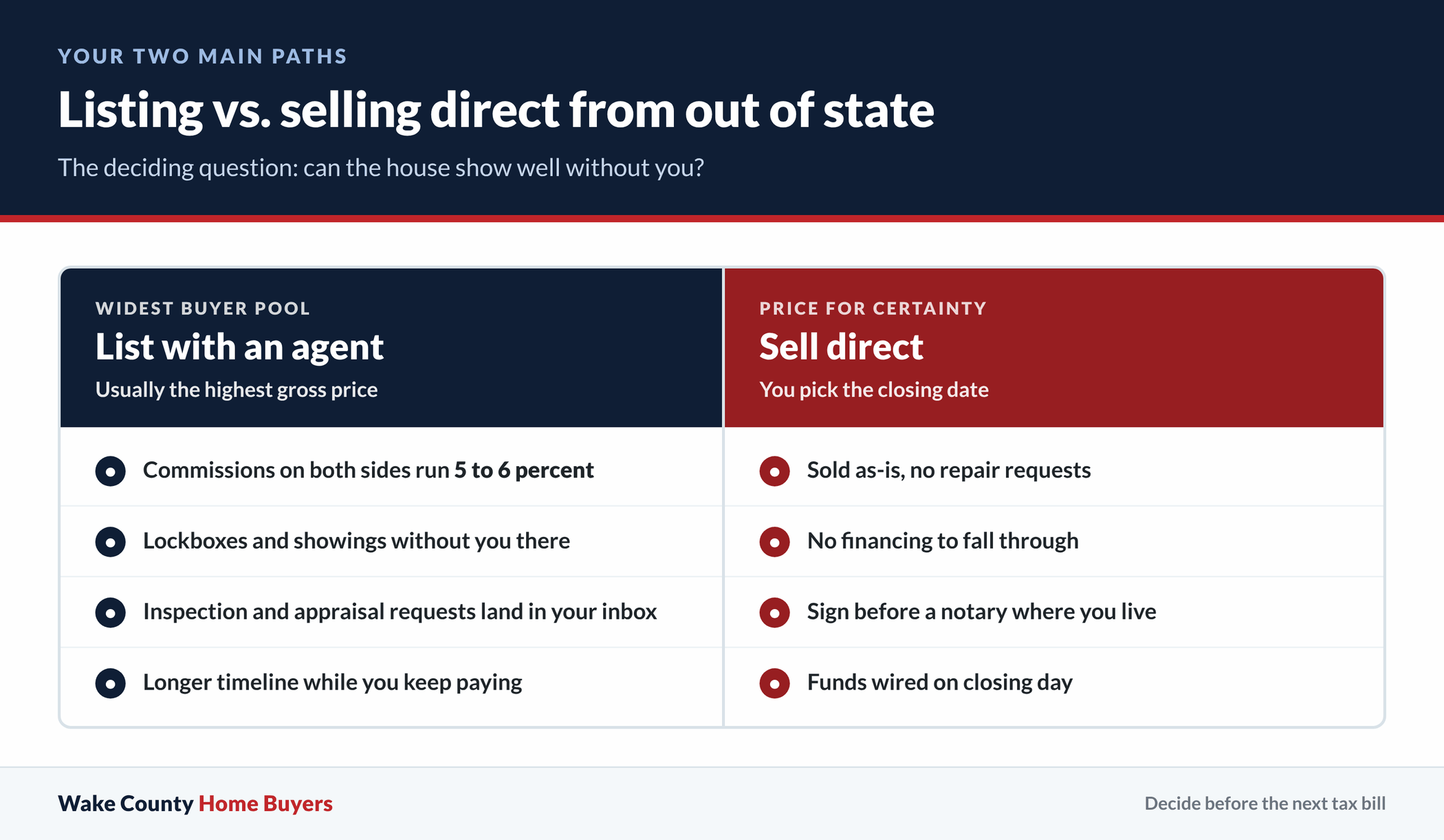
Whether you should list it or sell it direct, my answer depends on one thing: can you get the property shown well without flying back?
Listing with a real estate agent gives you the widest buyer pool and usually the highest gross price. Agent commissions on both sides typically run 5 to 6 percent of the sale price, and that comes out of your proceeds at closing. A good listing broker in Raleigh or Asheville can handle lockboxes, photography, and showings without you present, which means you don’t have to fly back for every walkthrough. Repairs are the sticking point, though. Buyers with financing will send an appraiser and an inspector, and their requests land in your inbox while you’re at work in another state.
Selling to a direct buyer trades price for certainty. You pick the closing date.
For sale by owner is the third path, and I’ll say plainly that it’s the worst fit for anyone handling a sale from out of state.
Renting it out is an option people choose and then regret. Long-distance landlording works for maybe one owner in five, and the rest end up calling me two years later.
Companies like Wake County Home Buyers handle the as-is sale route across Wake County and the surrounding towns, which matters when you can’t walk the property yourself before signing anything.
Whatever route you pick, decide before the next tax bill, not after. Out of state sellers who wait for a “better market” usually just pay more carrying costs.
How Do North Carolina Laws Affect an Out of State Home Sale?
Sign the wrong power of attorney and your closing stops cold, sometimes on the day of funding, with movers already loaded.
Attorney-closing is required in North Carolina. A licensed state attorney supervises residential real estate closings here, which is different from the title-company model you may know from Texas or Arizona.
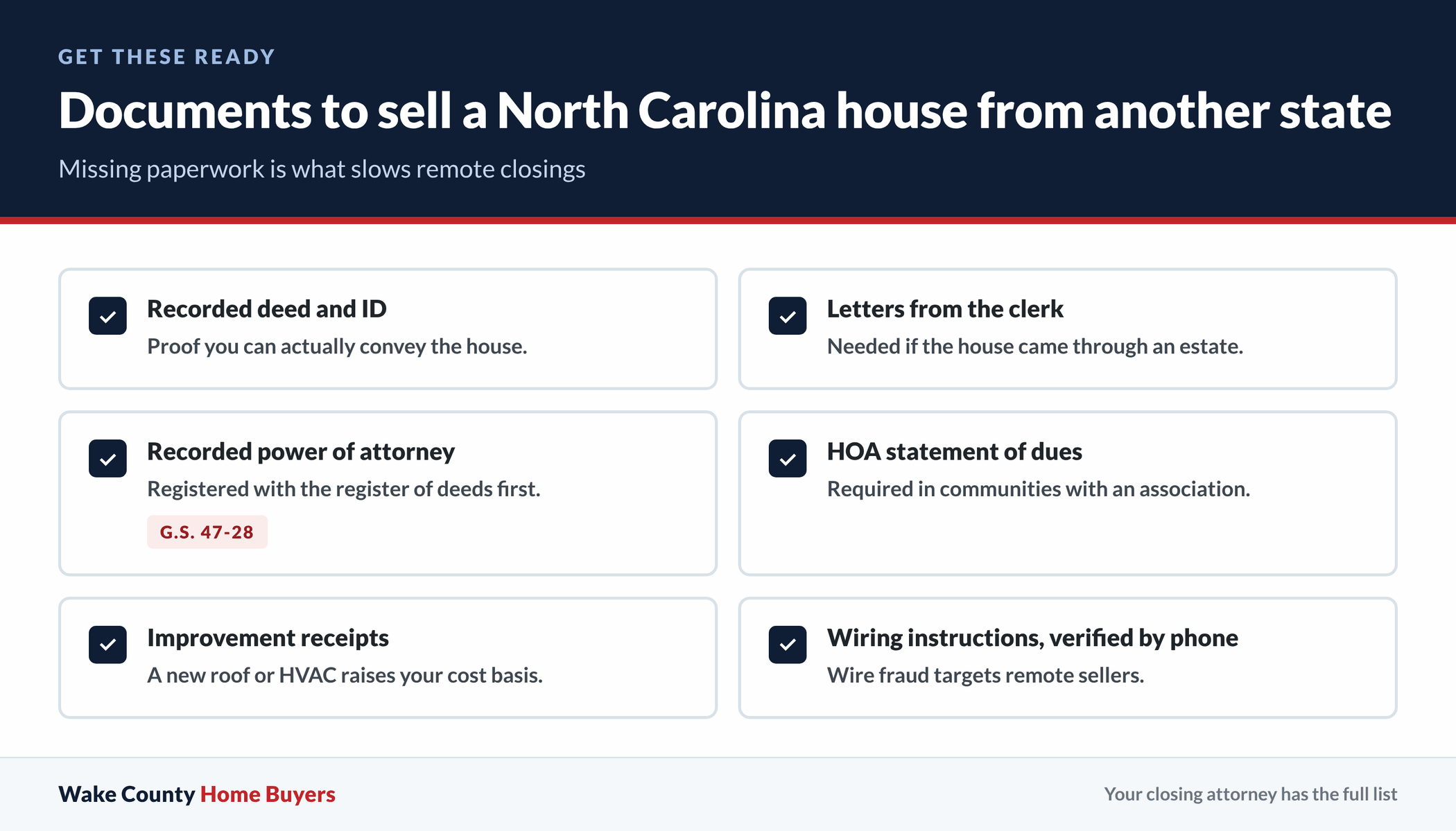
Many out of state sellers use a limited power of attorney so someone local can sign. Under G.S. 47-28, the power of attorney or a certified copy must be registered with the register of deeds before an agent executes a transfer of real property. This isn’t a step you can skip even if you’re signing from another state. For non-residents of the state, the statute allows recording in a county where you own property or have a real business reason to record there. Deeds signed this way reference the book, page, and county where that document was recorded.
Can you just sign everything remotely? Partly. The state allows remote electronic notarization, but the rules place specific restrictions on using a remotely notarized power of attorney to convey real property.
Disclosure still applies. Sellers there complete the Residential Property and Owner’s Association Disclosure Statement, and living elsewhere doesn’t excuse you from answering honestly about what you know.
One mistake I keep seeing: sellers bring a general financial power of attorney drafted in their home state and assume it’ll work. Have a North Carolina attorney draft a property-specific one instead.
What Documents Do You Need to Sell a House in North Carolina From Another State?
Sellers picture a folder with the deed in it and figure that’s the job done. Then the title search turns up a lien from a roofing contractor in 2019, or the deed lists a deceased co-owner. The closing attorney needs three more documents nobody anticipated.
Start with proof you can actually convey. That means the recorded deed showing current ownership, plus a government ID matching the name on it.
If the property came through an estate, the paperwork multiplies. You’ll want letters testamentary or letters of administration from the clerk of superior court in the county where probate was opened, along with the will if there is one. Heirs scattered across different states each need to sign, and I’ve seen coordinating four signatures in four time zones take longer than the actual closing.
Homeowners insurance policy details matter too, because your insurer needs a cancellation date once the sale records.
HOA documents trip up out of state owners regularly. Say your house sits in a community like Brier Creek or Ballantyne, the association has to issue a statement of dues and any outstanding assessments.
Keep receipts for capital improvements as well. A new roof, an HVAC replacement, a finished basement: every documented upgrade raises your cost basis and shrinks the taxable gain.
Your closing attorney will also need wiring instructions verified by phone. Wire fraud targeting remote sellers is real, so confirm those numbers by voice with a person you called, not a number from an email.
How Do Taxes Work When You Sell a North Carolina Home While Living Out of State?
For years I told sellers the state took a cut at the closing table, and that was wrong.
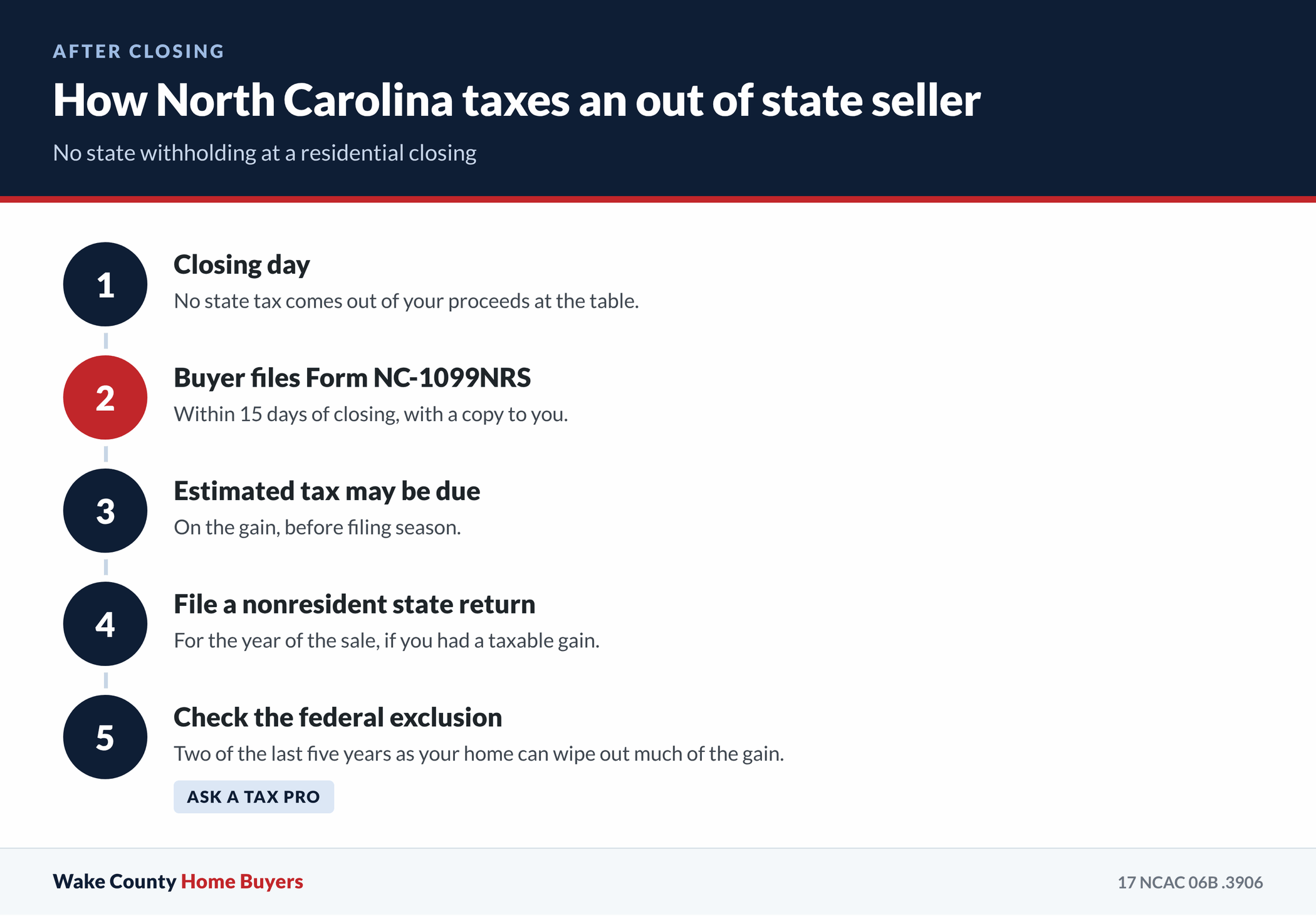
North Carolina doesn’t withhold state tax from a nonresident seller’s proceeds at a residential closing. What happens instead is a reporting step. The buyer files Form NC-1099NRS with the Department of Revenue within 15 days of the closing date, listing the seller, the property location, the closing date, and the gross sales price. A copy goes to you.
The rule itself sits in the state administrative code at 17 NCAC 06B .3906.
That form isn’t a tax. It’s how the state knows a nonresident sold property here.
The actual obligation lands on your return. If you sell North Carolina real property and recognize gain for federal purposes, that gain is subject to state income tax. A nonresident seller files a state return for the year of the sale. You may also owe estimated tax on that gain before filing season.
Federal treatment runs on its own track. If you lived in the house two of the last five years, the IRS primary-residence exclusion can wipe out a large chunk of gain. Many out of state sellers still qualify if they moved recently.
Rental properties are a different animal. Depreciation you claimed over the years gets recaptured, and that’s taxable regardless of where you now live.
Bring your closing statement and your basis records to someone licensed in both states.
How Fast Can You Sell Your North Carolina House When You Live in Another State?
“Nothing moves fast when you’re not there to push it.” I hear versions of that constantly, and the market data says otherwise if you pick the right path.
Listed homes take time right now. Median days on market statewide hit 71 in October 2026 according to Realtor.com data tracked by FRED, up from 58 in June of the same year. Add 30 to 45 days for a financed buyer’s closing and you’re looking at roughly three and a half months from list to funded.
Local markets vary, and a Wake County house can move on a very different clock than one in Charlotte or the mountains.
A direct cash sale compresses all of it. Title search and attorney scheduling drive the timeline rather than buyer financing, so two to three weeks is normal. I’ve closed in nine days when the title came back clean and the seller had the power of attorney already recorded.
What slows out of state sales? Three things, mostly: unresolved probate, missing signatures from a co-owner, and title defects nobody knew about.
Order your title work early. If you suspect a lien or an old boundary issue, tell the closing attorney in week one instead of week four.
Will a direct sale bring less than a listing? Yes, usually. Whether the discount is smaller than four more months of mortgage payments, insurance, utilities, and yard service on a house you’re not living in is what determines the right move. Run that math honestly, because plenty of out of state owners find the gap closes fast.
What Happens to Your North Carolina Home Sale If You Already Moved Out of State?
A seller in Greensboro handed over her keys in March and started her new job in Denver two weeks later.
Vacancy raises your risk. Most standard homeowners policies restrict coverage once a house sits empty past 30 or 60 days, and your insurance company may deny claims after that. Call your insurer and tell them the truth about occupancy; getting a vacant policy costs more than silence but far less than an uncovered loss.
I know it’s tempting to shut off power to save thirty dollars. A house without climate control in a North Carolina July grows mold in weeks. And winter pipe freezes in the mountains near Boone destroy value overnight.
Maintenance needs a local set of hands. Hurricanes reach well inland here, as eastern counties learned repeatedly.
Property taxes keep coming regardless of where you live, so your county tax office mails bills to the address on record. Update that address the week you move, or you’ll miss a notice and find out about it through a delinquency letter forwarded three months late.
Forward your mail. Sounds obvious; remote sellers skip it constantly.
The crew at Wake County Home Buyers sees a lot of these already-vacant situations, and buying as-is means the condition the house drifted into doesn’t blow up the sale.
How Do You Get a Cash Offer on Your North Carolina House From Another State?
“Can someone really make me an offer without me being there?”
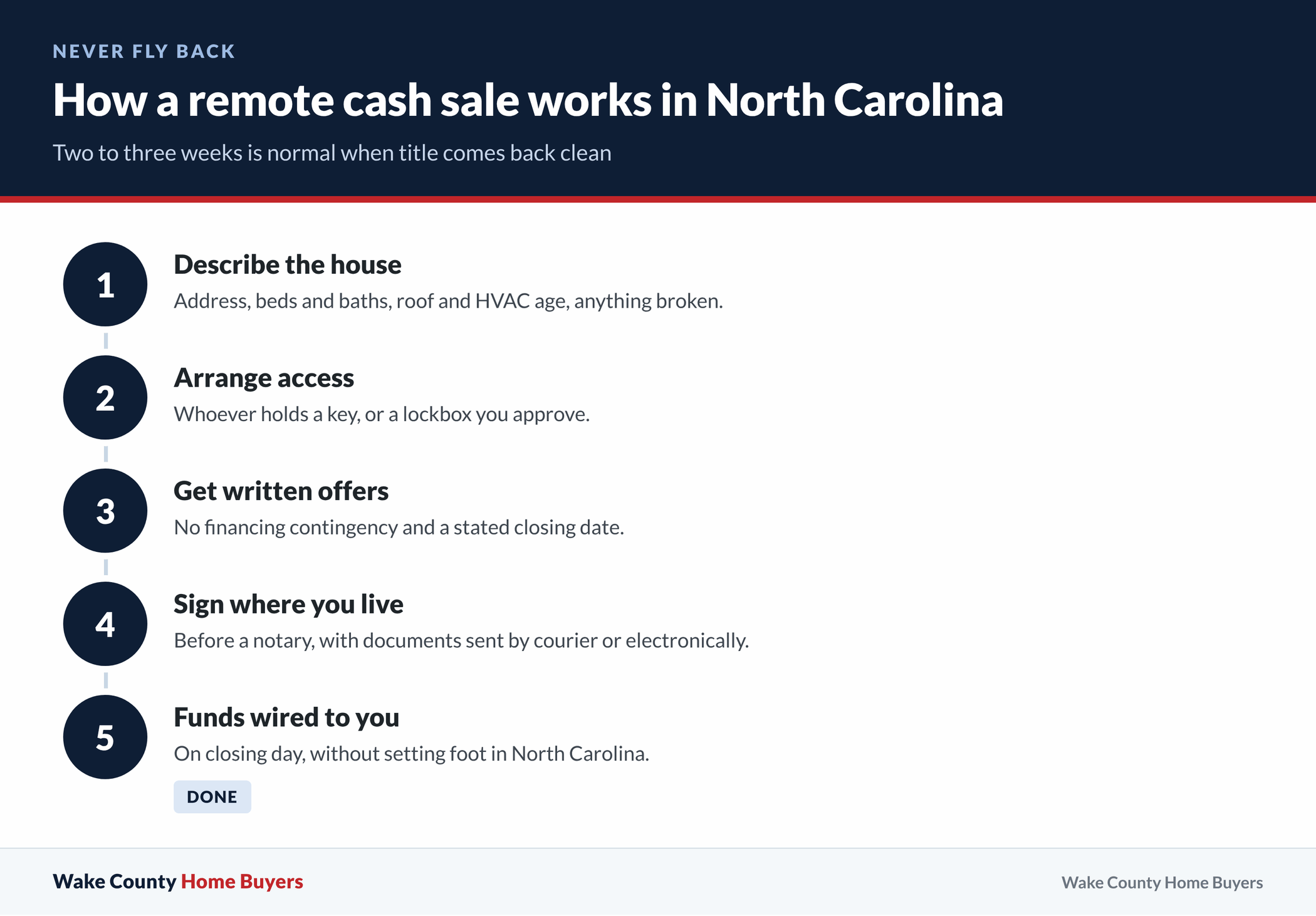
Yes, and the process is quicker than it sounds. You describe the property: address, beds and baths, roof age, HVAC age, anything broken. Photos help. No photos? A neighbor or the last tenant usually has some.
Interior access gets arranged through whoever holds a key, or through a lockbox the buyer installs with your permission.
Buyers should submit written offers with no financing contingency and a stated closing date. Ask what’s deducted. A straight cash sale shouldn’t carry agent commissions, and the buyer typically covers standard closing costs.
Compare at least two offers. I’d rather lose a house to a competitor than have a seller wonder for years whether they left money on the table.
Then your paperwork moves electronically to the closing attorney, you sign before a notary wherever you live, and funds wire to your account on closing day. You never set foot in North Carolina.
An heir I worked with in Hickory had inherited her aunt’s house holding thirty years of accumulation: boxes stacked chest-high in every bedroom and a garage full of canning jars and Christmas decorations. We bought it with everything inside, and she never had to book a flight.
That’s the piece out of state sellers underweight: the cost of emptying a house you can’t drive to. Selling as-is to a buyer who handles cleanout isn’t laziness, it’s recognizing that four round-trip flights and a dumpster rental cost real money.
Frequently Asked Questions About Selling a North Carolina House From Out of State
Do I Have to Travel to North Carolina to Close on My House?
No. Remote closings happen here routinely, and your signing can take place in front of a notary wherever you live. Your closing attorney sends documents by courier or electronically, and funds wire to your bank on the closing date. Some documents may require wet-ink signatures, so ask the attorney early which ones those are.
Can I Sell an Inherited North Carolina House If I Live Out of State?
You can, but probate has to be far enough along that someone has legal authority to sign the deed. That usually means letters issued by the clerk of superior court in the county where the estate was opened. If multiple heirs inherited together, every one of them signs unless a personal representative holds the power to sell. Start that process before you start marketing the property.
Who Pays the Closing Attorney When Selling From Another State?
Customarily the buyer selects and pays the closing attorney in most North Carolina transactions, though sellers sometimes hire their own counsel to review documents. If you’re using a limited power of attorney, expect a recording fee at the register of deeds for that document. Direct cash buyers frequently absorb the standard closing costs, so ask for that in writing before you sign.
Will I Owe North Carolina Income Tax If I No Longer Live There?
Yes, if the sale produces a taxable gain. Income from selling real property located in the state is sourced to North Carolina, so a nonresident files a state return for that year even while living elsewhere. The federal exclusion described earlier may eliminate much of the gain on a former primary residence, but the state filing obligation stands on its own. Talk to a tax preparer familiar with multi-state returns.
What If My North Carolina House Needs Repairs I Can’t Oversee From Out of State?
Then sell it as-is. Coordinating contractors remotely means paying for work you can’t inspect, chasing invoices, and extending your carrying costs by months. A direct buyer prices the property in its current condition and closes without a repair addendum. Listing it and hoping an inspection goes smoothly is the riskier choice when you’re managing everything from another state.
How Do I Avoid Wire Fraud When Selling North Carolina Property Remotely?
Call the closing attorney’s office using a number you looked up independently, never one pulled from an email signature, and verbally confirm the wiring instructions before sending anything. Criminals target remote sellers specifically because you can’t walk into the office. When instructions change at the last minute, treat that as a red flag and verify twice.
Is It Better to Rent My North Carolina House Instead of Selling It?
Depends on your tolerance for distance management. Rentals can work if you have a trustworthy property manager and the numbers clear after fees, vacancies, and repairs. Long-distance landlording wears people down, and deferred maintenance on a house you never see tends to surface all at once. If you’re already tired of owning it, selling usually beats renting.
Sitting in another state and wondering what your North Carolina house is worth as-is? We’re happy to talk through which path makes sense for your situation. No pressure, no obligation, and no hard sell if selling isn’t the right move right now.
Selling a Raleigh House From Another State
Plenty of the out of state owners we talk to have homes around the Triangle. Listings across the Raleigh metro took a median of 64 days to sell in October 2026. The figure comes from Realtor.com figures published by FRED, and that’s a long time to carry a house from another state.
Talk Through Your Out of State North Carolina Sale
When you’re managing a North Carolina house from far away, contact Wake County Home Buyers and tell us what you’re working with. You can also use the form below, and we’ll walk you through your options with no pressure.